
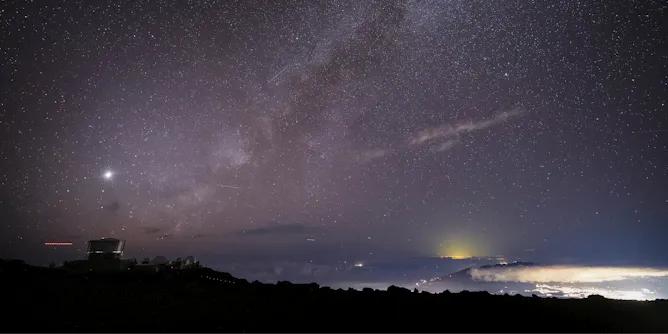
Over the next few days, astronomers will pull together evidence to determine whether the object is a comet.
Articles on Space
Displaying 181 - 200 of 1109 articles
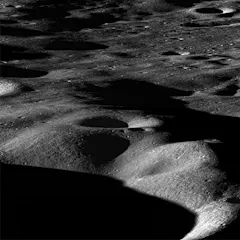
As humanity moves closer to extracting and using space resources, the need for a cohesive and responsible global governance system has never been greater.
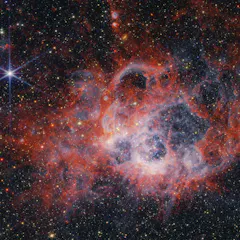
The James Webb Space Telescope has 2 powerful instruments that see light the human eye can’t.
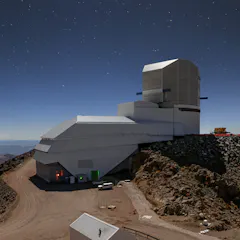
Vera C. Rubin’s research into stars in galaxies led to the modern understanding of dark matter.
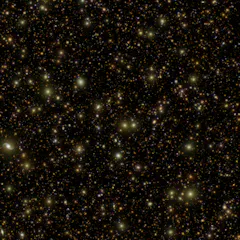
To make a truly realistic fake picture of a galaxy, you can model exactly how light particles travel through the atmosphere and telescope to reach its sensor.
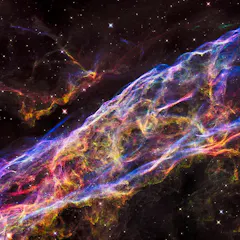
Almost everything on Earth is made up of atoms, but where do these fundamental building blocks come from?
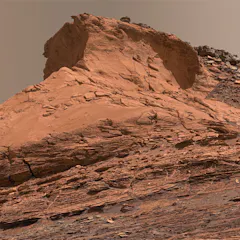
Mars isn’t a bright, fire-engine red, but the iron oxide in its rocks makes it appear redder than other planets, especially from afar.
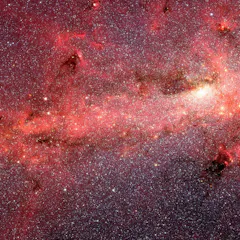
As the universe expands, it feels like it must be spreading out from some initial point. But a physicist explains why that’s not how it works. Hint: space-time is involved.
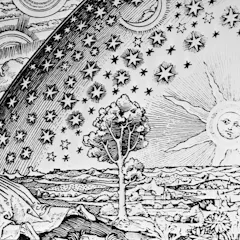
In the 19th century, astronomers could see Mars through telescopes, but not clearly. Some used their imaginations to fill in what the blurry images couldn’t convey.
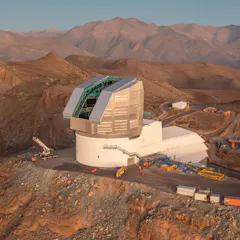
The Vera C. Rubin Observatory will capture enough detail to see a golf ball from 25km away.
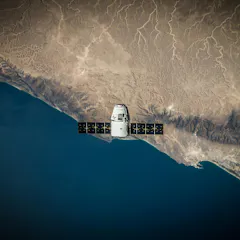
Salvage is a heartbreaking, life-affirming Australian dystopia that centres human connection – as the rich search for ways to escape and the poor salvage what they can.
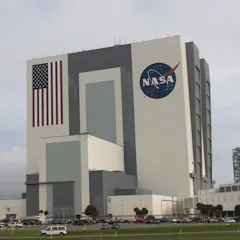
Under the proposed budget, several major projects, such as the Mars Sample Return and the Space Launch System, would face cancellation.
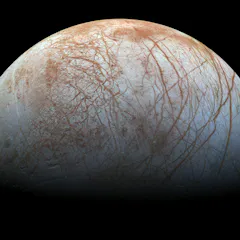
As NASA rolls out more powerful telescopes in the future, scientists will need a way to determine where to point them. A new approach could help.
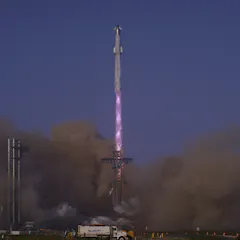
The Starship program has already experienced more failures than many other space missions in the past. Will it ever see success – and if so when?

The object doesn’t resemble any known type of star or system in the Milky Way.
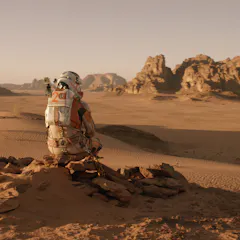
NASA hasn’t landed humans on Mars yet. But thanks to robotic missions, scientists now know more about the planet’s surface than they did when the movie was released.
The speed of light is the fastest anything can travel. What happens to a photon from a galaxy 25 million light years away on its journey toward Earth?

Space tourism is in an exploration phase – the decisions companies make around how to conduct these experiences now will set the tone moving forward.
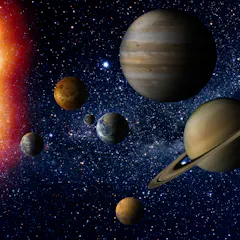
The biggest planets hogged a lot of the raw materials and were fully formed first.
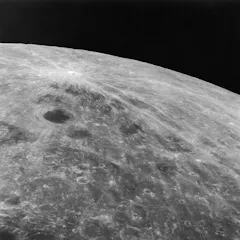
NASA’s learned a lot about the Moon since Apollo. But a perfect landing still requires incredible planning and scientific precision.
Top contributors
-

University Distinguished Professor of Astronomy, University of Arizona
-
Professor of Strategy and Security Studies, Air University
-
Professor of Planetary and Space Sciences, The Open University
-
Professor (Astrophysics), University of Southern Queensland
-
Associate Professor in Archaeology and Space Studies, Flinders University
-
Associate Professor in Astronomy, Monash University
-
Emeritus Professor of International Law, Western Sydney University
-
Senior Lecturer in Physics, Nottingham Trent University
-
Reader in Astrophysics, Keele University
-
Associate Dean of Innovation and Engagement, Swinburne University of Technology
-
Associate Professor, Astronomy, University of Regina
-
Professor of Air and Space Law, University of Mississippi
-
Kevin Orrman-Rossiter is a Friend of The Conversation.
Sterrenkenner, History & Philosophy of Science, The University of Melbourne
-
Lecturer in Astronomy, Nottingham Trent University
-
Professor of Physics and Astronomy, USC Dornsife College of Letters, Arts and Sciences