
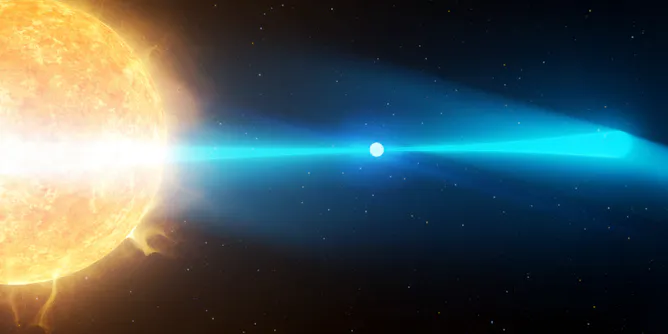
Slowly blinking radio signals from space have puzzled astronomers since 2022.
Articles on Astrophysics
Displaying 1 - 20 of 293 articles
The Swift Observatory allowed astronomers to study events that happen quickly in the universe, such as stars exploding.
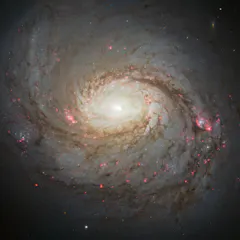
Galaxies act a little bit like figure skaters twirling on the ice – but at an astronomical scale.
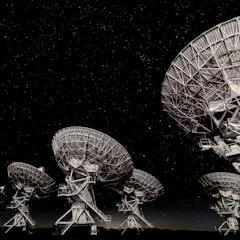
A researcher just won a Nobel Prize for detecting tiny particles from space. Scientists now want to get better at figuring out where in the cosmos they come from.
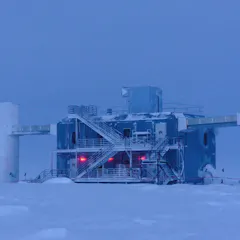
For more than a century, scientists have treated Antarctica’s environments as windows into worlds beyond Earth.
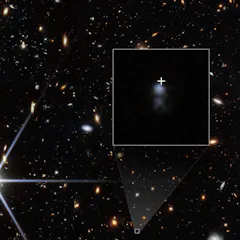
A flash of radio waves from a young galaxy 3 billion years after the Big Bang is lighting up 80% of the universe’s history.
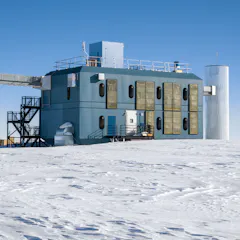
IceCube looks for high energy neutrinos from space. It joins the ranks of complementary experiments that study neutrinos originating closer to home.
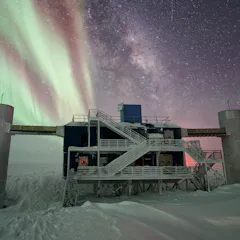
The 2026 Nobel Prize in physics recognizes Francis Halzen’s vision in building an unusual telescope in Antarctica, as well as the neutrino discoveries it’s made.
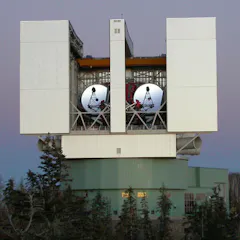
The early universe was kind of like a big game of musical chairs – scientists are figuring out how many particles were able to find ‘seats’ to understand the cosmos.

Massive objects bend light around them, a quirk that opens up unique opportunities for astronomical surveys.
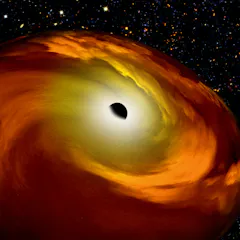
Some stars turn into black holes at the end of their lifespans, once they stop burning the fuel in their cores.
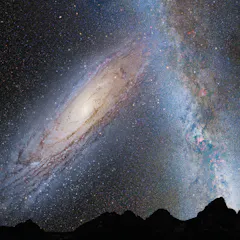
The Milky Way contains a fossil record of galaxies it has absorbed.
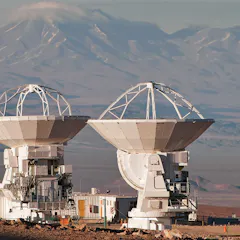
Interstellar maps can help scientists find patterns that tell them about fundamental chemical processes in the cosmos.
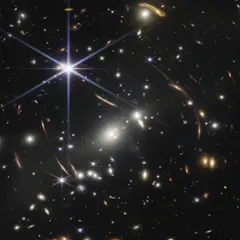
A recent paper claimed that dark energy might not exist. But new research suggests this conclusion was premature.
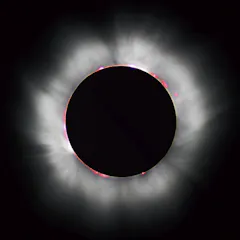
What’s the most impressive natural phenomenon known to humankind? Probably a solar eclipse! Here’s a brief overview ahead of this summer’s big celestial event.

A ‘failed star’ 1,350 light years away may hold clues about what makes other stars succeed.
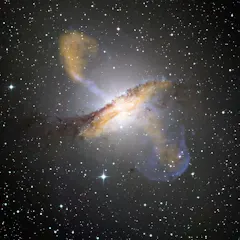
An astronomer explains why artificial black holes are pure science fiction – at least for now.
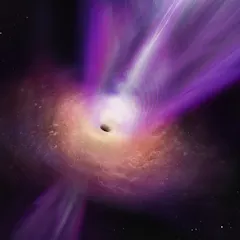
Black holes are a mainstay in sci-fi movies. How do these massive black holes, spread throughout our universe, actually work in real life?
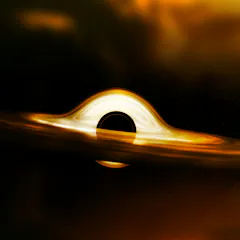
For the first time, scientists have gained information from the very surface of a newborn black hole.
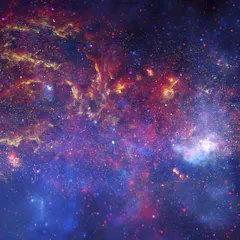
As a galactic archaeologist, my job is to reconstruct the past of our galaxy – and read the signs of its future.
Top contributors
-

Professor (Astrophysics), University of Southern Queensland
-
Professor of Astrophysics, University of Sydney
-
University Distinguished Professor of Astronomy, University of Arizona
-
Associate Dean of Innovation and Engagement, Swinburne University of Technology
-
ARC Laureate Fellow, Swinburne University of Technology
-
John Curtin Distinguished Professor (Radio Astronomy), Curtin University
-
Emeritus Professor, ARC Centre of Excellence for Gravitational Wave Discovery, OzGrav, The University of Western Australia
-
Professor of Physics, Penn State
-
Professor, Radio Astronomy, University of Sydney
-
ARC Australian Laureate Fellow, School of Physics, The University of Melbourne
-
Professor of Astrophysics, UNSW
-
Professor of Astrophysics, Macquarie University
-
Senior Lecturer and ARC Future Fellow, Monash University
-
Reader in Astrophysics, Keele University
-
Pro Vice-Chancellor Flagship Initiatives, Swinburne University of Technology