
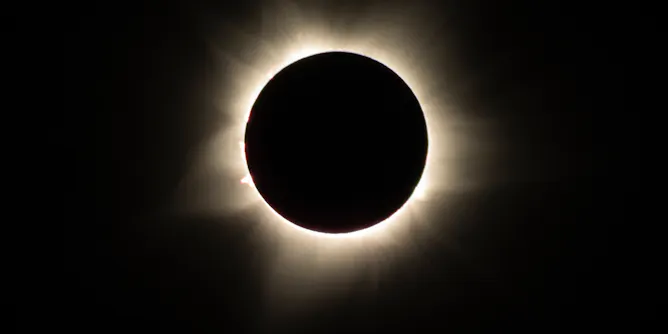
The eclipse will allow scientists to get rare measurements of the Sun’s atmosphere.
Articles on Space
Displaying 381 - 400 of 1109 articles
Floating crystals can pause the stellar aging process, providing a final energy source to otherwise dead stars.
Eclipses have inspired myths, predictions and scientific discoveries. The total solar eclipse occurring on April 8 provides a once-in-a-lifetime opportunity to engage with science and the cosmos.
Many people will see a dazzling eclipse this April, but these events are possible only because of the sizes and precise distances between Earth, the Moon and the Sun.
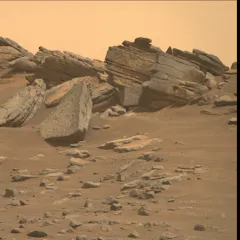
Determining whether or not life exists on another planet is an extraordinarily complicated – and expensive – scientific endeavor.
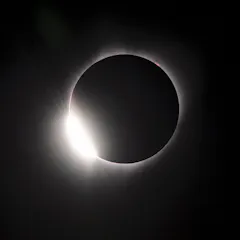
Mentions of total solar eclipses in ancient history help researchers pinpoint precise dates of notable events.
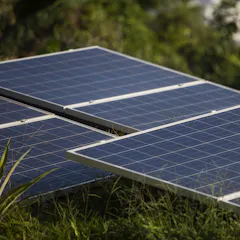
When the Moon blocks the Sun during an eclipse, utility suppliers have to pull power from the grid to make up for gaps in solar energy.
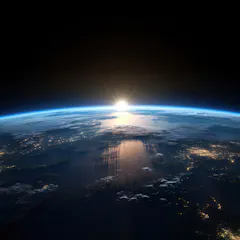
If we need to use forensic techniques in space, we’ll need to understand how things behave differently in microgravity.
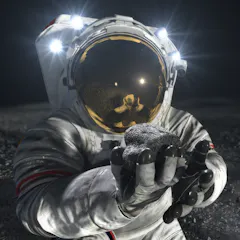
The next generation of spacesuit needs to do more than simply protect an astronaut from the vacuum of space.
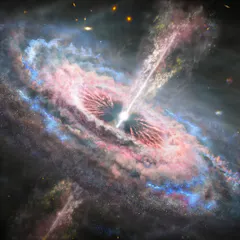
The discovery raises big questions about widely accepted models of galaxy formation.
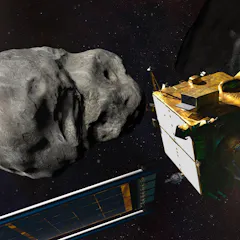
The mission provided details about how to deflect an asteroid should one threaten Earth in future.
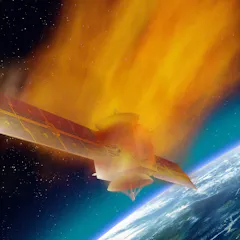
We know particles from spacecrafts are in the stratosphere. But what this means for the ozone layer or the climate is still unknown.
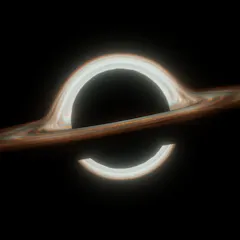
The extreme object could tell us more about the environment around black holes.
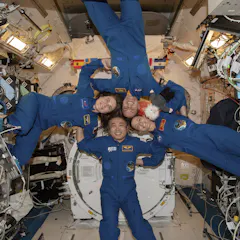
Can astronauts spend prolonged time in close quarters millions of miles from Earth without killing each other?
The capability for attacking satellites in space using cyber technology is advancing fast
Destroying satellites in space can lead to cascades that are hard to predict.
Russia isn’t likely to put nuclear missiles in space, but their reported anti-satellite weapon is just as alarming. An expert on nuclear strategy explains.
The observation could fill in gaps in our knowledge about planet formation.
Megaconstellations of satellites are hindering the most powerful tool for space exploration: telescopes.

Spaceplanes seemed out of favour when the shuttle was retired in 2011; they now seem to be making a comeback.
Top contributors
-

University Distinguished Professor of Astronomy, University of Arizona
-
Professor of Strategy and Security Studies, Air University
-
Professor of Planetary and Space Sciences, The Open University
-
Professor (Astrophysics), University of Southern Queensland
-
Associate Professor in Archaeology and Space Studies, Flinders University
-
Associate Professor in Astronomy, Monash University
-
Emeritus Professor of International Law, Western Sydney University
-
Senior Lecturer in Physics, Nottingham Trent University
-
Reader in Astrophysics, Keele University
-
Associate Dean of Innovation and Engagement, Swinburne University of Technology
-
Associate Professor, Astronomy, University of Regina
-
Professor of Air and Space Law, University of Mississippi
-
Kevin Orrman-Rossiter is a Friend of The Conversation.
Sterrenkenner, History & Philosophy of Science, The University of Melbourne
-
Lecturer in Astronomy, Nottingham Trent University
-
Professor of Physics and Astronomy, USC Dornsife College of Letters, Arts and Sciences