
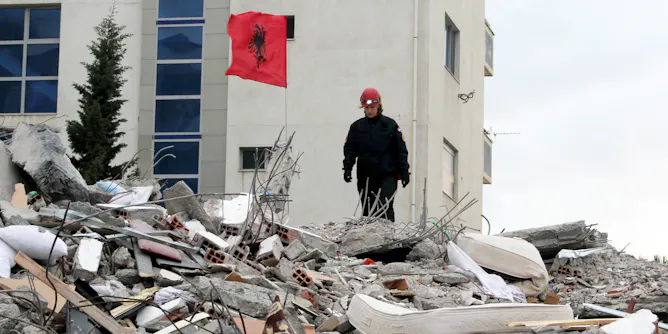
Post-earthquake aftershocks are often assumed to be less violent, but that’s not always the case.
Articles on Geology
Displaying 261 - 280 of 461 articles
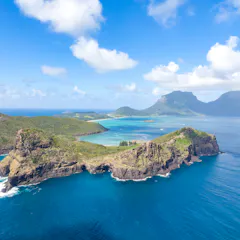
We undertook a 28-day voyage to explore a possible lost continent in a remote part of the Coral Sea, in an area off the coast of Queensland. Here’s what we found.
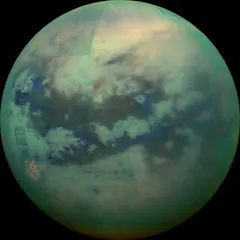
Saturn’s largest moon has been fully mapped for the first time.
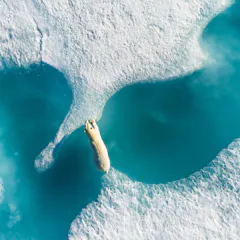
Antarctica is no longer the sleeping giant of sea level rise. New research delved into the past and found when the Earth warms, its ice sheets can melt extremely quickly.

Why did Earth’s climate rapidly cool 12,800 years ago? Evidence is mounting that a comet or asteroid collision is to blame, with new support coming from the bottom of a South Carolina lake.

Hundreds of archaeologists provided on-the-ground data from across the globe, providing a new view of the long and varied history of people transforming Earth’s environment.
Geology will be key to any green transition, but its academic reputation needs an urgent makeover.
Fossil fuels are heating the atmosphere – but the fact that we’re burning them may not be the only reason.
Good news – underground aquifers could be a reliable source of drinking water in sub-Saharan Africa even as the climate warms.
Millions of Americans rely on groundwater for their lives and livelihoods, but regulation is piecemeal. A new study maps groundwater wells nationwide and finds that they are drilling steadily deeper.
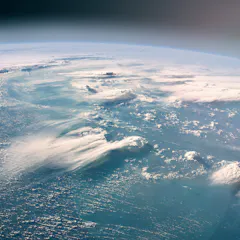
Oxygen flooded the atmosphere for the first time and then … nothing. Or so we thought.
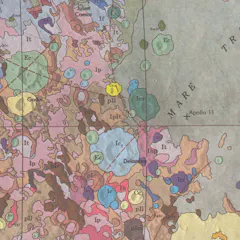
We have the Apollo missions to thank for a lot of our geological knowledge about the moon.
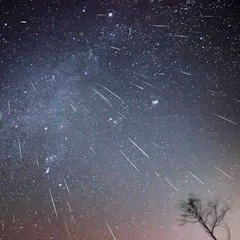
Every day about 50 tons of rocks from space fall on Earth. An examination of these meteorites has inspired a new theory about how exactly these rocks formed.
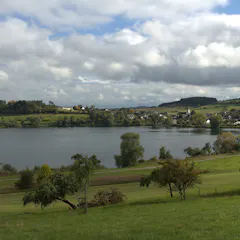
A maar is a volcanic crater, often filled with water. New research highlights the similarities between oral stories around the world that shed light on the formation of these craters.
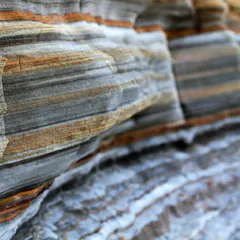
Layers of rock provide a historical record of variations in the Earth’s orbit, revealing information about the planet’s climate billions of years ago.
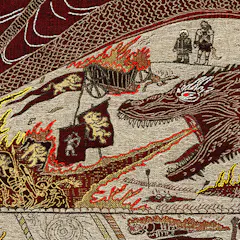
Even in this fantasy world, geological processes like tectonic plate movement, earthquakes and volcanic eruptions would have built the mountains, carved the rivers, and created vast oceans.
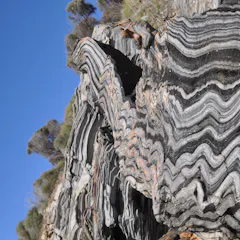
Giant forces slowly move continents across a viscous layer of the Earth, like biscuits gliding over a warm toffee ocean. This stresses the continents, and twists and contorts the crust.
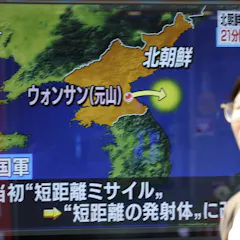
North Korea is a major military threat to the US and its Asian allies, but exactly how powerful are its nuclear weapons? An earth scientist explains why it’s hard to answer this question.

A paleooceanographer describes her ninth sea expedition, this time retrieving cylindrical ‘cores’ of the sediment and rock that’s as much as two miles down at the ocean floor.
If you’ve never heard of a form of wave called a ‘seiche’ – which can occur in swimming pools during earthquakes – this is your chance to catch up.
Top contributors
-

Professor of Geochronology, Curtin University
-
Professor of Geology, Adelaide University
-
Professor of Palaeobiology, University of Leicester
-
ARC Future Fellow and Associate Professor in Igneous Petrology/Volcanology, The University of Queensland
-
Professor in Earth Sciences, Nanyang Technological University, Singapore, and Emeritus Professor of Mineral Physics, University of Cambridge
-
Professor of Earthquake Science, The University of Melbourne
-
Professor of Geophysics, University of Sydney
-
Associate Professor, Earth and Planetary Sciences, Curtin University
-
Professor of Planetary Geosciences, The Open University
-
Senior Curator of Geosciences, Museums Victoria Research Institute; Monash University
-
Professor in Earth & Climate Science, University of Southampton
-
Harold T. Stearns Professor of Earth Science, Wesleyan University
-
Adjunct professor, UNSW
-
Redmond Barry Distinguished Professor Emeritus, The University of Melbourne
-
Professor of Earth and Space Sciences, University of Washington