
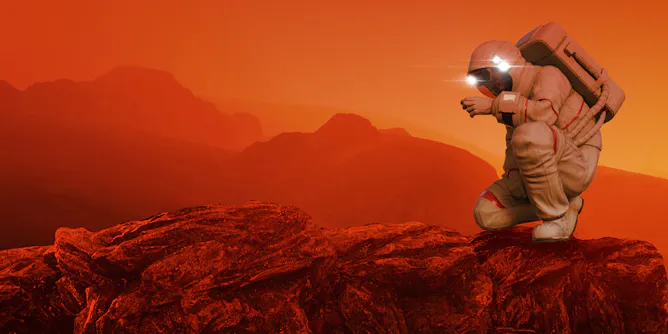
It’s hard to look for something you’ve never seen before – and that might not even exist. But you have to start somewhere.
Articles on Space
Displaying 341 - 360 of 1109 articles
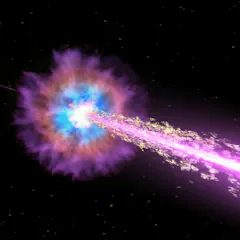
Analysis of two major cosmic blasts deepens the mystery of where the universe’s ‘heavy’ elements come from.

The best spots on the Moon for lunar bases are the same spots where scientists want to build telescopes − can these two interests coexist?
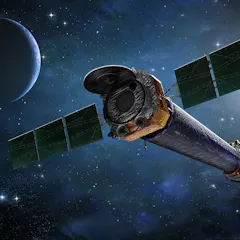
2024 marks 25 years since NASA’s Chandra X-ray Observatory started detecting X-rays from energetic astronomical events.
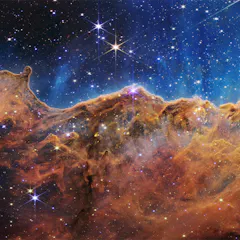
You have the US space program to thank for some of the technology in your phone and laptop.
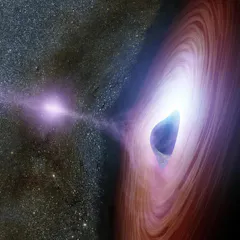
Studying theoretical, fast-spinning black holes is helping physicists understand more about the elusive black holes out in the universe.
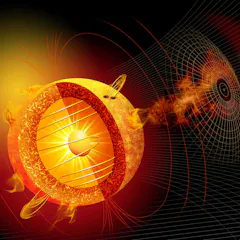
Solar storms can play havoc with electrical grids, satellites and railway lines.
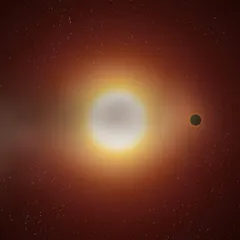
Research on one exoplanet that’s rapidly losing its atmosphere is hinting to scientists why exoplanets tend to look a certain way.
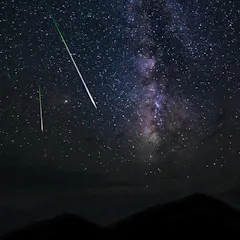
When rocks from space fall towards Earth, they usually don’t do any damage – here’s why.
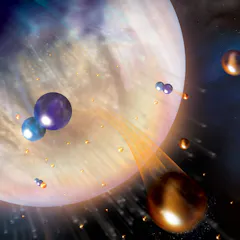
Studying Venus’ water loss can help scientists better understand how planets go from potentially habitable to incapable of supporting life.
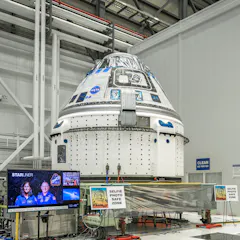
Starliner is only the second vehicle to launch astronauts from US soil since the retirement of the shuttle in 2011.
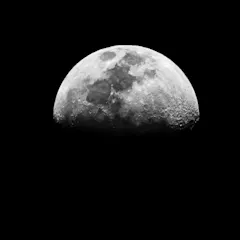
China’s Change'6 is going to explore the Moon’s far side and bring back precious lunar soil for scientists to study.

The Starliner launched June 5 after several delays, making it the first commercial crew craft that’s not SpaceX’s Dragon to lift off.
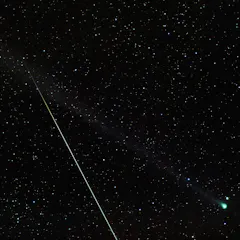
The Eta Aquariid meteor shower peaks each year in early May, but this year it should be particularly good, thanks to dark skies and extra activity.
Astrophysicist Jacco van Loon joins us on The Conversation’s Curious Kids podcast.
The Netflix series ‘3 Body Problem’ is based on Liu Cixin’s scifi novel that follows what happens to the alien residents of a planet that orbits two stars.

It’s not easy to collect rocks on a budget when the rocks are 140 million miles away.

The Perseverance rover has arrived at what’s thought to be an ancient shoreline on Mars.
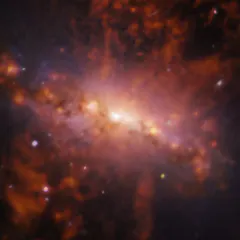
When astronomers focused on the galaxy NGC 4383, they didn’t expect the data to be so spectacular. This is the first detailed map of gas flowing from this galaxy as stars burst within.

If you look carefully at the night sky, you may spot this fuzzy visitor with the naked eye – but binoculars will help.
Top contributors
-

University Distinguished Professor of Astronomy, University of Arizona
-
Professor of Strategy and Security Studies, Air University
-
Professor of Planetary and Space Sciences, The Open University
-
Professor (Astrophysics), University of Southern Queensland
-
Associate Professor in Archaeology and Space Studies, Flinders University
-
Associate Professor in Astronomy, Monash University
-
Emeritus Professor of International Law, Western Sydney University
-
Senior Lecturer in Physics, Nottingham Trent University
-
Reader in Astrophysics, Keele University
-
Associate Dean of Innovation and Engagement, Swinburne University of Technology
-
Associate Professor, Astronomy, University of Regina
-
Professor of Air and Space Law, University of Mississippi
-
Kevin Orrman-Rossiter is a Friend of The Conversation.
Sterrenkenner, History & Philosophy of Science, The University of Melbourne
-
Lecturer in Astronomy, Nottingham Trent University
-
Professor of Physics and Astronomy, USC Dornsife College of Letters, Arts and Sciences