
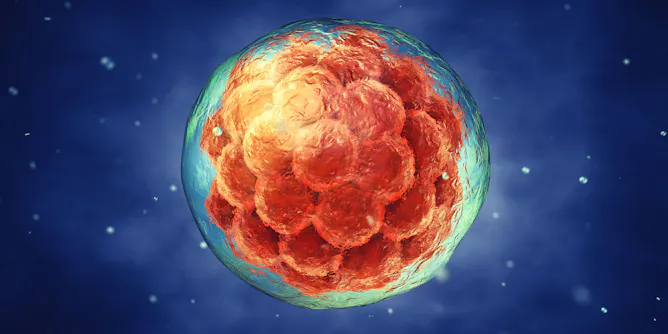
Pigs with human kidneys? Brain-powered computer chips? Science is creating new kinds of living things – and our moral understanding needs to catch up fast.
Articles on Philosophy
Displaying 221 - 240 of 754 articles

Humility doesn’t get the fanfare of virtues like courage, compassion or generosity. But without humility, those other virtues won’t get much traction in the quest to live a good life.

You can be connected across lifetimes in so many different ways, from lovers to passerbys.

The science of human consciousness offers new ways of gauging machine minds – and suggests there’s no obvious reason computers can’t develop awareness.

For Buffett, escapism was not merely some fiddling flight of fancy. It acknowledged the brutalities and indignities of everyday life.

Simone Weil is one of the 20th century’s most remarkable, paradoxical figures. The Need for Roots, published in the year she died at just 34, is a tour de force of ethics and political philosophy.

The famous French anthropologist, world-renowned for his theory of non-places and his analyses of the “overmodern” city, died during the summer.

Philosopher Markus Gabriel argues that a new enlightenment based on moral facts is necessary to overcome the darkness of our times.

Aristotle believed that the biggest and most widespread source of political tension is the struggle between the haves and the have-nots. More than 2,000 years later, he’s got a point.

Jean-Paul Sartre broke with Aristotle’s essentialism, but both philosophers would agree that to philosophise is to learn how to live.

Being minimally Buddhist requires a practitioner to abstain from destroying any breathing beings. So how is it ok for some Buddhists to eat meat? Two philosophers explain.

For any kind of human relationship to work, it must have great friendship at its core.

In California, surfers say an otter is hassling them and stealing their surfboards. But does she really deserve recapture and life in captivity?

Blaise Pascal, a mathematician and a Catholic theologian, born 400 years ago,
left a deep and lasting influence on the world that can be felt today.

An intriguing new history of Oxford philosophers tells the story of a cloistered world giving out under pressure from an intransigent reality.
First published in 1975, Animal Liberation opened our eyes to the exploitation of animals. At a time of ‘ag-gag’ laws and ‘skyscraper’ farms, a new edition assesses the state of animal rights today.

Ancient Greek philosophers despised the Sophists’ rhetoric because it searched for relative truth, not absolutes. But learning how to do that thoughtfully can help constructive debates.

The ancient Chinese text is considered a military classic, but Western readers often overlook its philosophical roots.

Why is there such a great discrepancy between what scholars of education have been telling us and what happens in the classroom?

For animals to find the motivation to forage and mate, life must be at least slightly positive.
Top contributors
-

Professor in Philosophy, Australian Catholic University
-
Associate Professor of Philosophy, Deakin University
-
Associate Professor of Philosophy of Education, University of Birmingham
-
Professor of Philosophy, La Trobe University
-
Senior Lecturer in Philosophy and Education; Curriculum Director, UQ Critical Thinking Project, The University of Queensland
-
Deputy Director, Institute for Ethics, Governance & Law, Griffith University
-
Associate Lecturer, University of Notre Dame Australia
-
Honorary Associate in Philosophy, University of Sydney
-
Professor, Philosophy of Science, The University of Melbourne
-
Professor of Philosophy, University of Pretoria
-
Senior Lecturer in Philosophy and Ethics, Nottingham Trent University
-
Assistant Professor in Philosophy and History, Bond University
-
Researcher, UQ Critical Thinking Project, The University of Queensland
-
Associate Professor in Philosophy, University of Nottingham
-
Lecturer in Philosophy, Queen's University Belfast