
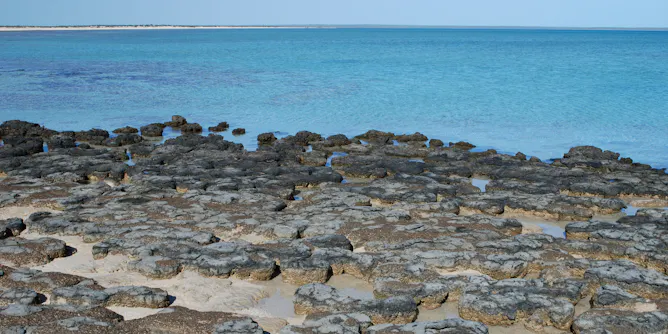
The end-Triassic mass extinction was a cataclysm for the world’s prehistoric species, killed off by volcanoes that altered Earth’s seas and skies. But new research shows it didn’t happen when we thought.
Articles on Palaeontology
Displaying 121 - 140 of 239 articles

The assumption that the lateral semicircular canal of the inner ear can be used to reconstruct head posture in extinct species has long remained unchallenged.
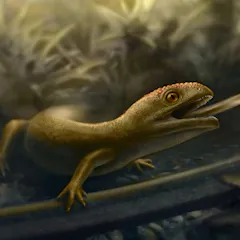
If albanerpetontids were around today, they’d easily fit in your hand. And although their bones are found all over the world, these unique amphibians eluded experts for a long time.
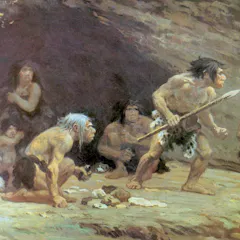
Did Neanderthal military superiority delay our migration out of Africa?
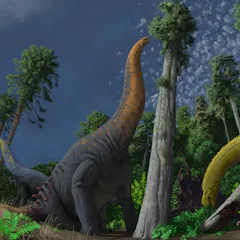
Tooth fossils from NSW have confirmed sauropods weren’t exclusive to Queensland. They’re also providing a first look at how these colossal dinosaurs fed from Australia’s land.
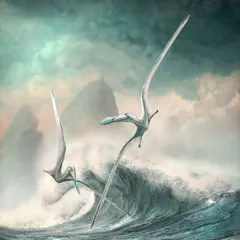
Fossils reveal that dinosaurs’ flying cousins become twice as efficient at flying over 150 million years.
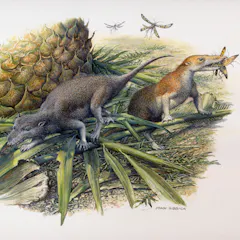
New study used X-rays of the teeth of early mammals’ to show they were more like cold blooded reptiles.
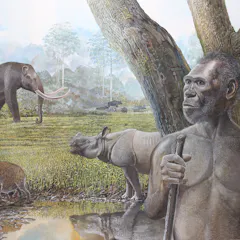
Several theories have suggested either humans, climate change or both drove megafauna extinctions in Southeast Asia. Our newest work suggests otherwise.
Microfossils offer up an array of information to scientists, like the time periods in which they lived and how environments have changed.
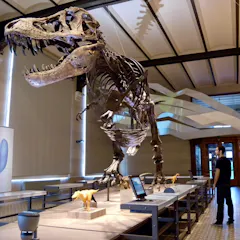
You can gauge a dinosaur’s body mass either by reconstructing it as accurately as possible, or by scaling its leg bones against those of today’s animals. Research shows both methods work well together.
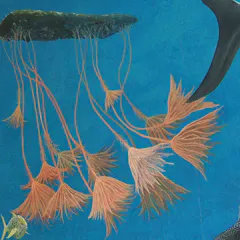
New research show how crinoids could live for so long on floating wood without it breaking up.
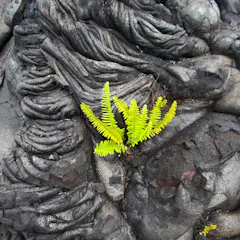
When the dinosaurs went extinct, some species took over the world. Adaptability, not survivability, explains why.
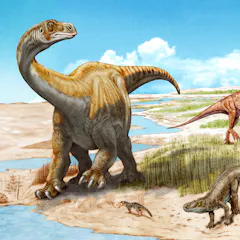
How we identified a new ancestor of the likes of Diplodocus from old bones.
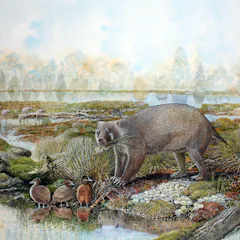
The extinct Mukupirna - which translates to ‘big bones’ - is estimated to have been more than four times larger than any living wombat.
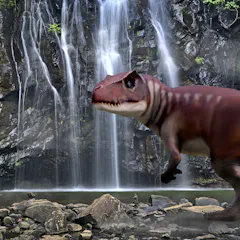
Photos from Queensland coal mines helped researchers discover a missing top predator in the ancient Australian food chain.
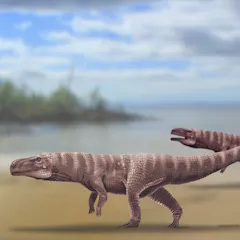
We found footprints that measure around 24 centimetres long. We suspect they came from animals with legs the same height as humans.

New research on the Late Devonian extinction suggests the ozone layer could be naturally depleted as the temperature rises.
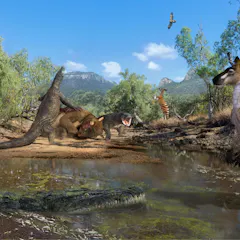
These megafauna were the largest land animals to live in Australia since the time of the dinosaurs.
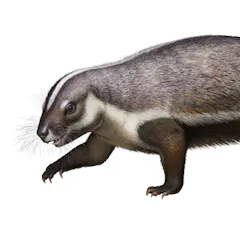
This ancient cat-sized animal lived millions of years ago and had features not found in any of today’s mammals.

During the transitional period between the Pleistocene and Holocene epoch, the Earth’s temperature underwent massive change, forcing prehistoric humans in Indonesia to change their diet.
Top contributors
-

Professor of Vertebrate Palaeontology, University of Bristol
-
Associate professor in Vertebrate Palaeontology, University of the Witwatersrand
-
Senior Lecturer in Paleontology and Evolutionary Biology, Life Sciences at the University of Bath, University of Bath
-
Professor in Geochronology and Geochemistry, Southern Cross University
-
Technical Specialist in Earth Sciences, University of Bristol
-
Emeritus Strategic Professor in Palaeontology, Flinders University
-
Senior Research Scientist, South Australian Museum; Flinders University
-
Professor in Geochronology, School of Natural Sciences, Macquarie University
-
Professor, Palaeobiology, University College Cork
-
Chancellor's Fellow in Vertebrate Palaeontology, University of Edinburgh
-
Research Associate in the College of Science and Engineering, Flinders University
-
Research Associate, African Centre for Coastal Palaeoscience, Nelson Mandela University
-
Professor of Palaeobiology, University of Portsmouth
-
Lecturer in the School of Applied Sciences, Edinburgh Napier University
-
Professor of Dinosaur Paleontology, University of the Witwatersrand