
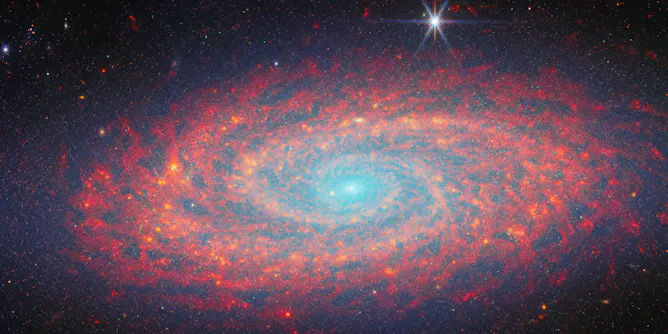
From the microscopic structure of particles and atoms, to the fate of black holes and the large-scale structure of the universe, the quantum ‘vacuum’ plays a role.
Articles on Black holes
Displaying 1 - 20 of 161 articles
For more than a century, scientists have treated Antarctica’s environments as windows into worlds beyond Earth.
Black holes are a mainstay in sci-fi movies. How do these massive black holes, spread throughout our universe, actually work in real life?
For the first time, scientists have gained information from the very surface of a newborn black hole.
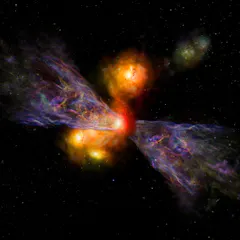
All things die, even galaxies.
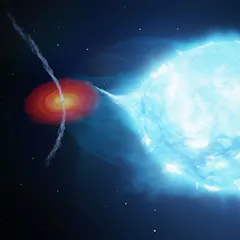
Astronomers have discovered stellar winds can cause black hole jets to change direction – just like wind on Earth can blow around the water in a fountain.

The black holes could be relics from a time before the Big Bang.
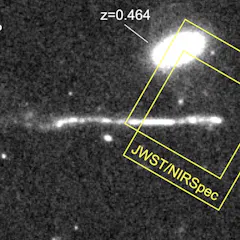
Astronomers have spotted runaway black holes screaming through space, leaving trails of stars in in their wake.
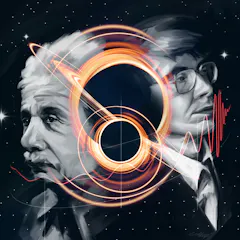
First, gravitational waves proved Einstein correct. Now, they’ve confirmed Stephen Hawking was right about black holes.
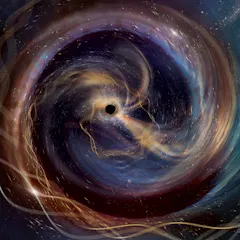
Stephen Hawking’s prediction about what happens when two black holes merge has finally been verified.
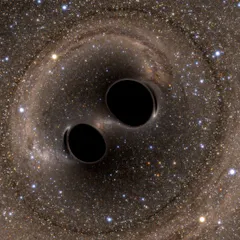
Too big to come from a dying star and too small to inhabit the center of a galaxy, these black holes are a puzzle that scientists are using LIGO to investigate.
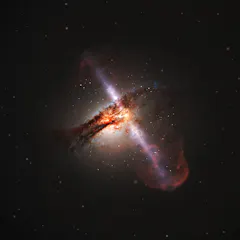
The satellites the world relies on for navigation, communication and more get their bearings from distant black holes – but radio noise is blurring the picture.
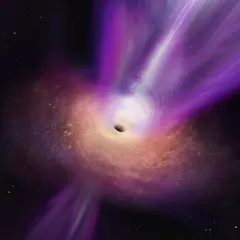
Whether a galactic environment has the right conditions for habitable planets to form could depend on how the black hole in that galaxy is rotating.
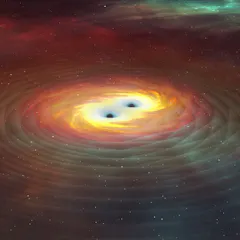
Gravitational waves carry information about massive cosmic events and help scientists to ‘listen’ to space.
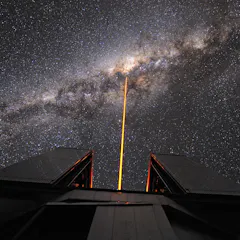
The discovery helps explain a long-running cosmic mystery about why some stars hurtle through space much faster than others.
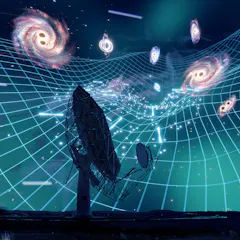
A new effort to map the rumblings in spacetime caused by enormous black hole collisions paints a surprisingly loud and lopsided picture of the universe.
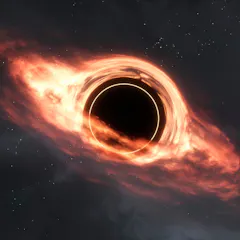
At a singularity, the laws of physics as we know them suffer a complete breakdown. So such objects really shouldn’t exist.
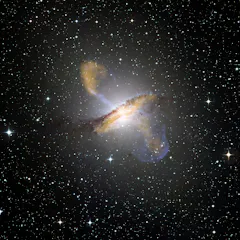
New analysis of radio telescope data links the shape of galaxies to the supermassive black holes they host.
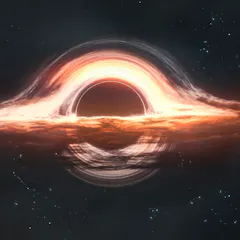
New research can help us understand how supermassive black holes formed – and why many of them appear to be more massive than expected.
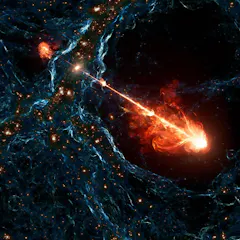
Astronomers have found a true colossus of a jet in the night sky, over 100 times larger than our galaxy. It’s almost perfectly straight, which presents a puzzle.
Top contributors
-

Emeritus Professor, ARC Centre of Excellence for Gravitational Wave Discovery, OzGrav, The University of Western Australia
-
Professor of Astrophysics, University of Sydney
-
University Distinguished Professor of Astronomy, University of Arizona
-
Professor, Curtin Institute of Radio Astronomy, Curtin University
-
Senior Lecturer in Physics, Western Sydney University
-
Professor, Radio Astronomy, University of Sydney
-
Professor of Theoretical Astrophysics, Monash University
-
Professor of Astronomy, Swinburne University of Technology
-
Professor and Director of the Centre of Excellence for Data Science, AI and Modelling, University of Hull
-
Senior Lecturer and ARC Future Fellow, Monash University
-
Senior Curator (Astronomy), Museums Victoria Research Institute; The University of Melbourne
-
ARC Laureate Fellow, Swinburne University of Technology
-
Professor, Swinburne University of Technology, Swinburne University of Technology
-
Professor of Astrophysics, University of Southampton
-
Professor of Astronomy, UMass Lowell