
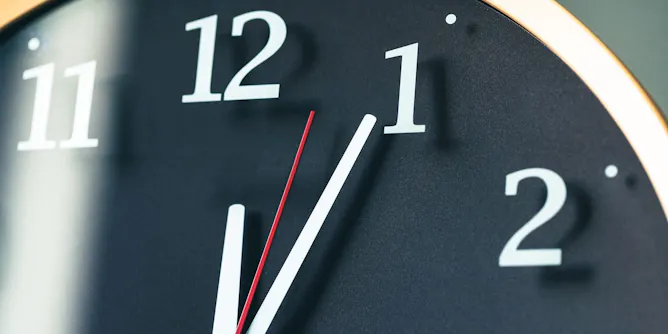
If you think about leap years, it may seem like humans have a very odd way of measuring time. Sometimes, timekeepers even have to add extra seconds to clocks.
Articles on Physics
Displaying 1 - 20 of 596 articles
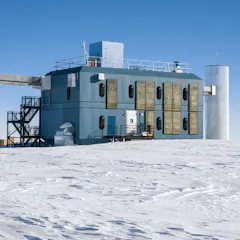
IceCube looks for high energy neutrinos from space. It joins the ranks of complementary experiments that study neutrinos originating closer to home.
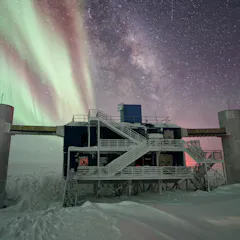
The 2026 Nobel Prize in physics recognizes Francis Halzen’s vision in building an unusual telescope in Antarctica, as well as the neutrino discoveries it’s made.
Belgium-born Francis Halzen has won for the detection of high energy neutrino particle from space.
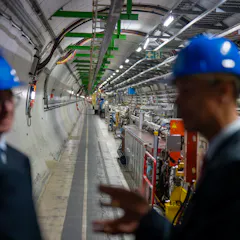
Particle accelerators aren’t just for testing the Standard Model. They’re also used to diagnose and treat disease and study world history.
A 100-year-old equation helps scientists build solar cells, develop biofuels and even study quantum computers.
The early universe was kind of like a big game of musical chairs – scientists are figuring out how many particles were able to find ‘seats’ to understand the cosmos.

Scientists recreated cosmic rays in a massive underground particle collider.

Scientists studied active matter systems by racing worms through tubes – to unexpected results.

Energy transfer is the secret ingredient that makes iced tea a particularly refreshing drink on a hot day.
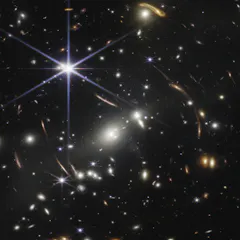
A recent paper claimed that dark energy might not exist. But new research suggests this conclusion was premature.
The government wants a knowledge-rich physics curriculum, but packing in too many topics without a clear order could backfire.
The closer you zoom in, the more fascinating it is.
The expansion of the universe may not in fact be accelerating, calling dark energy into question.
Particles’ properties at the quantum level could one day enable faster computing and better cybersecurity.

What happens in the deep ocean might seem far removed from your everyday life. A new study shows otherwise.

What do cacti spines and wasp stingers have in common? What about snail genitalia and shark teeth?
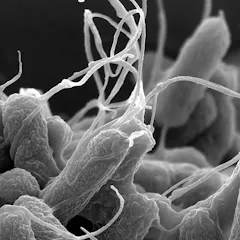
Scientists are using AI and physics-based simulations together to design new peptides that will kill previously drug-resistant bacteria.
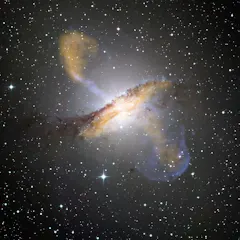
An astronomer explains why artificial black holes are pure science fiction – at least for now.
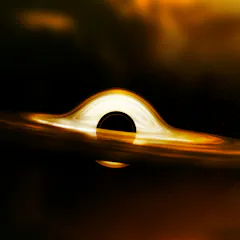
For the first time, scientists have gained information from the very surface of a newborn black hole.
Top contributors
-

Professor, Philosophy of Science, The University of Melbourne
-
Professor of Nuclear Physics, Michigan State University
-
University Distinguished Professor of Astronomy, University of Arizona
-
Professor of Engineering Practice, Purdue University
-
Post Doctoral Research Associate, Centre for the Subatomic Structure of Matter, Adelaide University
-
Physicien, Professeur des Universités, Université Paris-Saclay
-
Professor of Astrophysics, University of Sydney
-
Emeritus Professor, ARC Centre of Excellence for Gravitational Wave Discovery, OzGrav, The University of Western Australia
-
Principal Lecturer of Physics and Astronomy, Clemson University
-
Professor of Physics, Penn State
-
Lecturer, The University of Queensland
-
Senior Lecturer in Physics, University of New England
-
Professor, University of Sydney
-
Professor of Mechanical and Aerospace Engineering, North Carolina State University
-
Professor of Physics and Astronomy, Rochester Institute of Technology