
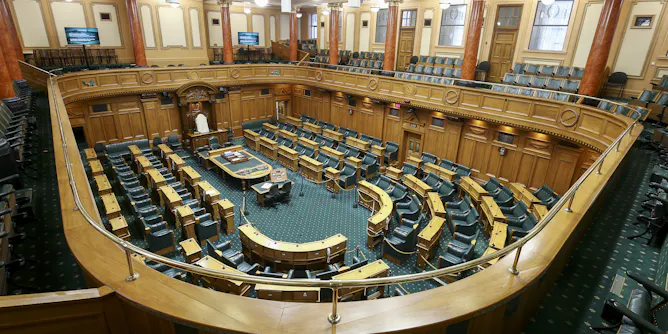
New Zealand’s parliament is small compared to similar countries. Proportionality will be increasingly hard to achieve without adding more seats.
Articles on Proportional representation
Displaying 1 - 20 of 57 articles
Two previous opportunities to improve the way MMP works have been missed. The 2026 election result shows why better stewardship of the system is needed.
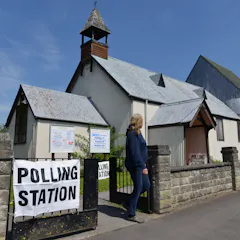
Some systems leave voters feeling more positive about their choices than others.
Vote splitting and parliamentary overhangs are not unheard of in New Zealand elections. But making them a deliberate campaign tactic is different.

A new book examines the outsized influence of one man on the pivotal 1984 election which ushered in a new New Zealand.

The history of electoral reform in NZ is full of policy surprises. But the prime minister’s latest announcement still makes little political sense.

Canadians should push for more than immediate byelections after floor crossings to strengthen the country’s democracy — they should turn their attention once again to broader electoral reform.

The electoral system used by many global democracies eliminates gerrymandering and has been shown to give more equal representation to minorities and women.
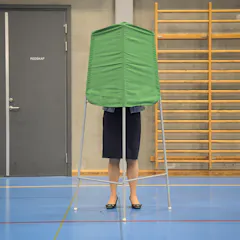
Proportional voting is, at least philosophically speaking, the best electoral system.

ACT won’t work with Labour, Labour won’t work with NZ First, National won’t work with Te Pāti Māori … What happened to the cross-party compromise MMP was meant to foster?

A new book argues that South Africa should ‘start again’, but the reviewer says it doesn’t make a strong case.

A new electoral system in Canada could help curb polarization, ensure fairer representation and transform Canadian democracy for the better.

Ireland’s fractured party system often leads to protracted political stalemates.

Surveys show Americans do not believe the political system is serving them. A mathematician of democracy highlights evidence-based changes that could improve matters without tearing the nation apart.

Under France’s second-ballot system, French voters can vote with their hearts in the first round, knowing they’ll be able to vote in the second round with their heads — in other words, strategically.

Arguments for electoral reform in the UK just got stronger with a low Labour vote delivering a massively disproportionate number of seats.

Even marginal seats are really only contests between two parties. No wonder voters don’t feel enthusiastic.

First past the post tends to deliver the winning party more seats in parliament than they’d get under a truly proportional voting system – but this year is off the charts.

There are many ways bad mathematics interferes with our democracy. Assigning delegates is just one example.

Slovakia has steadfastly supported Ukraine in the war, but there are signs this may change after the election.
Top contributors
-

Professor of Politics, Te Kunenga ki Pūrehuroa – Massey University
-
Professor of Sociology, University of the Witwatersrand
-
Senior Lecturer, Department of Languages and Linguistics, La Trobe University
-
Professor of Mathematics, Director of Institute for Mathematics and Democracy, Wellesley College
-
Senior Lecturer in Politics, University of Strathclyde
-
Lecturer and Teacher, Department of Politics and International Relations, Cardiff University
-
Reader in Law, City St George's, University of London
-
Anniversary Professor of Politics, University of York
-
Lecturer in Law, Durham University
-
Lecturer in Politics, University of Sheffield
-
Professor Emeritus of Political Science, Indiana University
-
Adjunct Professor, Stout Research Centre, Victoria University of Wellington and Auckland University of Technology, Professor of Political Science, Charles Sturt University
-
Assistant director, Centre for the Study of Democratic Institutions, University of British Columbia
-
Research Associate, Public Policy Institute, University of Auckland, Waipapa Taumata Rau
-
Director of Global Languages, Massachusetts Institute of Technology (MIT)