
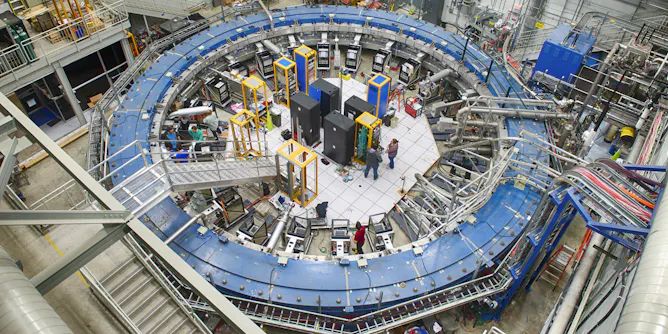
A series of thrilling research means physicists may have to start inventing brand new physics.
Articles on Particle physics
Displaying 41 - 60 of 110 articles

A decadelong experiment produced the most accurate measurement yet of the mass of W bosons. These particles are responsible for the weak force, and the result is more evidence for undiscovered physics.
Physicists know a lot about the most fundamental properties of the universe, but they certainly don’t know everything. 2021 was a big year for physics – what was learned and what’s coming next?
A new result from the MicroBooNE neutrino experiment has dashed hopes for a neat resolution to several puzzles for physicists.

Particle physicists might be on the brink of a major breakthrough.

Laser-cooling enables new measurements that could explain why antimatter is so scarce in our universe.
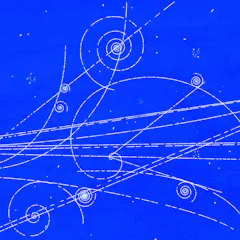
For 15 years, there has been a mismatch in physics. A particle called the muon wasn’t behaving the way theory predicted it should. A new theory and new experiment might solve this problem.

New particles or forces may exist that aren’t accounted for in the standard model.
A transcript of episode 9 of The Conversation Weekly podcast, including an update on the situation for Rohingya refugees in Myanmar living in camps in Bangladesh.

Plus why the situation for Rohingya Muslims living in Bangladesh has gone from bad to worse. Listen to episode 9 of The Conversation Weekly podcast.
A long-sought crack in the Standard Model of particle physics may have been spotted.
If the finding really is the result of new fundamental particles then it will finally be the breakthrough that physicists have been yearning for for decades.
The theory of tiny particles isn’t complete. But new discoveries are helping scientists expand it.

Plus new research finds a way to speed up the search for dark matter. Listen to episode 4 of The Conversation Weekly.

The compact accelerators are 100 times smaller than traditional ones, and could easily fit inside hospitals and laboratories.
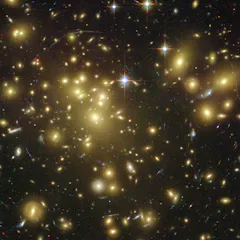
Researchers have found a way to speed up the search for dark matter using technology from quantum computing. By squeezing quantum noise, detectors can now look for axions twice as fast.

It’s all to do with the light from the Sun and a blanket of air wrapped around Earth called the ‘atmosphere’.

New physics may be needed to explain why there’s more matter than antimatter in the universe.

The study of neutrinos produced within the Earth’s interior provides a better understanding of the radioactivity of our planet.
Field theory describes the universe as energy flowing along unending lines. With this perspective, it is possible to define a new fundamental building block of matter.
Top contributors
-

Particle physicist, University of Cambridge
-
Head of School for Physics, University of Sydney
-
Post Doctoral Research Associate, Centre for the Subatomic Structure of Matter, Adelaide University
-
Professor of Physics, Head of Department, Lancaster University
-
Professor of Physics, Monash University
-
Professor, Philosophy of Science, The University of Melbourne
-
ARC Research Associate (Centre of Excellence for Particle Physics at Tera Scale), Adelaide University
-
Postdoctoral Fellow in Quantum Physics, University of Colorado Boulder
-
Professor of Nuclear Physics, Mississippi State University
-
Doctoral Student, College of Community and Public Affairs, Binghamton University, State University of New York
-
Senior Lecturer of Particle Physics, Lancaster University
-
Royal Society University Research Fellow and Lecturer in Particle Physics, UCL
-
Senior Lecturer in Particle Physics Informatics, Brunel University of London
-
Associate Professor of Physics, Durham University
-
Research Professor and Director of the International Institute for Accelerator Applications, University of Huddersfield