
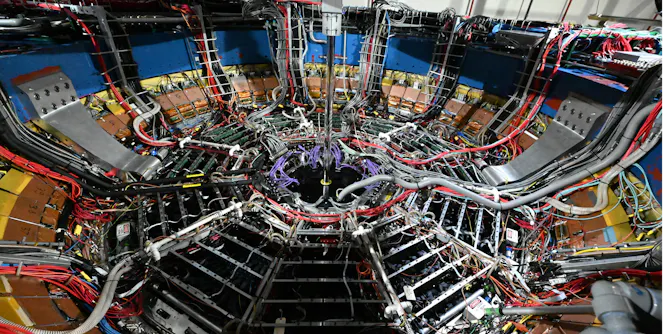
Measurements of 16 ‘antihyperhydrogen’ nuclei may help resolve mysteries of the universe’s exotic matter.
Articles on Particle physics
Displaying 21 - 40 of 110 articles
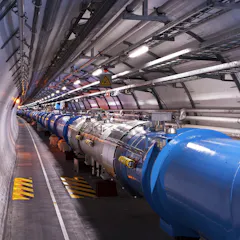
The LHC is back in business for the year, but getting it ready to collect data isn’t always a straightforward process. You can’t just unplug it and plug it in again.

An exciting new experiment is being set up at Yale university in the US.
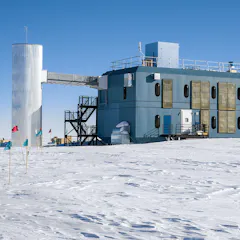
Tau neutrinos are notoriously difficult to spot in detectors like IceCube. But researchers have managed to isolate 7 candidates.
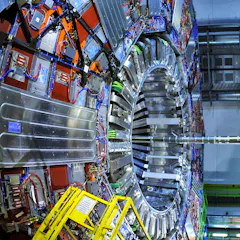
The US, Europe and China are all planning particle colliders that would study the Higgs boson.

During a walk in the Scottish Highlands, one of the greats of particle physics had the idea of a lifetime
A new measurement of gravity at small scales hints at an alternative to billion-dollar experiments for the future of physics.
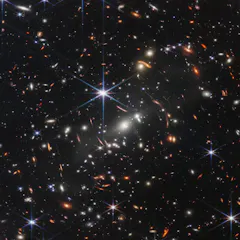
The universe is expanding faster than physicists would expect. To figure out what processes underlie this fast expansion rate, some researchers are first trying to rule out what processes can’t.
Physicists uncovered a new experiment hidden in old data from the Large Hadron Collider. Using this innovative approach, the team has unlocked an entirely new way to study quantum physics.

It seems there isn’t a sci-fi part if the universe in which everything is made of antimatter.
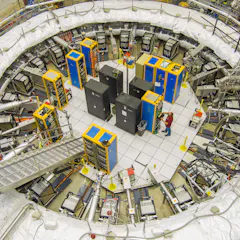
New measurement of wobbling muons back up previous findings – potentially challenging the Standard Model of Particle Physics.
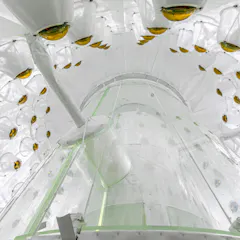
To detect dark matter, you need to build an ultra-sensitive detector and put it somewhere ultra-quiet. For one physics collaboration, that place is almost a mile under Lead, S.D.
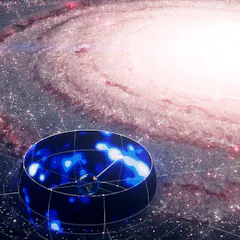
Neutrinos are some of nature’s most elusive particles, but new research has used them to create an image of our own galaxy.
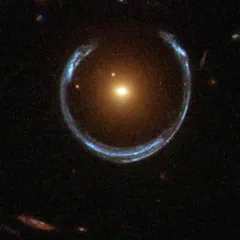
For decades physicists have argued over the nature of the elusive dark matter that pervades the Universe. A clever new study uses gravitational lensing to bring new evidence to the debate.
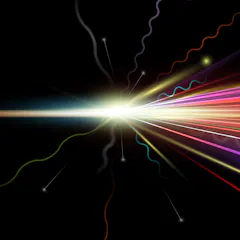
A new particle accelerator has just begun operation. It is the most powerful accelerator of its kind on Earth and will allow physicists to study some of the rarest matter in the universe.
A multitude of experiments have shown the mysterious phenomena of quantum mechanics to be how the universe functions. The scientists behind these experiments won the 2022 Nobel Prize in physics.
Recent discoveries have led to an alphabet soup of particles.
The Matter of Everything is a partial account of the history of physics, which leaves out a lot, including the story of some key women scientists.
Regular matter makes up just one-sixth of all the matter in the universe. What would it mean to finally understand what makes up the rest?

Studying the properties of the Higgs boson could throw up some shocking truths about the nature of reality.
Top contributors
-

Particle physicist, University of Cambridge
-
Head of School for Physics, University of Sydney
-
Post Doctoral Research Associate, Centre for the Subatomic Structure of Matter, Adelaide University
-
Professor of Physics, Head of Department, Lancaster University
-
Professor of Physics, Monash University
-
Professor, Philosophy of Science, The University of Melbourne
-
ARC Research Associate (Centre of Excellence for Particle Physics at Tera Scale), Adelaide University
-
Postdoctoral Fellow in Quantum Physics, University of Colorado Boulder
-
Professor of Nuclear Physics, Mississippi State University
-
Doctoral Student, College of Community and Public Affairs, Binghamton University, State University of New York
-
Senior Lecturer of Particle Physics, Lancaster University
-
Royal Society University Research Fellow and Lecturer in Particle Physics, UCL
-
Senior Lecturer in Particle Physics Informatics, Brunel University of London
-
Associate Professor of Physics, Durham University
-
Research Professor and Director of the International Institute for Accelerator Applications, University of Huddersfield