
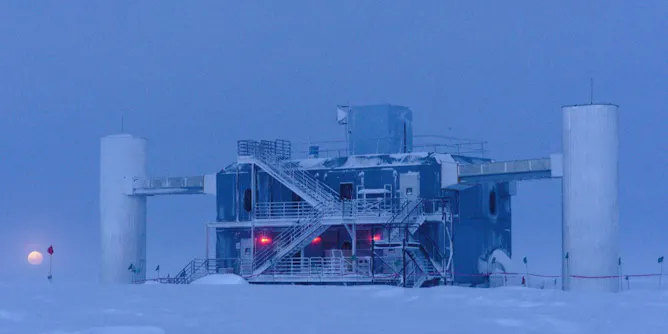
For more than a century, scientists have treated Antarctica’s environments as windows into worlds beyond Earth.
Articles on IceCube
Displaying all articles
IceCube looks for high energy neutrinos from space. It joins the ranks of complementary experiments that study neutrinos originating closer to home.
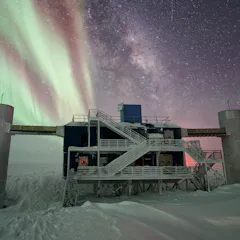
The 2026 Nobel Prize in physics recognizes Francis Halzen’s vision in building an unusual telescope in Antarctica, as well as the neutrino discoveries it’s made.
Belgium-born Francis Halzen has won for the detection of high energy neutrino particle from space.
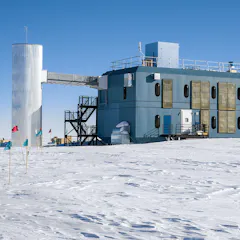
Tau neutrinos are notoriously difficult to spot in detectors like IceCube. But researchers have managed to isolate 7 candidates.

New data from the IceCube collaboration shows neutrino emissions from within our Milky Way galaxy – but figuring out where exactly these ghost particles come from is harder than it seems.
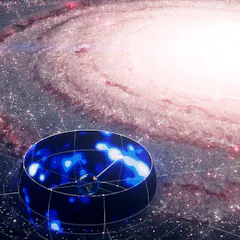
Neutrinos are some of nature’s most elusive particles, but new research has used them to create an image of our own galaxy.
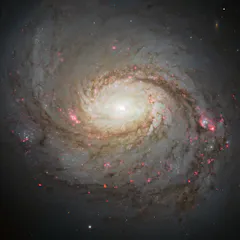
The IceCube telescope near the South Pole has received a first glimpse into the core of the galaxy NGC 1068.
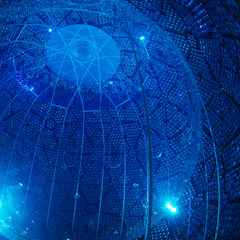
Deep underground, scientists research subatomic particles from space in a bid to understand the building blocks of our universe.
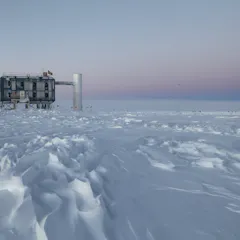
A cubic kilometer of clear, stable ice could help physicists answer big questions about cosmic rays and neutrinos. Hardy scientists collect data via a unique telescope at the frozen bottom of the world.
Top contributors
-

Professor of Physics and Astronomy, Michigan State University
-
Professor of Physics and Professor of Astronomy and Astrophysics, Penn State
-
Professor, Physics and Astronomy, University of Canterbury
-
Executive Director, Wisconsin IceCube Particle Astrophysics Center, University of Wisconsin-Madison
-
Senior Lecturer, School of Mathematics and Physics, University of Surrey
-
Research Affiliate, Scott Polar Research Institute, University of Cambridge
-
Research scientist at SNOLAB, Adjunct faculty at Laurentian University, Laurentian University
-
Assistant Professor of History, Texas Tech University
-
Associate Professor, Astrophysics and Dark Matter Researcher, Adelaide University