
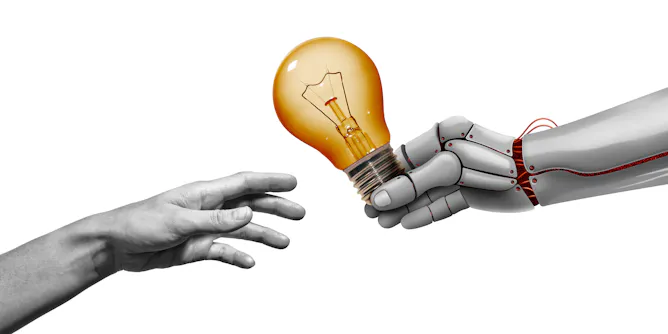
Maybe the tool matters less than the user.
Articles on Generative AI
Displaying 101 - 120 of 256 articles

Music and technology have been evolving together since long before the advent of AI. But without better safeguards now, artists face an uncertain future.
Just because you can deal with your inbox more quickly doesn’t mean you’ll spend your afternoon on the beach.

Even if you suspect a fake, here’s what to consider before accusing someone of using AI to create art, music or writing.

What if instead of trying to detect and avoid AI glitches, we deliberately encouraged them instead?

Whether you think AI is a good or bad thing, the fact is it’s here. AI literacy enables students to make safe and informed decisions when using AI, preventing habits that compromise academic integrity.
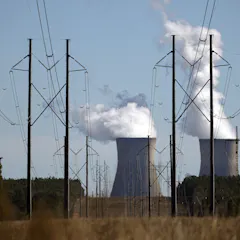
The hundreds of millions of people now using AI have added significant demand to the power grid, and that demand is only growing.

Workers still know things that algorithms don’t. They’re essential to designing AI systems to enhance, not replace, jobs.
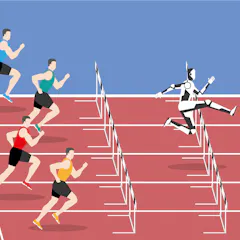
AI’s advantage over humans comes down to 4 dimensions: speed, scale, scope and sophistication. Whether AI can replace you depends on how much one or more of the S’s matter in what you do.

Remember when everything was ‘blockchain’? AI will plateau just like other hyped-up technologies in the past – but that doesn’t make it useless.

Simply setting rules around using AI is not enough. To ensure assessments are valid and fair, unis and teachers need to change the task itself.

AI watermarks are supposed to help us tell if content is real or generated. But they dramatically vary in effectiveness.

During the Industrial Revolution, craftsmanship retreated to the margins. As AI becomes widely adopted, will the same happen to original thinking?

Informal research methodologies informed by a distinctly Jewish approach can provoke new and more inclusive ways of engaging with generative AI.

Researchers developed an educational chatbot to help law students and save time. But the AI kept giving inaccurate, misleading and even incorrect feedback.

Concerns about privacy, consent and memory raised by artificial intelligence will become more urgent as more advanced models enter the market.

As artificial intelligence is incorporated into more newsrooms, journalists must ensure they use AI with transparency so that it does not undermine their credibility.

The solution demands two simple and clear actions: declare that photo manipulation has taken place and disclose what manipulation was carried out.

If AI allows students to automate routine cognitive tasks, it doesn’t mean they’re thinking less. It means their thinking is changing.

We’re just as likely to share intimate info with a chatbot as we are with a fellow human. It’s a privacy risk.
Top contributors
-

Associate Professor of Visual Communication & Digital Media, RMIT University
-
Senior Lecturer in Law, University of New England
-
Associate Professor of Linguistics and Director of Language Lab, The University of Western Australia
-
Senior Lecturer in Law and Emerging Technologies, Western Sydney University
-
Senior Lecturer in Business Information Systems, University of Sydney
-
Professor of Philosophy and Director of Applied Ethics Center, UMass Boston
-
Professor in Computational Intelligence, Australian Catholic University
-
Adjunct Lecturer in Public Policy, Harvard Kennedy School; University of Toronto
-
Professor of Digital Communication, Director of QUT Digital Media Research Centre, Queensland University of Technology
-
Professor of Computer Science and Director of the Art & AI Lab, Rutgers University
-
Director of Sydney Executive Plus, Business School, University of Sydney
-
Professor of Computer Science, University of California, Berkeley
-
Associate Professor of Information Science, University of Colorado Boulder
-
Assistant Professor, Faculty of Business, University of New Brunswick
-
Associate Professor of Political Science, Brock University