
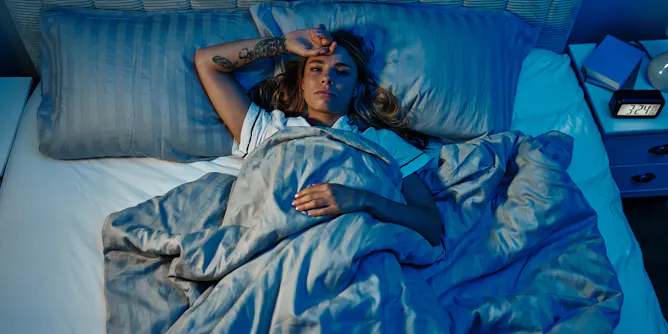
Inadequate sleep can have negative downstream effects on everyday cognitive functioning and mental health, which can then lead to even worse sleep.
Articles on Circadian rhythms
Displaying 21 - 40 of 161 articles

The answer lies in what’s known as the body’s ‘master clock’.

Aligning mealtimes with your body’s natural rhythms can help steady energy, mood and sleep through the darker months.

It’s not just down to being a night owl or an early bird. There’s a large body of evidence to show most of us are stronger and faster later in the day.
Many animals synchronise their behaviour to the phases of the Moon.

Is it equally detrimental to us all – or do some groups of people suffer more than others?

Folklore suggests that a full moon has a strong effect on sleep. But the reality is more complex, and lifestyle habits like screen use before bedtime are likely to have a larger effect.

A study followed thousands of medical interns and found a genetic link to their ability to adjust to shift-work changes.

The effects can be powerful enough, governments should consider regulating lights in casinos.

Immune cells known as neutrophils act as first responders to infection. Research on zebrafish shows light regulates their activity and boosts their ability to kill bacteria.
Here’s how your body might respond when you turn your clock back an hour on Saturday night.

Waking up early may help you to adjust faster though.

Improving your indoor lighting could help you sleep more soundly and be more active during the day.

Insomnia and bad sleep can lead to high blood pressure and increase hormone levels and inflammation.

The current system − daylight saving time and early school start times − wastes billions while causing more car accidents, workplace injuries and health issues.

Opioids and other addictive drugs can alter the rhythmic activity of genes involved in sleep-wake cycles.

Your brain’s clock struggles to catch up from jet lag, but your metabolism adjusts much quicker.

You can train your brain to wake up on time naturally.

Here are just some of the ways light is important for our wellbeing and mental health.

We have trillions of body clocks – a central one in the brain and others in each cell of our body. Here’s how they work with light to control our health.
Top contributors
-

Emeritus Professor of Psychology, Adelaide Institute for Sleep Health, Flinders University
-
Professor, School of Medicine, University of Connecticut
-
Professor of Neurology and Pediatrics, Vanderbilt University
-
Director, Appleton Institute, CQUniversity Australia
-
Associate Professor, Physiology of Circadian Rhythms, Institute for Molecular Bioscience, The University of Queensland
-
Lecturer, University of Cambridge; Anglia Ruskin University
-
Research fellow, The University of Queensland
-
Associate Professor of Neurology, University of Pittsburgh
-
Conjoint Senior Lecturer, School of Medicine and Public Health, University of Newcastle
-
Professor of Chronobiology and Integrative Physiology, University of Surrey
-
Personal Chair in Nutrition, The Rowett Institute, University of Aberdeen
-
Professor (Assoc), School of Pharmacy and Biomolecular Sciences (PBS), RCSI University of Medicine and Health Sciences
-
Associate Professor, Cognitive and Affective Neuroscience, University of Southampton
-
Associate Professor of Physical & Biological Sciences, University of California, Santa Cruz
-
Professor of Endocrinology, University of Oxford