
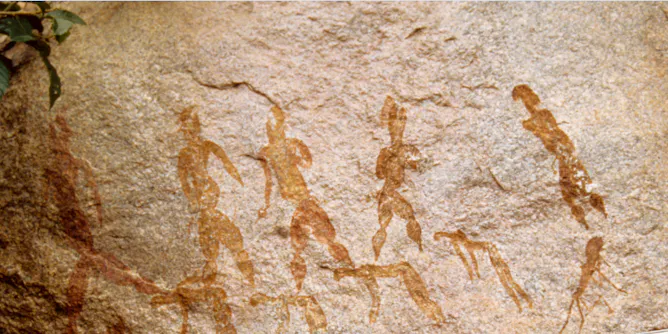
Trance states may influence the movements depicted in rock art.
Articles on Archaeology
Displaying 41 - 60 of 670 articles

An archaeologist examines the cultural obliteration Iran has incurred as a result of strikes in the US-Israel-Iran conflict. How can such damage be compensated and which global organisations can the country turn to?

Evidence of hominins butchering huge animals suggests that our human ancestors lived in big social groups.

Did Earth’s major diversification event really happen in one sudden explosion? Our fossil discovery suggests not.

Based on international collaborations lasting decades, two new studies have unlocked previously unavailable information from the bones of dogs long dead.
Archaeology offers a useful way to counter some biases.
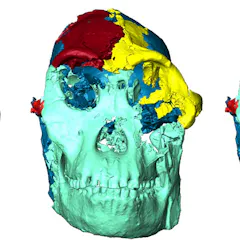
What did the face of our ancestors looks like 3 million years ago? Meet the reconstructed skull of “Little Foot” which provides valuable insights into how our ancestors adapted to their environment.

Tiny triangular-shaped flints from arrowheads found in Uzbekistan shed light on how the first settlement of ‘Homo sapiens’ – our modern human ancestors – came to Europe.

Our study has finally uncovered the circumstances surrounding the death of 77 people, mostly women and girls.

The discovery points to a long evolutionary history in north Africa, much earlier than modern Homo sapiens.

Some of the dances depicted in rock art are just about entertainment, not ritual.

The recently discovered heart-shaped locket may offer a rare glimpse into the king’s personal affections.

Digital tools allow archaeologists to identify similarities between fragments and artifacts and potentially recover previously unknown parts of their stories.
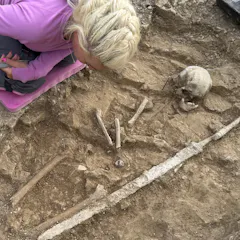
Swords found in early medieval graves show the complex cultural meanings that weapons can hold.

Aerial lidar raises ethical questions because it can collect data remotely without the knowledge or consent of Indigenous and descendant populations that are on the ground.

People were creating cave art in Indonesia 67,800 years ago – before modern humans reached Australia.
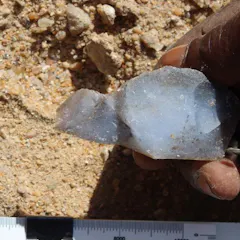
The age of the oldest known Oldowan stone tools from east Turkana has been pushed back by 700,000 years.

The discovery that small stone arrow tips were treated with plant poison 60,000 years ago means that ancient African hunters were capable of complex thinking.
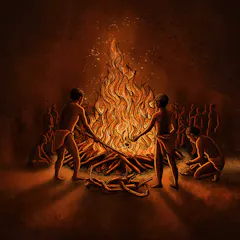
An ancient cremation would have been a community spectacle in a place returned to and reignited over many generations. What was behind this unexpected funeral ritual?

Pharaohs may have used this vessel to hunt hippopotami.
Top contributors
-

Professor of Environmental and Geographical Sciences, Bournemouth University; University of Reading
-
PhD Candidate, Anthropology and Archaeology, University of Bristol
-
Associate Professor of Archaeology, Griffith University
-
Professor in Geochronology and Geochemistry, Southern Cross University
-
Director, ARC Centre of Excellence for Transforming Human Origins Research, Griffith University
-
Professor of Archaeology and Biological Anthropology, School of Social Science, The University of Queensland
-
Professor of Archaeology, Griffith University
-
Associate Professor and Director, Flinders Microarchaeology Laboratory, Flinders University
-
Curator of Human Evolution of the Cleveland Museum of Natural History and Research Assistant Professor of Anthropology, Stony Brook University (The State University of New York)
-
Senior Lecturer, University of Mpumalanga
-
Honorary Professor, Archaeology, The University of Queensland
-
Honorary Associate Professor, UNSW
-
Associate professor, University of Johannesburg
-
Postdoctoral fellow, University of Tübingen
-
Associate Professor of Anthropology, Rice University