
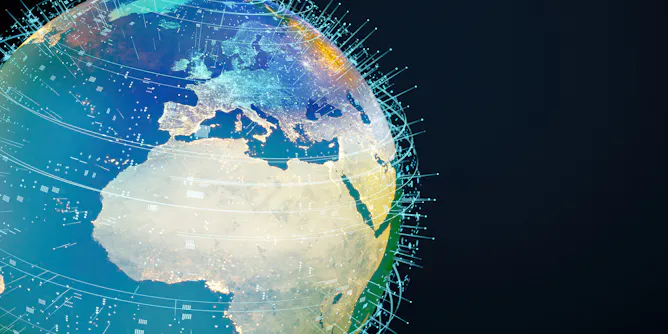
The weather would get wild and windy if one side of the planet was always cold and dark and the other side always hot and light.
Articles on Universe
Displaying 1 - 20 of 189 articles
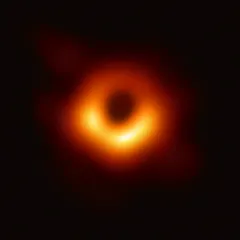
New results provide a fresh perspective on the iconic ring structure of the M87 black hole.
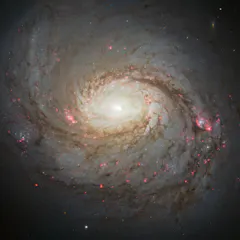
Galaxies act a little bit like figure skaters twirling on the ice – but at an astronomical scale.
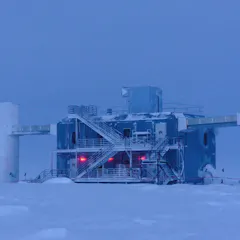
For more than a century, scientists have treated Antarctica’s environments as windows into worlds beyond Earth.
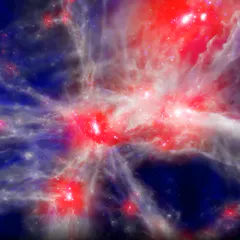
Turns out the Milky Way is as good as it gets.
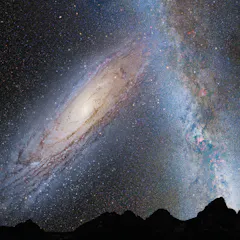
The Milky Way contains a fossil record of galaxies it has absorbed.
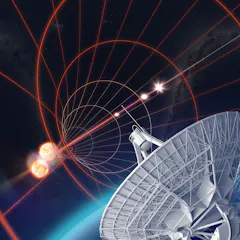
Astronomers have revisited data from a dramatic collision of neutron stars to help resolve the infamous ‘Hubble tension’.

Listen to the The Conversation’s Curious Kids podcast to hear astronomer Michael Lam on what theories scientists have for what came before the Big Bang.
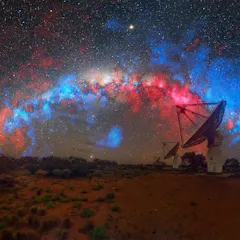
The best map yet of cosmic magnetic fields has been created with Australia’s most powerful radio telescope.

Seeing a signal in different kinds of light is like having a text written in several forms of writing – it makes it easier to decipher.

The black holes could be relics from a time before the Big Bang.
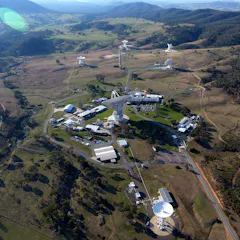
Ground stations in Australia are crucial for contacting the astronauts travelling to the Moon.
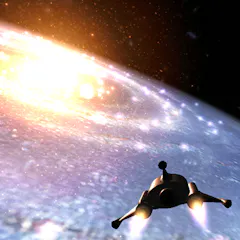
With college students less likely to read through a full textbook than they once were, video games can help keep them engaged.
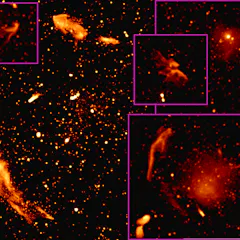
South Africa is using homegrown technology to answer questions about where our universe came from and where it is going.

While direct evidence of multiple universes is hard to come by, indirect evidence raises intriguing possibilities.

The Rubin Observatory in Chile has the largest camera ever built – and is set to find objects never before seen by human eyes.

The electron is the tiniest particle. Then there are neutrinos, which are as small but may weigh more.
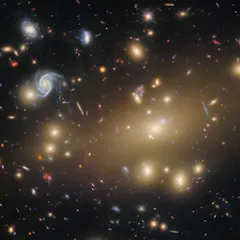
Two ways of measuring how fast the universe is expanding disagree, a puzzle known as the Hubble tension. Tiny magnetic fields from the Big Bang may offer a solution.

Radio pulses repeating every minute-to-hour have puzzled astronomers, but a new paper in Nature Astronomy might finally shed some light.

Fire obviously isn’t a liquid or a solid. In fact, it’s not matter at all – it’s a process.
Top contributors
-

Professor of Astrophysics, University of Sydney
-
Associate Professor in Astronomy, Monash University
-
Associate Dean of Innovation and Engagement, Swinburne University of Technology
-
ARC Laureate Fellow & Distinguished Professor, Centre for Astrophysics & Supercomputing, Swinburne University of Technology
-
Emeritus Professor of Cosmology and Astrophysics, Institute of Astronomy, University of Cambridge
-
Senior Curator (Astronomy), Museums Victoria Research Institute; The University of Melbourne
-
Senior Lecturer in Physics, Western Sydney University
-
Professor, The University of Queensland
-
Pro Vice-Chancellor Flagship Initiatives, Swinburne University of Technology
-
Reader in Astrophysics, UCL
-
Professor (Astrophysics), University of Southern Queensland
-
Cosmologist, University of Tasmania
-
Professor, Macquarie University
-
John Curtin Distinguished Professor (Radio Astronomy), Curtin University
-
Professor of Astronomy & Astrophysics, University of California, Santa Cruz