
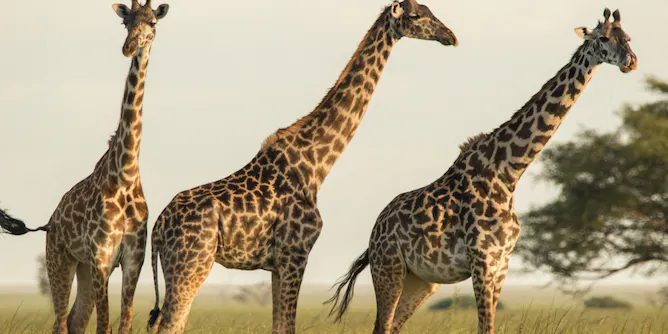
Giraffe numbers have plummeted from an estimated 150,000 in 1985 to fewer than 100,000 today.
Articles on Tanzania
Displaying 161 - 180 of 351 articles

Africa’s key to future food-nutrition security may depend on the untapped potential of indigenous fruit trees.
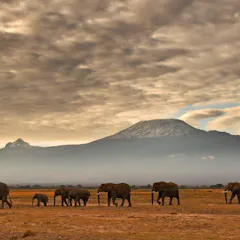
When natural habitats are isolated it means species are less able to migrate, leading to less genetic variation and species diversity.

The pandemic will not end for anyone, anywhere until it is controlled in every country. Tanzania’s approach will make it that much harder for normality to return.

Even those that live in areas where the population has already been vaccinated would not be totally protected if the virus mutates elsewhere.

A new report from the GovLab and the French Development Agency (AFD) examines how development practitioners are experimenting with emerging forms of technology to advance development goals.

South Africa’s famous toyi-toyi was adopted from Zimbabwean troops, who learned it in Algeria – showing the interconnected nature of Africa’s liberation struggles.
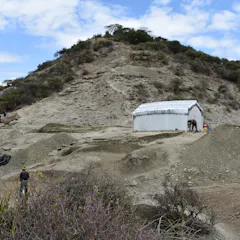
The research shows that 2 million years ago humans were not constrained technologically and already had the capacity to expand their geographic range.

People are swayed by social pressure to help relatives, share contacts or reciprocate favours received from their networks. Many also believe that corruption is normal.

Researchers have come up with a new framework that assigns an invasive species threat score to World Heritage Sites. This will improve how these species monitored and managed.

In some countries there appear to be mismatches between lists of essential medicines and lists of registered medicines.

President John Magufuli won a second term by a contested landslide and looks set to take even greater control of Tanzania’s democratic space.

CC BY-NC-ND15 MB (download)
Is authoritarianism on the rise on the continent? Or is democracy doing well? Nic Cheeseman discusses.
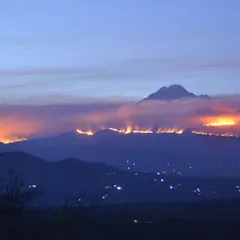
There have been several severe fires on Kilimanjaro over the last few decades that have dramatically changed land cover.

Tanzania’s October poll shows that elections are purely performative for governments which do not adhere to the basic tenets of democracy.

This invasive mosquito thrives in the type of habitat commonly found in urban areas. This means that malaria could become more prevalent in African cities.

International observation will not insulate controversial polls – such as Tanzania’s in October – from malpractices, but will make them less likely and allow them to be exposed.
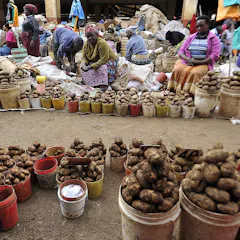
Potato cyst nematodes suppress crop growth and can cause huge yield losses of up to 80%, and even total crop failure.
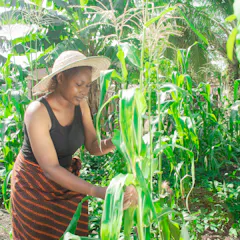
Africa is far from having an ageing farming population. What is missing is a critical mass of skilled, young farmers with access to finance who could drive productivity in farming.

A united opposition could create enough momentum to unseat incumbent John Magufuli from power.
Top contributors
-

Researcher, United States International University
-
Lecturer, Tumaini University Makumira
-
Assistant professor, University of Sussex
-
Post-Doctoral Research Fellow, SARChI in Higher Education and Human Development Research Group, University of the Free State
-
PhD Candidate, Department of Political Science and Public Administration, University of Nairobi
-
Senior Lecturer in Politics and International Relations, University of East London
-
Professor of Democracy, University of Birmingham
-
Research Associate Plant Systematics, Bayreuth University
-
Associate Professor of International Studies, University of Nottingham
-
Lecturer in Wildlife Conservation
-
Professor of French and Critical Disability Studies, Lancaster University
-
Asso. Professor in Anthropology, University College London, UCL
-
Professor of Disease Ecology and Public Health, University of Glasgow
-
Senior Lecturer in Social Work, Australian Catholic University
-
Researcher, SAMRC/Centre for Health Economics and Decision Science- PRICELESS SA, University of the Witwatersrand