
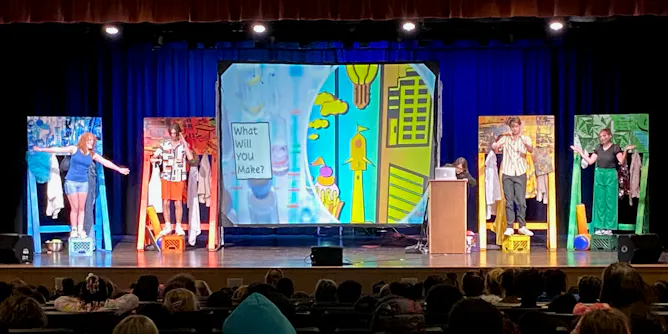
Is it a STEM education or a STEAM education? Integrating arts into science programming and vice versa can pique kids’ curiosity − a play touring Michigan aims to do just that.
Articles on Mathematics
Displaying 121 - 140 of 647 articles

They are popular because they are popular, which is a circular argument that suits a pie chart. But there are some serious downsides to using the humble pie.
AI will not become sentient and decide to kill us all. But our own conscious or unconscious beliefs about AI can potentially increase the likelihood of any outcome, including catastrophic ones.
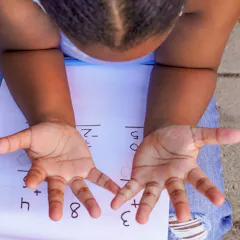
Findings of a study suggest using a ‘hundreds chart’ showing numbers one through 100, beginning with one in the top-left corner, fosters children’s counting by 10s.
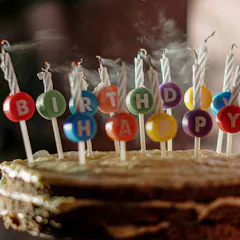
The logic of shared birthdays is stranger than you might think, but learning to understand counter-intuitive mathematics is key to seeing the world clearly.
University maths departments are shrinking or closing.
Pisa measures 15-year-olds in reading, maths and science every three years - but is that the best way to test an education system?

The annual ritual of buying a gift for a random recipient opens a window onto some fascinating mathematics.

To boost post-pandemic math learning, a multi-dimensional approach is needed that promotes the success of the whole child: academic, physical and socio-emotional.
The latest Programme for International Student Assessment (PISA) show Australian 15-year-olds have recorded similar results to 2015 and 2018 in maths, science and reading.
In The Manic, Benjamin Labatut tells the story of the ‘smartest man of the 20th century’.

A mathematician explains the important difference between absolute risk and relative risk.
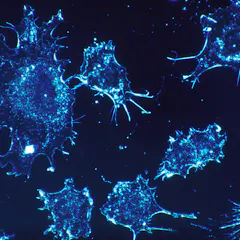
From math to evolutionary game theory, looking at cancer through different lenses can offer further insights on how to approach treatment resistance, metastasis and health disparities.
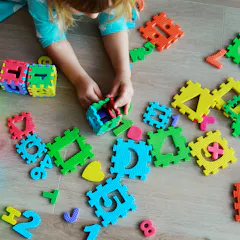
Changing attitudes to maths from the start of education can lead to more success later on.
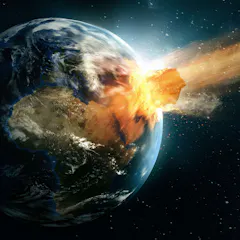
What are the odds of the end of humanity? There’s no real way to know.
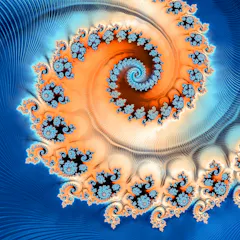
A book-length thought experiment uses math to investigate some of life’s big questions.

Mathematical models, video games and experiments with ants can all further our understanding of the dynamics of war.
Graphic novels pair text and images to explain complex topics – from thermodynamics to abstract math – without alienating STEM-averse students.
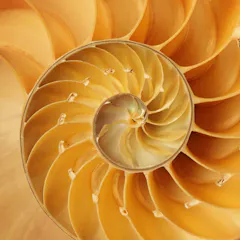
Humans have been making symbols for numbers for thousands of years. Different cultures developed their own symbols, but all use addition and multiplication, suggesting arithmetic is a universal truth.
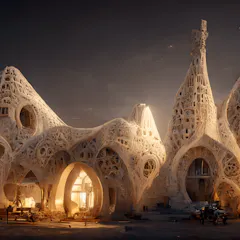
By bridging culture and computation, heritage algorithms challenge the myth of ‘primitive cultures’ and forge a new understanding of science and art.
Top contributors
-

Laureate Professor of Mathematics, University of Newcastle
-
PhD; Lawrence Berkeley Laboratory (retired) and Research Fellow, University of California, Davis
-
Emeritus Professor, University of Nottingham, (currently Vice-Chancellor at MILA University, Malaysia), University of Nottingham
-
Professor of Mathematics, University of Florida
-
Professor of Mathematical Biology and Public Engagement, University of Bath
-
Lecturer in Mathematics Education, University of Sydney
-
Senior Lecturer in Mathematics Education, University of Sydney
-
Senior Lecturer in Mathematics, Department of Mathematical Sciences, City St George's, University of London
-
Research Fellow, School of Biological Sciences, Monash University
-
PhD Candidate, Australian National University
-
Professor of Mathematics, Toronto Metropolitan University
-
Associate Professor, Department of Physiology, Monash University
-
Mathematician, University of Portsmouth
-
Lillian Gilbreth Postdoctoral Fellow, Purdue University
-
Professor of Mathematics and Statistics, University of Maryland, Baltimore County