
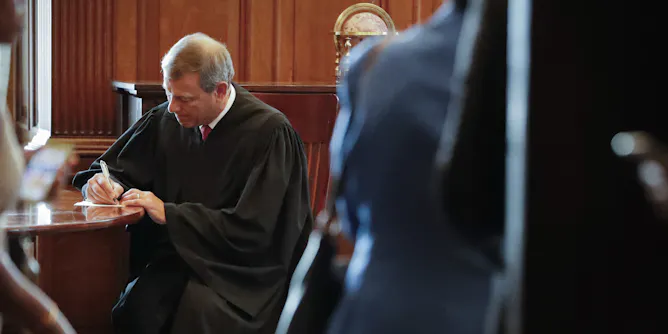
While the Court’s politics have veered right over the past decade, the justices’ prose has shifted left, becoming more colloquial and accessible.
Articles on Justice Neil Gorsuch
Displaying all articles

A widely anticipated Supreme Court ruling will sharply limit federal agencies’ power to interpret the laws that they execute and decide how best to carry them out.
With their upcoming decision concerning whether Donald Trump can appear on the Colorado ballot, Supreme Court justices face the possibility that the ruling could be ignored or defied by the public.

An important but controversial legal doctrine, known as Chevron deference, is at issue in two fishing cases. The outcome could affect many sectors across the nation.
The ‘most divided’ Supreme Court ever may have been in 1941, when seven of the nine justices were New Deal supporters appointed by the same president, Franklin D. Roosevelt.
Major Supreme Court decisions and reversals last term are leaving some people, including this scholar on constitutional politics, wondering – what’s going on with the court?
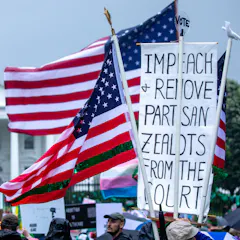
History shows that political contests over the ideological slant of the court are nothing new.

The judicial theory has been a major talking point during the Supreme Court’s last term. But what does it actually mean?
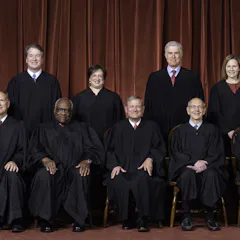
In a 6-3 conservative majority, the more important divisions may be among the six Republican-appointed justices.
Justices declined GOP requests to block court-approved congressional maps in North Carolina and Pennsylvania. But justices punted a bigger question over the role of courts until after the midterm elections.
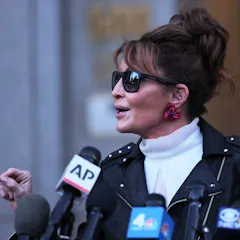
Under the Sullivan standard, a public official has to prove that there was ‘actual malice’ in defamation cases. That could be challenged in the Supreme Court.
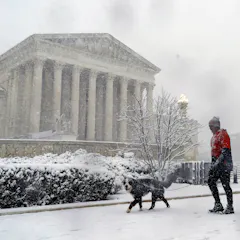
The court appears split over the future of vaccination mandates, with conservative justices skeptical of the Biden administration’s authority to enforce requirements.
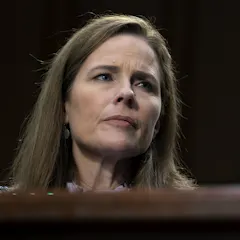
The judicial theory has been a major talking point during the past three Supreme Court nominations. But what does it actually mean?
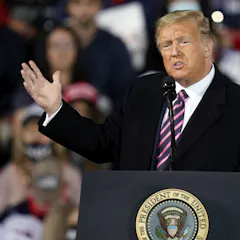
A quantitative analysis of potential nominees to the Supreme Court reveals that conservatives could get a real lock on the nation’s highest court.
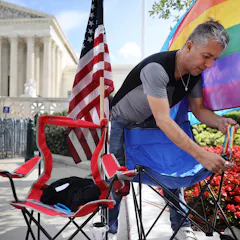
Both sides of the debate over religious freedoms and LGBTQ rights use the language of equality and opposition to discrimination. It will be up to the courts to decide whose claim is stronger.
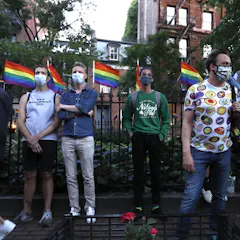
Federal law now protects lesbians, gay men and transgender people from being fired or otherwise discriminated against at work. But there are more questions and court cases to come about their rights.

The Supreme Court’s pandemic-related move to oral argument over the telephone has improved those arguments and allowed the public to engage with these discussions of the meaning of our Constitution.
Top contributors
-

Professor of Law, University of Kansas
-
Professor of American Civics, University of Tennessee
-
Associate Professor of Law, Arizona State University
-
Professor of Communication, Radford University
-
Associate Professor of Sociology, University of Nebraska-Lincoln
-
Assistant Professor of Political Science, University of South Carolina
-
Assistant Professor of Political Science, West Virginia University
-
Professor of Law, Arizona State University
-
Professor of Political Science and Women’s, Gender and Sexuality Studies, University at Albany, State University of New York
-
Professor of History, Arizona State University
-
Professor of Political Science, LaGrange College
-
Professor of Sociology and Women's and Gender Studies, University of Nebraska-Lincoln
-
Professor of Law, University of Richmond
-
Professor and Director of Legal Writing, University of Miami
-
Professor of Political Science, USC Dornsife College of Letters, Arts and Sciences