

Jackson’s concurrence traces the 14th Amendment to work done by people ‘beyond Congress’ and Black Americans who ‘helped galvanize the push for full equality.’
Articles on Justice Clarence Thomas
Displaying all articles

Under Chief Justice John Roberts, the Supreme Court has made it much harder for federal prosecutors to go after corrupt state and local officials.
The ‘most divided’ Supreme Court ever may have been in 1941, when seven of the nine justices were New Deal supporters appointed by the same president, Franklin D. Roosevelt.
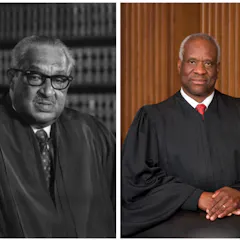
Throughout Thomas’ tenure on the court, he has pushed the Supreme Court to replace Marshall’s vision with one more amenable to the powerful than the powerless.

Justices are weighing the arguments in two cases that have the potential of changing the way social media platforms operate.
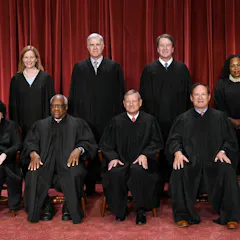
The US Supreme Court is poised to determine the fate of the use of race in college admissions. Supporters of affirmative action, like the military, fear the worst.
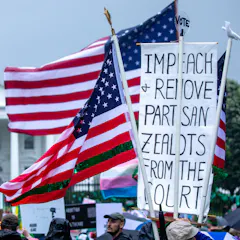
History shows that political contests over the ideological slant of the court are nothing new.

The judicial theory has been a major talking point during the Supreme Court’s last term. But what does it actually mean?

Several rap songs speak on the subject of abortion from the perspective of the unborn child.

The justices who decided to overturn the abortion rights precedent of Roe v. Wade explained their reasoning, and signaled other precedents could be reversed as well.
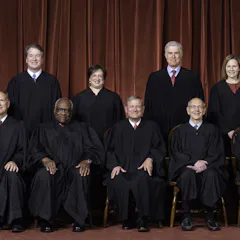
In a 6-3 conservative majority, the more important divisions may be among the six Republican-appointed justices.
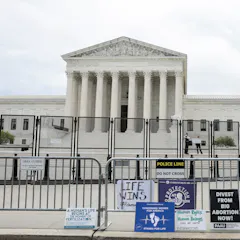
A Supreme Court scholar explains the significance of the recent Supreme Court leaked draft opinion.
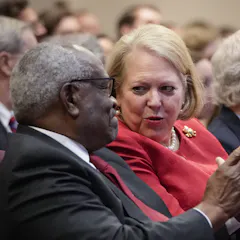
Conflicts of interest at the Supreme Court are nothing new. But no one has found a way to fix them.
Justices declined GOP requests to block court-approved congressional maps in North Carolina and Pennsylvania. But justices punted a bigger question over the role of courts until after the midterm elections.
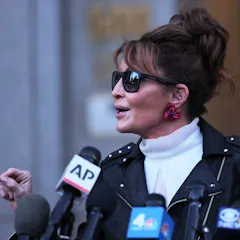
Under the Sullivan standard, a public official has to prove that there was ‘actual malice’ in defamation cases. That could be challenged in the Supreme Court.

Unlike in most countries, US Supreme Court justices enjoy life tenure. Some legal scholars believe that centuries-old custom, meant to protect judicial independence, no longer serves the public.

There is value in observing legal precedent, but sometimes circumstances, logic or judges’ views determine it’s time to overturn it.
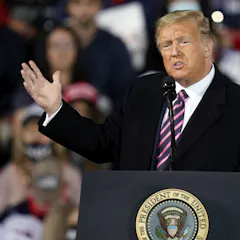
A quantitative analysis of potential nominees to the Supreme Court reveals that conservatives could get a real lock on the nation’s highest court.

The Supreme Court’s pandemic-related move to oral argument over the telephone has improved those arguments and allowed the public to engage with these discussions of the meaning of our Constitution.
Top contributors
-

Professor of Political Science, Hamline University
-
Professor of Legal Studies and Political Science, UMass Amherst
-
William Nelson Cromwell Professor of Jurisprudence and Political Science, Amherst College
-
Professor of Law, American University
-
Professor of Political Science, Northern Illinois University
-
Professor of Political Science, LaGrange College
-
Professor of Communication, Radford University
-
FedEx Professor of Law; Author of The Transition: Interpreting Justice from Thurgood Marshall to Clarence Thomas, University of Memphis
-
Professor of American Civics, University of Tennessee
-
Ph.D. Candidate in Political Science, University of Notre Dame
-
Associate Professor of Political Science, Oklahoma State University
-
Adjunct Professor of History, University of North Carolina – Charlotte
-
Professor of Law, Stetson University
-
Professor of History, Arizona State University
-
Associate Professor of Law, Arizona State University