
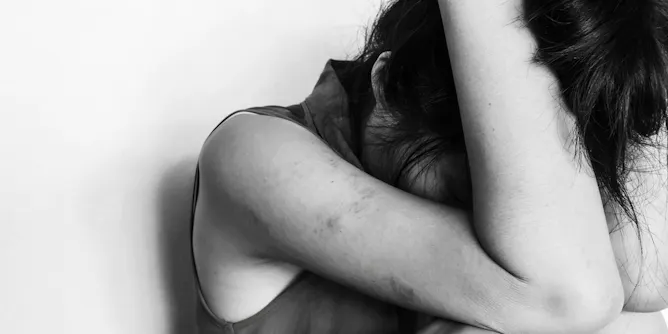
Health and service workers are not asking women about a potential traumatic brain injury, there’s a lack of referral options, and often no diagnosis.
Articles on Family violence
Displaying 81 - 100 of 224 articles

For years, we’ve taken major sporting events, a public holiday, added alcohol and gambling, then watched domestic violence rates rise. It’s time we did something different.
The ten-year National Plan to End Violence Against Women and Children is proposing to align with Closing the Gap to address First Nations violence. This could work, but there are limitations.

We need not just an acknowledgement of children as victim-survivors in their own right but a commitment to boost resourcing of child-centred recovery support.

A new ten-year plan to end violence against women and children has some significant strengths, but it also has some deficits, and details are still to be released.

Young women lack voice and visibility in discussions about family violence in Australia, and particularly intimate partner violence. This must change, urgently.
After separation, mothers who experienced domestic violence on average suffered a drop in income of 34%, compared with a 20% decrease for mothers who didn’t experience domestic violence.

Young people who experienced violence between other family members, and had been directly subjected to abuse, were 9.2 times more likely to use violence in the home.

As well as abuse, many Australian have also experienced threats of harm and harassing behaviour.

In Australia, the discussion around gendered violence is increasingly focused on diversity. However, policy and services continue to be based mostly on the experiences of white, Anglo-settler women.

In a new report, child family violence survivors describe how family court worsened their trauma and profoundly affected their well-being even into adult life.
Survivors of violence, and those working to support survivors, want to see programs that focus on getting the first response right, every time.

New research shows how threats of self-harm and suicide are a tactic of coercive control men use against female partners.
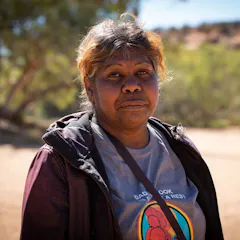
The murder of R. Rubuntja brings to light the ways Australian media and the Australian justice system continues to fail First Nations women.
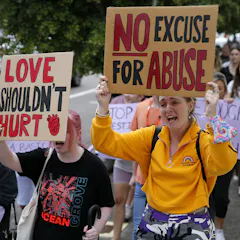
There is a crisis in women’s safety but the commitments are piecemeal and some aren’t even new.

First Nations women are disproportionately more likely to be targets of online abuse. More needs to be done to respond to and support women experiencing technology-facilitated abuse.

A new study finds that while there have been improvements in the way victim-survivors are treated at work, there is still much to be done.
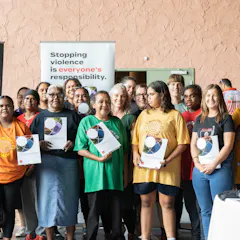
The Northern Territory has the highest rates of domestic, family, and sexual violence in Australia. The Tangentyere women’s group shows how prevention projects can address gender inequality.
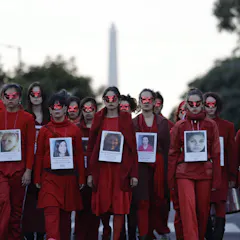
Private and public violence rely on each other as forces that work together to ensure women and girls ‘stay in their place’ — the one that patriarchal social structures have prescribed.

When tech companies aim for ‘safety by design’, they can reduce the risk their products will be weaponised for stalking and domestic violence.
Top contributors
-

Professor (Practice), Faculty of Business and Economics, Monash University
-
Professor of Family and Sexual Violence, RMIT University
-
Eleanor Rathbone Chair of Sociology, University of Liverpool
-
Professor of Social Work; Leneen Forde Chair in Child & Family Research, Griffith University
-
Chief Investigator for the Australian Research Council Centre of Excellence for the Elimination of Violence against Women (CEVAW), School of Philosophical, Historical & International Studies, School of Social Sciences (SOSS), Monash University
-
ARC Future Fellow and Professor of Criminology, The University of Melbourne
-
Emeritus Professor Monash University, Monash University
-
Professor of Law and Deputy Director of the Centre of Excellence for the Elimination of Violence Against Women (CEVAW), The University of Melbourne
-
Associate Professor of Social Work, The University of Melbourne
-
Professor of Family Violence Prevention, The University of Melbourne
-
Managing Director, Her Story Consulting & Postdoctoral fellow, Australian National University
-
Professor, Centre for Women's Studies & Gender Research, Sociology, Monash University
-
CEO, Sentencing Advisory Council
-
Director of the Monash Gender and Family Violence Prevention Hub and Senior Lecturer in Criminology Monash University, Monash University
-
Lecturer in Criminology, University of Liverpool