
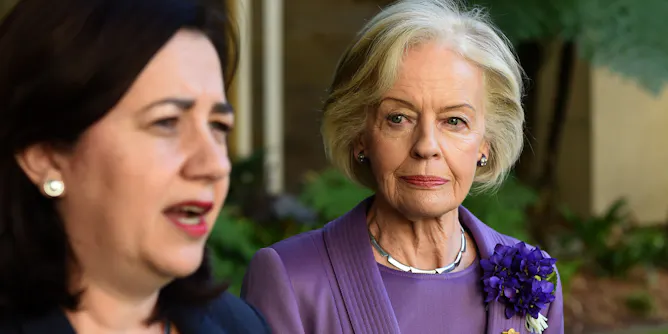
We’ve heard promises to act on domestic violence too often before. But a new Queensland plan offers public accountability measures – which could finally turn rhetoric into real action.
Articles on Family violence
Displaying 201 - 220 of 224 articles

Victoria’s Royal Commission into Family Violence will today hear how the health system can better respond to partner abuse, with the help of trained professionals and broader, government support.

Many public awareness campaigns fail to change attitudes and behaviours because they start from the flawed premise that just telling someone something is bad will make them stop doing it.

To reduce family violence, we need to examine the culture of masculinity and the way we socialise our children into gender roles.
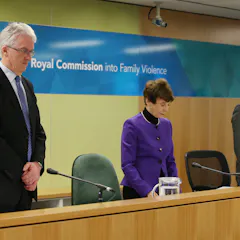
The royal commission presents a timely opportunity to greatly improve responses to family violence in Victoria. But as the volume of submissions reveal, this is a task not easily achieved.
Giving people the right to ask about their partner’s history of domestic violence sounds like a good idea – but there are good reasons why Rosie Batty and others have raised concerns.
While the disability system has undergone significant and important reforms over the past three decades, many problems remain. We’re still failing to protect people with disabilities.

Legal requirements for doctors to report family violence to police may sound good at first glance. But evidence shows it’s better doctors are trained to support women to make their own decisions.

Research on the UK’s only source of statistics on violent crime shows that domestic violence and violence against women are massively understated.

Technology violence is a term that encompasses all types of harassment and abuse that occurs online and serves to control or intimidate women in particular.

We need to support those who are subjected to family violence – mostly women and children – and this must remain our priority. But we must also intervene at the source of the problem.
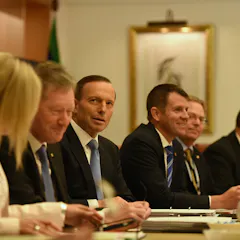
For decades, successive governments have cherry-picked reports on domestic violence for the easy fixes, and ignored the hard stuff. So no more summits and royal commissions – it’s time to act.
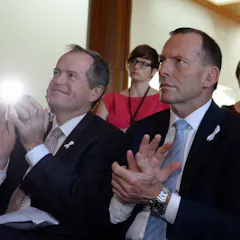
Responses to family violence by Tony Abbott and Bill Shorten and the terms of reference for Victoria’s royal commission fail to mention young people. Such a lack of recognition has dire consequences.

When Barbara, a 28-year-old mother of two pre-school boys, Josh and Noah, left her violent husband, she never expected to be punished for it at work.

For every woman who reports domestic abuse, many more remain silent through fear, shame or simply because they don’t know who to turn to. But new digital programs could help.
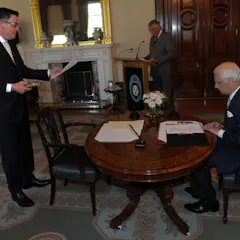
It is difficult to capture just how important a royal commission with this focus is. For too long, family violence has taken, threatened and pervaded the lives of so many in the Victorian community.
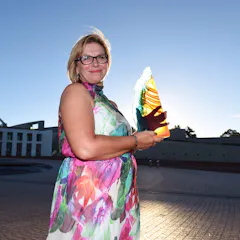
Domestic violence has been an agenda item for some time. It is not something that society, nor governments, have recently discovered.

Observers may be quick to declare social trends “good” or “bad” for families, but such conclusions are rarely justified. What’s good for one family – or group of families – may be bad for another. And…

As yet another NFL player stands accused of domestic violence, it is beginning to look as though the sport is riddled with wife-beaters and child-abusers. By apparently sweeping such behaviour under the…

The latest National Community Attitudes Survey on Violence against Women (NCAS), released today, shows that most measures of community understanding and attitudes on violence against women have not improved…
Top contributors
-

Professor (Practice), Faculty of Business and Economics, Monash University
-
Professor of Family and Sexual Violence, RMIT University
-
Eleanor Rathbone Chair of Sociology, University of Liverpool
-
Professor of Social Work; Leneen Forde Chair in Child & Family Research, Griffith University
-
Chief Investigator for the Australian Research Council Centre of Excellence for the Elimination of Violence against Women (CEVAW), School of Philosophical, Historical & International Studies, School of Social Sciences (SOSS), Monash University
-
ARC Future Fellow and Professor of Criminology, The University of Melbourne
-
Emeritus Professor Monash University, Monash University
-
Professor of Law and Deputy Director of the Centre of Excellence for the Elimination of Violence Against Women (CEVAW), The University of Melbourne
-
Associate Professor of Social Work, The University of Melbourne
-
Professor of Family Violence Prevention, The University of Melbourne
-
Managing Director, Her Story Consulting & Postdoctoral fellow, Australian National University
-
Professor, Centre for Women's Studies & Gender Research, Sociology, Monash University
-
CEO, Sentencing Advisory Council
-
Director of the Monash Gender and Family Violence Prevention Hub and Senior Lecturer in Criminology Monash University, Monash University
-
Lecturer in Criminology, University of Liverpool