
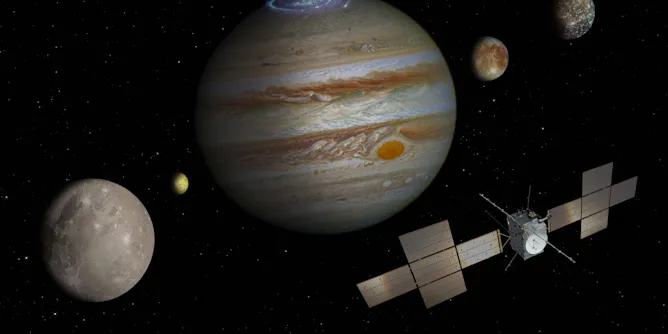
One of Jupiter’s moons, Ganymede, could contain more water than the Earth.
Articles on European Space Agency (ESA)
Displaying 41 - 60 of 97 articles
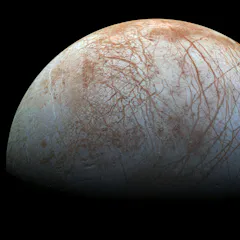
Europa Clipper and the Jupiter Icy Moons Explorer missions will arrive at Jupiter in the 2030s and provide researchers with unprecedented access to the moons orbiting the gas giant.
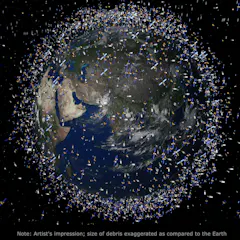
How might the space industry reduce its ecological footprint and better manage the debris it leaves in its wake?

Using space imagery can help guide relief efforts to critical areas during a natural disaster.
By spotting and counting tiny galaxies, we can work out how much dark matter is hiding in the cosmos.
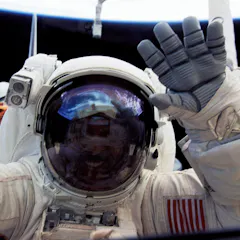
The European Space Agency has recruited the world’s first-ever disabled astronaut. But we’re still a long way from space being accessible to all.
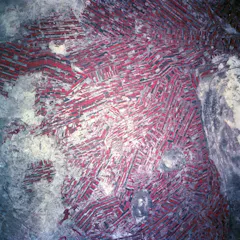
Technologies being developed for growing food in space have contributed to advances in agriculture and crops on Earth.
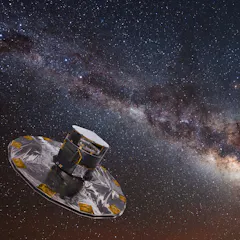
New data may settle dispute about the universe’s true expansion rate.
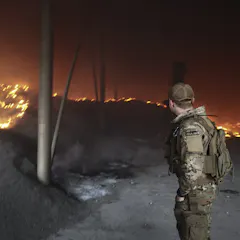
A digest of the week’s coverage of the war against Ukraine.
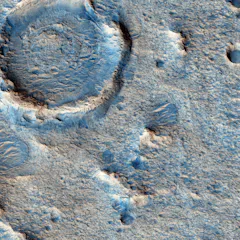
The European space agency will need both a launch vehicle and a lander platform to launch its ExoMars rover without help from Russia.
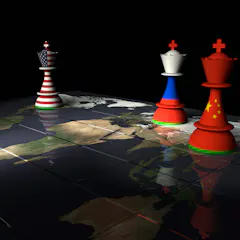
In the past 10 years, international alliances on Earth have begun to expand into space. Nations with similar interests collaborate with one another while competing with other space blocs.
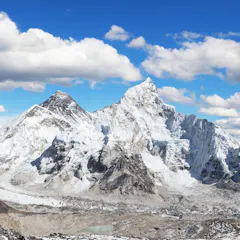
Remote sensing satellites provide the crucial data that helps scientists model disasters so that they can work on predicting avalanche patterns in future.
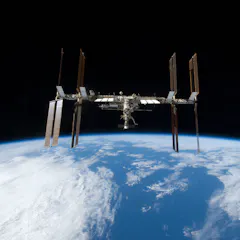
What happens to the International Space Station when tensions on Earth rise? A space policy expert explains how the ISS is run and how Russian aggression has threatened its operation in the past – and now.

What did Mercury look like as BepiColombo swung by?
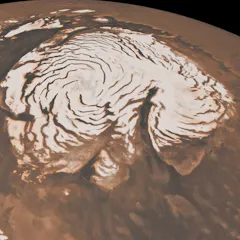
New results show why and how water is disappearing from Mars atmosphere.
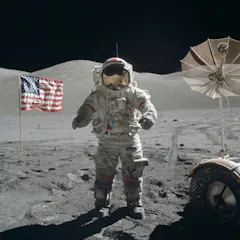
Several current programs aim at sending humans back to the Moon. What would be the purpose, and what are the real prospects?

Advanced techniques allowed our research team to build an open database of billions of individual trees and challenge some common perceptions about vegetation in arid and semi-arid zones.
Many of people may have dreamed of becoming an astronaut since childhood, but do you have what it takes?
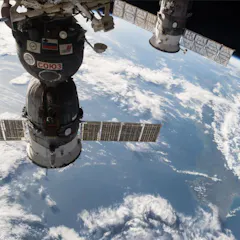
Over the coming decade, the arrival of constellations of small satellites will reshape the space industry. It constitutes a paradigm shift, particularly in terms of data gathering and processing.
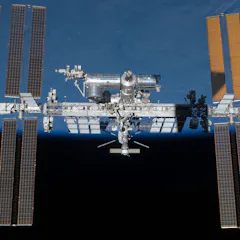
Humans have been living on the International Space Station for two full decades. So what comes next for this ailing technology, and what does it mean for future International ventures in space?
Top contributors
-

Professor of Planetary and Space Sciences, The Open University
-
Professor of Physics, Deputy Director (Solar System) at the Mullard Space Science Laboratory, UCL
-
Enseignante-chercheuse en Management Stratégique, Montpellier Business School, Montpellier Business School; European Academy of Management (EURAM)
-
Professor of Planetary Geosciences, The Open University
-
Professor of Strategy and Security Studies, Air University
-
Professeur des Universités, Université de Montpellier; European Academy of Management (EURAM)
-
Professor of Planetary Science, University of Leicester
-
Scientist, Max Planck Institute for Solar System Research
-
Lecturer in Orbital Mechanics, Surrey Space Centre, University of Surrey
-
Senior Lecturer in Physics, Nottingham Trent University
-
Postdoctoral research associate, University of Oxford
-
ARC Laureate Fellow and Winthrop Research Professor at the International Centre for Radio Astronomy Research, UWA., The University of Western Australia
-
Professor of Astrophysics Education, The Open University
-
Professor of Astronomy, Liverpool John Moores University
-
Professor of International Studies; Adjunct Professor of Law, University of Washington