
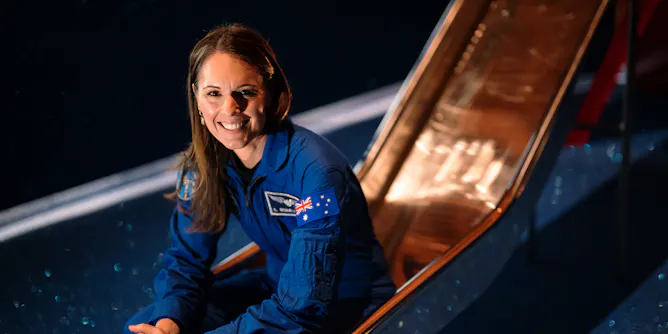
Spending $100 million on a single space mission in a cost-of-living crisis deserves proper scrutiny.
Articles on Astronauts
Displaying 1 - 20 of 152 articles
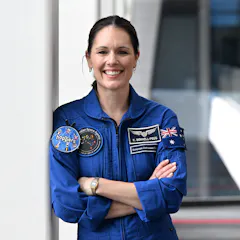
Sending Katherine Bennell-Pegg to the International Space Station is an investment in Australia’s space future.
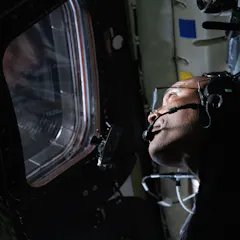
What happens to astronauts’ circadian rhythms when the Sun no longer provides a reliable schedule?
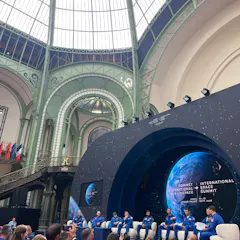
Paris’ International Space Summit was an opportunity to understand what and who Europe needs to reliably sustain its launch ambitions and become a world-class leader in Space.
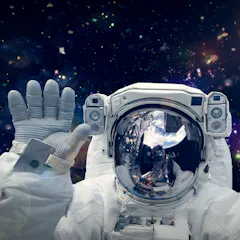
Spaceflight can reproduce some changes associated with later life within weeks, offering clues about muscle loss, frailty and recovery.
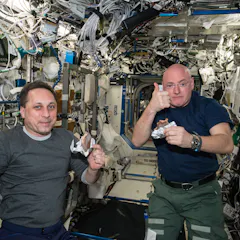
A speech-language pathologist on how complex swallowing is – and how small changes from gravity can complicate the process.
After decades assuming disabled people would struggle in spaceflight, researchers are finally asking what they can contribute.
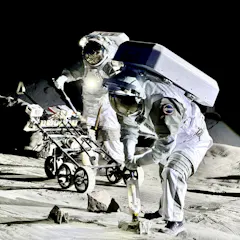
There is no one way to be an astronaut; you can’t go to astronaut school.
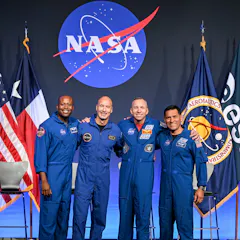
The Artemis program’s timeline and architecture has changed over the past year, so Artemis III will not land on the lunar surface.
In the 1950s, Arthur C. Clarke imagined an amputee astronaut. If John McFall reaches orbit, science fiction becomes science fact.
Astronauts report feeling profoundly awestruck when they go to space, an anthropologist reports. This experience shapes their perspectives even back on Earth.
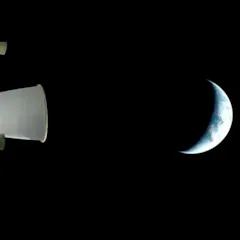
A planetary geologist and member of NASA’s First Artemis Lunar Surface Science Team witnesses the launch of the Artemis II moon rocket.

Curiosity and an openness to new ideas help Ryland Grace, the movie’s protagonist, navigate new discoveries about life in the universe.
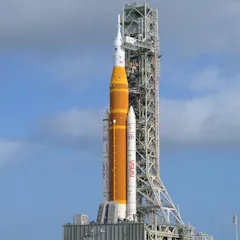
Worries were raised when the heat shield from a previous mission came back damaged.
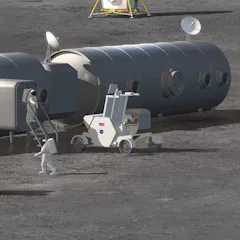
Changes to Nasa’s Moon exploration programme may include a base on the lunar surface.
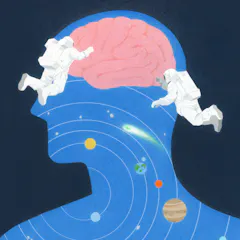
These changes aren’t permanent – the brain goes gradually back to normal after coming back to Earth. Understanding the physical effects of spaceflight helps plan space missions.
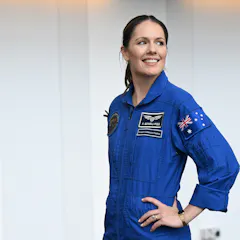
The 41-year-old from South Australia is the first Australian to qualify as an astronaut under the country’s national space program.
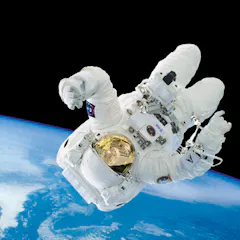
Spaceflight rewires the human body. Muscles shrink, bones thin and fluids shift towards the brain – but these changes may help improve life on Earth.
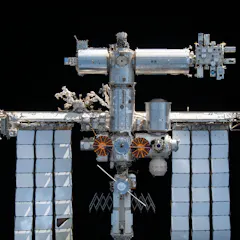
Archaeologists have studied how astronauts use the International Space Station to improve its potential future successors.

Astronauts generally can’t look out the window like you might in a car – a ‘virtual window’ could instead serve that purpose.
Top contributors
-

Postdoctoral research associate, University of Oxford
-
Senior Lecturer in Physics, Nottingham Trent University
-
Professor of Aerospace Medicine and Rehabilitation, Northumbria University, Newcastle
-
Professor of Planetary and Space Sciences, The Open University
-
Associate Professor in Archaeology and Space Studies, Flinders University
-
Professor, School of Engineering and Technology, CQUniversity Australia
-
Senior Lecturer, Department of Psychological Sciences, Birkbeck, University of London
-
Kevin Orrman-Rossiter is a Friend of The Conversation.
Sterrenkenner, History & Philosophy of Science, The University of Melbourne
-
Professor of Strategy and Security Studies, Air University
-
Professor in Earth and Planetary Science, Western University
-
Chercheur affilié à l'Observatoire international sur les impacts sociétaux de l’intelligence artificielle et du numérique (OBVIA), Université Laval
-
Lecturer in Astronomy, Nottingham Trent University
-
Research Fellow/Reader in Planetary Physics, Lancaster University
-
Associate Professor of Sport Science and Human Performance and Strategic Lead for Knowledge Exchange, Faculty of Sport, Health and Social Sciences, Southampton Solent University
-
Visiting Researcher at the Centre of Human and Aerospace Physiological Sciences, King's College London