
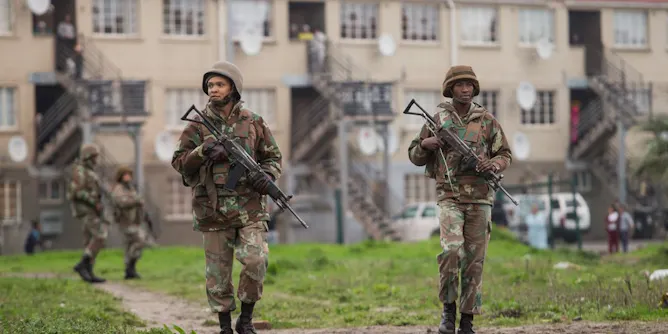
Successes by the army and police on the Cape Flats will depend entirely on levels of cooperation established on an ad hoc basis.
Articles on South African police
Displaying 21 - 40 of 55 articles
The biggest problem with using the military to fight rime is that soldiers are not trained for law enforcement, but warfare, using maximum force.
The law aimed at fighting gangs lacks the power to disrupt their activities.
South African voters are worried about how their country is being run. Most still support the ANC but in far fewer numbers.
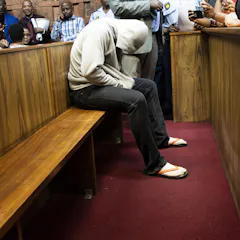
Social media presents new challenges in sensitive cases but media houses must stick to the law.
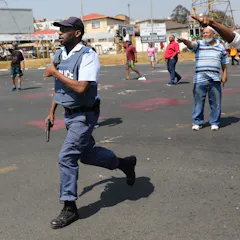
Data from victim and crime perception surveys help make sense of South Africa’s crime statistics.
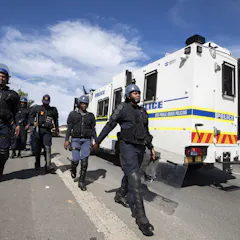
Increasing police patrols won’t solve South Africa’s high rates of violent crime. Underlying problems need to be addressed.
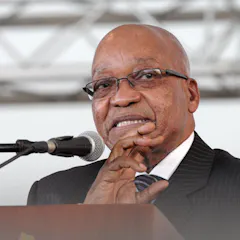
The axing of the prosecutions head follows sweeping changes to other king positions in the security cluster by President Cyril Ramaphosa.
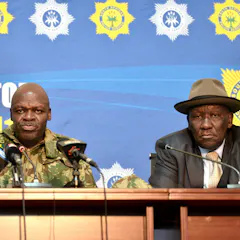
More than 90% of violent crimes in South Africa fall outside the categories named in the police’s new anti-crime strategy.

Poor leadership in crime intelligence and a struggling detective service are affecting the ability of South Africa - where a murder happens every 28 minutes - to bring down crime.
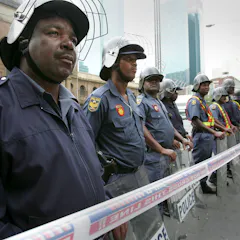
While many South African police officers, who were born into poverty, grew to appreciate the job, they want more for their children - careers requiring degrees - and work to provide them.
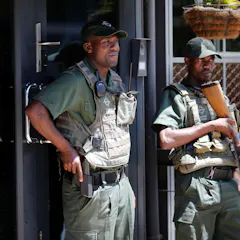
The future of private security is beset by many challenges and what forms of regulation would be required to align it with the public interest.
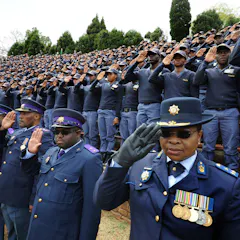
Born and raised in poor circumstances, many South African police officers find themselves in the job after original aspirations slipped beyond reach.
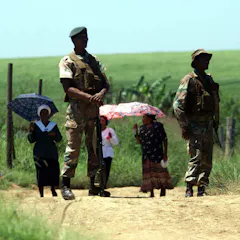
The military is not tactically trained for community protection and crime fighting and South Africa should not deploy soldiers in urban communities.
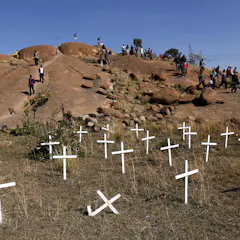
Five years on, no-one has been held to account for the Marikana massacre where 34 miners were shot dead by members of the South African Police Service in a single day.

If South Africa’s argument in court is that marijuana causes harm, it deserves to lose. The real question it should ask is whether criminal prohibition is the effective way forward.
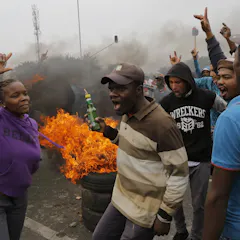
Protests in South Africa are about more than just service delivery of basic services such as water and electricity. They reflect a wider crisis about the failure to build a more equitable society.
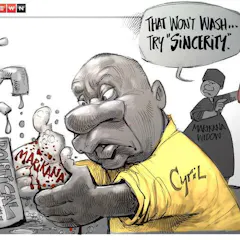
South African Deputy President Cyril Ramaphosa’s apology for his role in the 2012 Marikana massacre has no credibility, as there wasn’t full disclosure.

Notorious apartheid spy Craig Williamson’s sole interest was in reproducing what he regarded as his birthright – wealth and racial privilege.
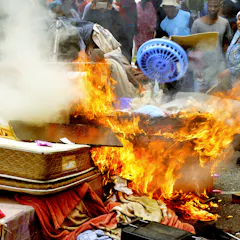
Vigilantism challenges the formal boundary between crime and punishment, between law and justice. But its largely been overlooked as a legal topic worthy of in-depth consideration.
Top contributors
-

Research Associate at UCT's Centre of Criminology, Consultant at the Institute for Security Studies (ISS), University of Cape Town
-
Senior researcher, University of Cape Town
-
Criminologist / Senior Lecturer, Stellenbosch University
-
Lecturer in Political Science, Nelson Mandela University
-
Co-Director of the Wits-Oxford Mobility Governance Lab, University of the Witwatersrand
-
Professor of Sociology in the Department of Sociology and Social Anthropology., Stellenbosch University
-
Researcher, University of the Witwatersrand
-
Professor of Digital Society, University of Glasgow
-
PhD, University of Cape Town
-
Professor in Political Science, University of South Africa
-
Associate Professor Julie Berg and Director, Institute for Safety Governance and Criminology, University of Cape Town
-
Senior lecturer, University of Edinburgh
-
Director of the Centre of Criminology, University of Cape Town
-
Professor of Political Science, Department of Political Studies and Governance, University of the Free State
-
Senior Research Fellow, Centre for the Advancement of Scholarship, University of Pretoria., University of Pretoria