

Sharing data openly across regions and organisations can help to accelerate preparedness and responses to public health emergencies.
Articles on Public health crisis
Displaying 21 - 36 of 36 articles
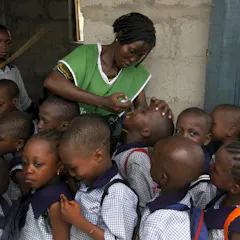
The global target to eradicate polio is being missed because a number of countries are struggling to reach high vaccine coverage.

Childhood adversity doesn’t just affect our choices – according to new research, it also weakens the body’s fundamental ability to stay healthy in old age.

Opioids kill an average of eight people every day in Canada. The federal government must officially declare this a ‘public welfare emergency’ and invest the funds critical to a humane response.
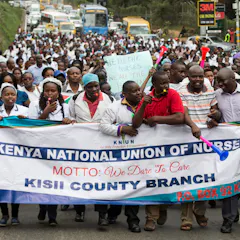
A strike by Kenyan nurses points to the country’s failure to manage the devolution of responsibility for health care from national to county governments.
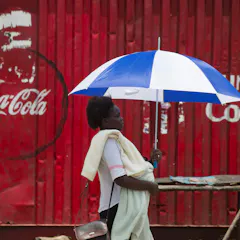
Unhealthy food corporations use various tactics to undermine public health policies aimed at tackling the scourge of non-communicable diseases like diabetes and obesity.
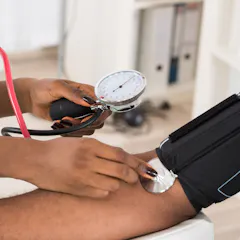
Although hypertension can easily be detected in Africa, up to half of the population are unaware of their condition.

Without leading edge innovations and coordination, Canadians will die from the epidemic of antibiotic resistant infections.

The power to overcoming Ebola was in public awareness by performing simple yet basic infection prevention and control measures like washing hands, isolation and reporting suspected cases.
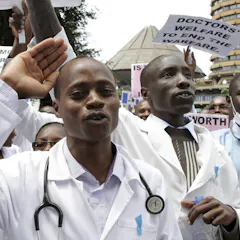
Kenya’s doctors embarked on a strike for a 100 days to push the government to implement a collective bargaining agreement signed in June 2013.

Cholera is estimated to infect between 3 to 5 million people globally, every year.
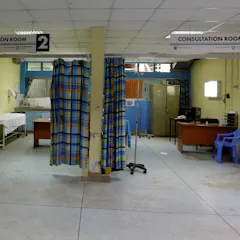
The striking doctors in Kenya have vowed not to resume work until the government meets their demands.

Even after 26 children and teachers were killed four years ago today at Sandy Hook, more mass shootings by disturbed white men and boys have occurred. Ignoring this crisis has severe consequences.

Cataract blindness continues to affects tens of millions of people because they cannot access proper care.

Despite ongoing efforts, achieving gender equality struggles because it is ignored or compartmentalised rather than interwoven throughout.
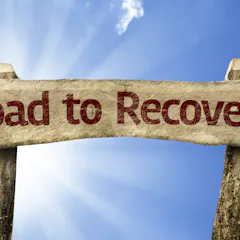
Teen drug abuse is a real problem with 46% of high school students hooked on some addictive substance. Recovery high schools are offering a new model of treatment.
Top contributors
-

Tutorial Fellow, School of Medicine, University of Nairobi, University of Nairobi
-
Researcher, consultant, lecturing professor, Drake University
-
Research Scientist, African Population and Health Research Center
-
Ophthalmologist at the School of Medicine, Aix-Marseille Université (AMU)
-
Lecturer, Mercer University
-
Professor of Microbiology and Immunology, University of British Columbia
-
Head of Education and Human Resources Programs at American Association for the Advancement of Science (AAAS); Trustee, California Institute of Technology
-
Medical Epidemiologist , Washington State University
-
Professor of Physical Activity and Public Health Science, University of Strathclyde
-
Research Manager at MRC/Wits Agincourt Research Unit, University of the Witwatersrand
-
Professor in the faculty of Medicine, Mbarara University of Science and Technology
-
Associate Professor & Director of Criminology, Le Moyne College
-
Research Director FNRS Director, Centre d’Etude et des Migrations (CEDEM) Directeur de l'IRSS,Faculté des Sciences Sociales, Université de Liège, Université de Liège
-
Associate Professor of Sociology, Kansas State University
-
Professor of Biochemistry and Biomedical Sciences, McMaster University