
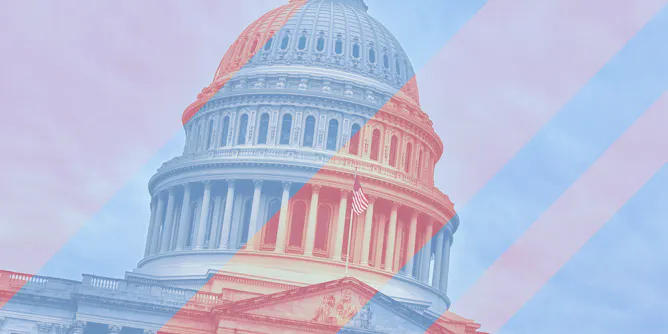
With massive Democratic majorities poised to enter the 120th Congress, did Republican attempts to gerrymander actually end up costing them some seats in the US House? The answer is complicated.
Articles on Partisanship
Displaying 1 - 20 of 103 articles
Surprising midterm elections that create new majorities on Capitol Hill look to be revolutions in the days after they occur. Years later, they often appear to be more complex – and less significant.
Money or other material benefits are often not enough to override a voter’s preferences and partisanship.

Vowels have become the latest players in partisan politics, a barometer of how beliefs and values fit within the old vs. new South.
What role might DSA-affiliated candidates play if they win election to Congress in the midterms and the Democrats gain a majority in the House of Representatives?
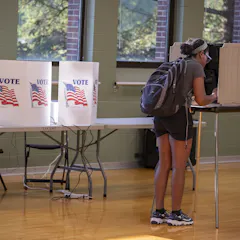
Despite their high confidence overall, almost half of surveyed election officials worried about the cost of running elections.

Why would a young Republican back solar but reject a carbon tax? Twenty years of survey data shows climate opinion is more complex than party labels suggest.
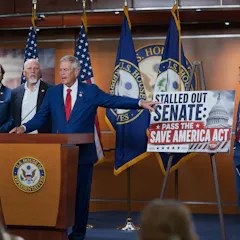
Republicans hold both chambers and publicly back the president’s signature bill that would curtail mail-in voting and enforce strict voter ID laws. Here, a public policy and politics scholar explains why it still isn’t law.

Partisan debates are less heated at the local level, providing lessons that might help calm the waters nationally.

Although she’s the world’s reigning pop star, attitudes toward Swift are split markedly along both partisan and gender lines.
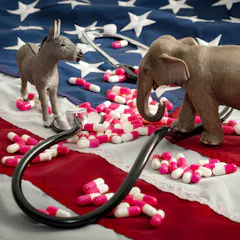
Why does health care reform keep failing despite decades of attention and expanding costs? A scholar of Congress has some answers.
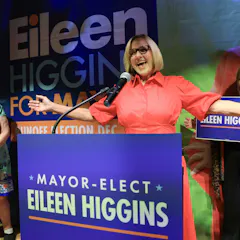
Eileen Higgins won a hard-fought election to become Miami’s new mayor. Now for the hard part – governing the city.

Message discipline is an increasing feature of Canadian politics. Canadians across the country should pay attention to what just happened in Alberta, where teachers were ordered back to work.

The public’s frustration with ‘politics as usual’ has led more political newcomers to win office. But amateurs are more likely to view bipartisanship as a concession, not a tool for advancing policy.
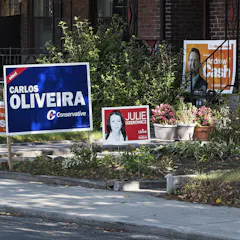
For now, the Canadian polarization story is one of caution, not crisis. Our political differences are real, but haven’t yet deeply divided us.

Tim Berners-Lee, the man who gave us the world wide web, dreamt the technology would unite us. But something went really wrong with the rise of social media.
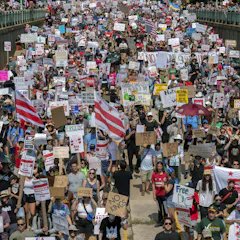
Anger at the other side, as represented by the political party opposing yours, is a powerful motivator to engage in protests.

Trying to change someone’s mind can seem futile. But there are approaches to political discourse that still matter, even if they don’t instantly win someone over.
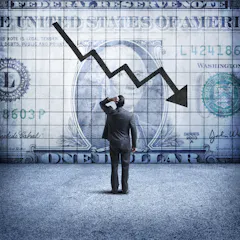
Partisan bias doesn’t stop with voters. When Republicans hold the White House, Republican economists consistently overshoot on growth forecasts.
President George Washington warned in his 1796 Farewell Address about dangers that lay ahead for the US – warnings that seem startlingly contemporary and relevant 229 years later.
Top contributors
-

Associate Professor of Political Science, Boise State University
-
W. Alton Jones Professor of Philosophy, Vanderbilt University
-
Assistant Professor of Public Policy and Politics, University of Virginia
-
Professor and Co-Director of the Center for an Independent and Sustainable Democracy; School of Public Affairs, Arizona State University
-
Associate Professor of Political Science, Park University
-
Senior Fellow, Miller Center, University of Virginia
-
Associate Professor of Political Science, University of Maryland, Baltimore County
-
Assistant Professor of Political Science, Indiana University
-
Lecturer, Political Science and International Studies, University of Birmingham
-
Professor of Communication and Journalism, University of Maine
-
Assistant Professor of Journalism and Media Innovation, Northeastern University
-
Assistant Professor, Department of Communication, University of Minnesota Duluth
-
Cornelius Vanderbilt Professor of Political Science and Director of LAPOP, Vanderbilt University
-
Distinguished McKnight University Professor and Professor of Political Science, University of Minnesota
-
Doctoral Student, Political Science, Vanderbilt University