
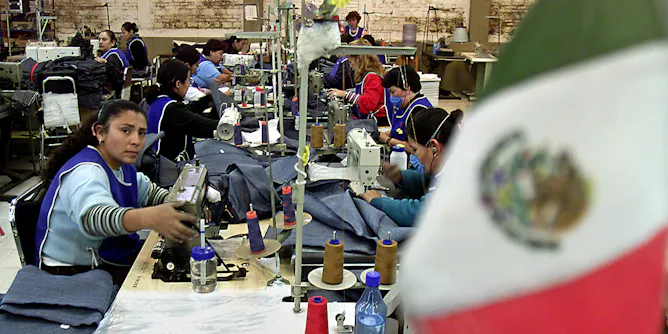
Trump has attacked NAFTA, saying that cheap, under-regulated Mexican labor hurts American workers. If he’s right, then NAFTA negotiations could be a chance to push Mexico on workers’ rights.
Articles on North American Free Trade Agreement (NAFTA)
Displaying 81 - 100 of 120 articles

Any number of implicit and explicit deadlines make 2018 look like a more eventful year than most.
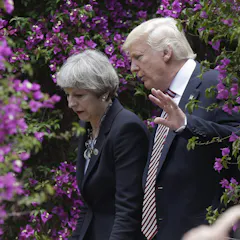
Donald Trump views himself as a deal-maker, so the prospect of a “quick” trade deal between the U.K. and the U.S. seems unlikely, despite the American president’s earlier optimism.

American lawmakers in the 1930s learned the hard way what happens when a country raises tariffs and makes other unilateral trade decisions.
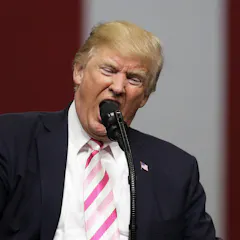
Precisely because of his problems at home, Donald Trump wants to do more abroad – possibly with disastrous results. How can those who know foreign policy rein him in?
There’s been a lot of rhetoric in the air about the fate of NAFTA, especially from the U.S. president. But its demise is extremely unlikely.
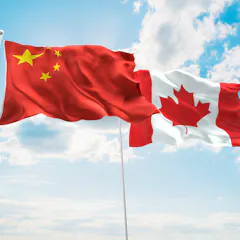
Never mind NAFTA – Canada’s quiet efforts to boost trade with China should be ringing alarm bells given Chinese human rights abuses, and raises questions about whether Beijing has demanded secrecy.

As the Trump team begins renegotiating NAFTA with Canada and Mexico, a key plank in its strategy – a threat to withdraw – may be a hollow one.
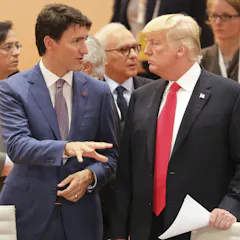
The US wants rid of NAFTA’s dispute settlement mechanism but for Canada it’s a red line issue.
Mexico has traditionally been NAFTA’s biggest loser. But Canada is at risk if the U.S. gets its way in removing a dispute settlement mechanism from the deal in the upcoming NAFTA renegotiations.

Lobster used to be a poor man’s meal. Now it’s the darling of foodies, and Canada’s lobster producers are poised to cash in on sales to the European Union thanks to CETA.

The administration’s objectives for NAFTA negotiations with Canada and Mexico, set to begin in August, will do little to help American workers, let alone create shared prosperity across the continent.
The Trump administration has outlined its plans to renegotiate the North American Free Trade Agreement (NAFTA).

NAFTA renegotiations may see provisions from the Trans-Pacific Partnership revive like zombies. We must remember their failures - on income inequality, labour and environmental protection.
A fundamental insight into the distributive effects of free trade from almost 90 years ago.
The Trump administration’s new deal with China, which won’t benefit many workers, shows the pitfalls of pursuing bilateral agreements at the expense of multilateral ones like NAFTA.
In a changing and unsettled world, migration can be a greater-than-ever contributor to development for communities of origin, destination areas, and for the migrants themselves.

President Trump wants to renegotiate or eliminate NAFTA because of its impact on U.S. trade, but the accord is also a cornerstone of continental cooperation on security issues as well.
There’s ample space to renegotiate some terms from the original agreement that would improve social welfare across the region.

If the United States withdraws from or significantly alters NAFTA, Mexico has more options than it thinks — and potentially less to lose than its northern neighbour.
Top contributors
-

Associate Professor of Political Science, Brock University
-
Associate Professor of Agri-Food Trade and Policy, University of Guelph
-
Director, Agri-Food Analytics Lab, Professor in Food Distribution and Policy, Dalhousie University
-
Associate Professor of Political Science, Georgia State University
-
Executive Fellow, School of Public Policy; Distinguished Fellow, Asia Pacific Foundation of Canada, University of Calgary
-
Professor and Distinguished Research Chair, Globalization and Health Equity, L’Université d’Ottawa/University of Ottawa
-
Assistant Professor of Economics, University of California, Merced
-
Senior Lecturer in Human Rights, Constitutional Law and Legal Theory, University of Wollongong
-
Canada Research Chair in Economy and Environment, Queen's University, Ontario
-
School of Social Sciences, Monash University
-
Lecturer in History, University of Exeter
-
Associate Professor of Political Science, Virginia Commonwealth University
-
Associate Professor of Agricultural Economics, Colorado State University
-
Associate Professor of Political Science, West Virginia University
-
FedEx Research Professor of Law, Vanderbilt University