
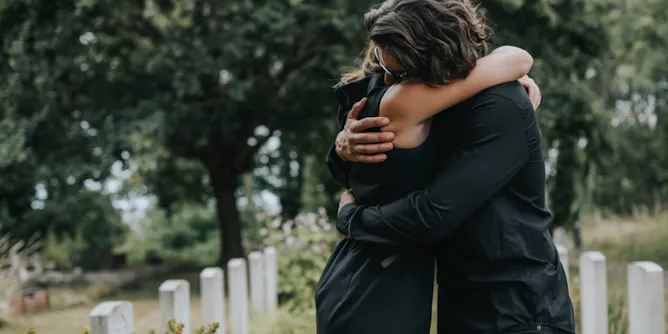
We have also lost moments of shared empathy – a space for others to see people who are travelling the same path.
Articles on Loss
Displaying 21 - 40 of 44 articles
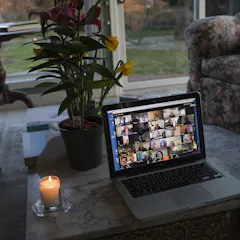
A scholar conducted over 70 hours of interviews with people involved in the medical and funerary professions to understand the impact of changes in death rituals during the pandemic.

Writing can help work through some of the emotions and boost wellbeing.

Behind the statistics are real people with real life stories of illness, death, disruption, sorrow and even despair.

Over 130 hours of conversations with older people reveal the truth of what it’s like to get old and how to cope with loneliness.

We are living through a one-in-one hundred year event. We are all doing the best we can. And that’s not only OK, it’s enough.
The negative impact of the pandemic on grief has raised concerns. Our study shows that 15 per cent of people dealing with grief are at risk of what’s known as complicated grief.

COVID-19 has impacted an important moment in many people’s lives: grieving the loss of a loved one. Here are some things that can help if you’re far away.

On Father’s Day, a scholar of ancient Greek poetry explains how he came to understand the father-son relationship and his journey of loss and yearning through reading the epics.
The Canadian government needs to develop a national grief strategy to address the needs of its citizens during and after the pandemic.

The testimonies of bereavement counsellors reveals devastatingly lonely experiences of grief, unexpected feelings of loss and even some silver linings.

On Nov. 7, when President-elect Joe Biden urged in his address that we “give each other a chance,” his words summoned Abraham Lincoln’s second inaugural address of 1865.

Families who lost their loved ones during the pandemic could not even properly grieve. Greek epics show why lamentation and memorial are so important and what we can learn in these times.

Even those of us spared the worst of COVID-19 are missing our favorite pastimes, places and people. But pleasure can also take unexpected new forms in a pandemic.

Grief encompasses our emotional responses to change and loss, and children’s grief might be expressed in what psychiatrist Elisabeth Kübler-Ross described as the five common stages of grief.

Whether we miss them, feel guilty about not having appreciated them more or struggle to forgive them, remembering our parents can hurt. Here’s how to move on.
We like to think there’s a silver lining to tragedy – and this may be influencing both how studies on post-traumatic growth are constructed and how subjects are responding.

We need to learn how to rebuild from loss, failure, or defeat in life, and that can also help in sport.

It’s hard to know where to start. But using the right language can help.
After acts of violence, we want to make sense of what is right and wrong and where we stand in the world. But we must ensure our belief systems are periodically and systematically checked.
Top contributors
-

Honorary Research Fellow, Director of Bereavement Services Counselling & Mental Health Clinic, York St John University
-
Professor of Classical Studies, Brandeis University
-
Associate Head of Early Childhood Studies, University of Guelph-Humber
-
Professor, Social Work, University of Waterloo
-
Professor of English Language and Applied Linguistics, University of Birmingham
-
Professor, English and Folklore Studies, University of Oregon
-
Senior Lecturer in English , University of Birmingham
-
Professor, Humanities and Social Sciences, Université du Québec à Chicoutimi (UQAC)
-
Researcher, Swinburne University of Technology
-
Associate Professor, Faculty of Dentistry, McGill University
-
Instructor (Grief Education Program), Therapist, Social Worker, Consultant, University of Toronto
-
Adjunct professor, Carleton University
-
Associate Professor of Philosophy and Asian/Asian American Studies, University of Connecticut
-
Associate Professor of Marketing, Loyola University Chicago
-
Chancellor's Professor of Medicine, Liberal Arts, and Philanthropy, Indiana University