
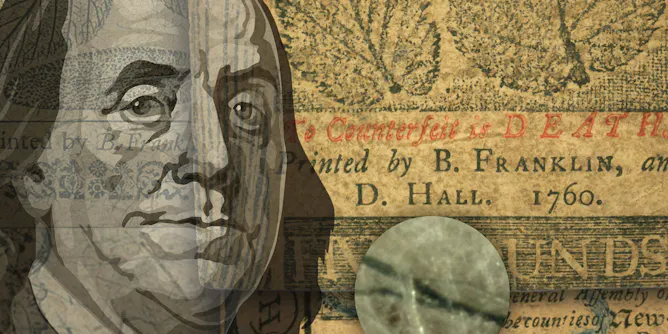
Ben Franklin led an effort to print paper bills in the American colonies, after a coin shortage constrained the economy.
Articles on Economic History
Displaying 1 - 20 of 52 articles

Today’s basic income proponents say cash payments would be good for everyone. In the 1790s, the idea’s inventor argued something else: It was owed to everyone.

Centuries of management practice were built on cruelty and exploitation. But history also offers a countercurrent – leaders who chose care, fairness and conscience.
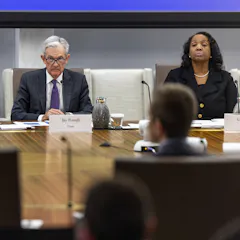
Political economist Cristina Bodea talks to The Conversation Weekly podcast about how central bank independence became the global norm for economic governance.

As the US imposes more tariffs, a global backlash is brewing – from subtle trade barriers to strategic countermeasures targeting red-state industries.

Black brands and consumers alike are struggling to prove the value of Black dollars.

Did Bronze Age Europe have a market economy? New research suggests “hoard piles” could be linked to the exchange of small pieces of metal – much like money changes hands today.

Forty years of the neoliberal experiment have created a world of vast and increasing inequality. But this can and should change.

As of 2022, only Nigeria and Sudan had lower trade-to-GDP ratios.
The Shortest History of Economics is not just a history of economic thought, but a history of economic life.
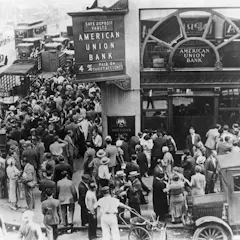
Crises fueled by bank runs, starting with the Great Depression, have had something in common: Unexpected changes spur bank failures, followed by general panic and then large-scale economic distress.
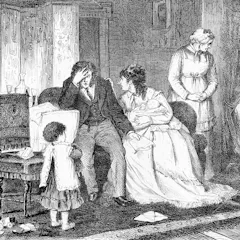
New rules following a spate of bank failures in 19th century Britain could provide some lessons for today’s regulators.
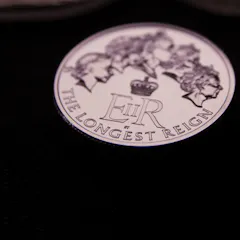
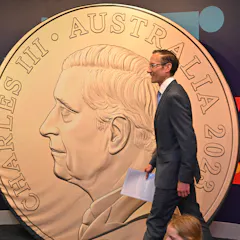
From the 1870s on, continual improvements in living standards became a birthright – not for everyone, but for humanity as a whole. King Charles III inherits a different future.
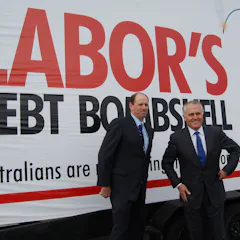
The double standard goes back to 1929, when Labor had the misfortune to be elected 12 days before the Wall Street crash that set off the Great Depression.

Britain’s economic system is built on inequality. Few governments have attempted to rectify this.

The story of how money injections became the go-to policy for tackling economic crises.
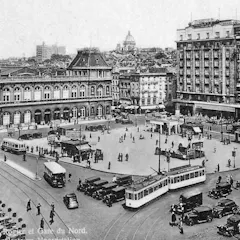
the International Financial Conference in Brussels in 1920 hoped to reset the global economic order after a disastrous world war and pandemic. It hold lessons for leaders today.

Economic historian and development scholar Bill Freund was impatient with theoretical fads.
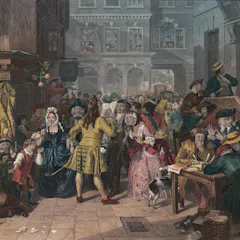
The real story of the South Sea Bubble and what happened when it burst 300 years ago.
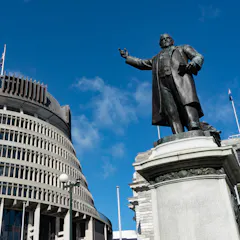
New Zealand’s 2020 budget must not only provide economic hope, it must balance the very different ideologies and aspirations of two earlier historic budgets.
Top contributors
-

Adjunct Professor, Business School, University of Technology Sydney
-
Professor, Department of Economics, Stellenbosch University
-
Professor of International Relations, Australian National University
-
Professor of Economics, University of Warwick
-
Chair in the History of Finance and Associate Pro-Vice-Chancellor Research, Prosperity and Resilience, Henley Business School, University of Reading
-
Senior Teaching Fellow, Management Science & Innovation, UCL
-
Departmental Lecturer in Egyptology and Coptic, University of Oxford
-
Adjunct Professor, Australia-China Relations Institute, University of Technology Sydney
-
Professor of Early Modern History, King's College London
-
Senior Professor of Economic and Business History, University of Wollongong
-
Professor of Economics, School of Economics & Finance, Curtin University
-
Professor of Finance, University of Liverpool
-
Researcher for the Food Research Collaboration, City St George's, University of London
-
Visiting Fellow, Crawford School of Public Policy, Australian National University
-
Director, Gender and Women's History Research Centre, Australian Catholic University