
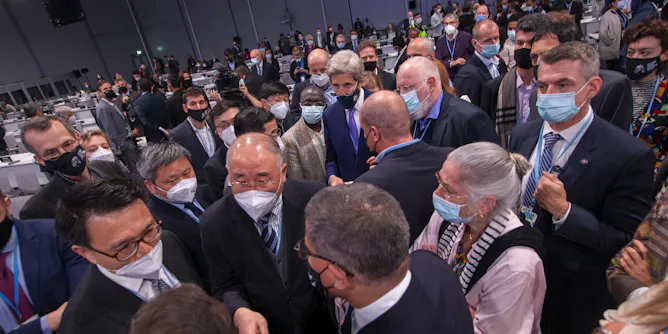
COP26 saw incremental progress but not the breakthrough moment needed.
Articles on 1.5 degrees
Displaying 41 - 60 of 79 articles
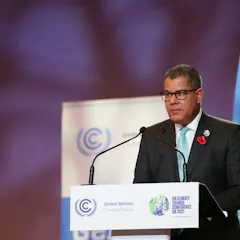
In Paris, the French drafted ambitious texts and dared the biggest emitters to oppose it. In Glasgow, it’s the least developed countries which will have to do the most work.
Heading into the final days of the Glasgow summit, the goal of limiting heating below 2°C looks attainable, and 1.5°C is still within reach. There is still room for hope.

Reducing jet fuel consumption by 2.5% each year could halt aviation’s growing influence on climate change.
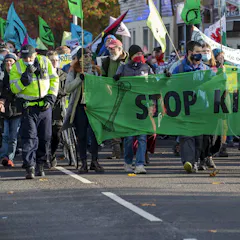
Week one in Glasgow has delivered more climate action than the world promised in Paris six years ago. But progress still falls well short of what’s required to limit warming to 1.5°C.
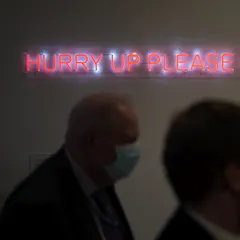
The clock tracks global emissions and temperature data, and uses the most recent five-year emissions trend to estimate how much time is left until global warming reaches the 1.5 C threshold.

Most concerning is the long-term upward trends of CO₂ emissions form burning fossil fuels, which are far from trending towards net-zero by 2050.
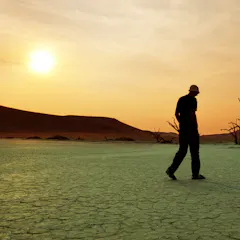
Many scientists now think 3°C of warming is likely.
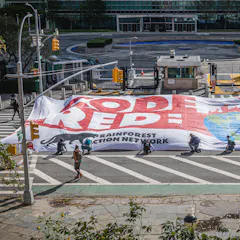
Pacific nations look to New Zealand for climate leadership. It has enshrined carbon neutrality by 2050 and a 1.5°C target in law, but, so far, emissions have continued to rise.

China and the US could supercharge global climate action. But if they fail to cooperate, there will be dire consequences for all.
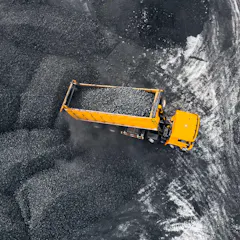
Our new study reveals how tight the world’s remaining carbon budget is.

IPCC authors go beyond the headlines to explain how 1.5°C warming is measured – and why there’s still reason to hope, and act, if Earth exceeds that limit.
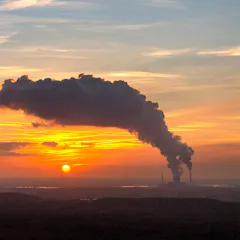
Our team of 40 researchers combined natural and social sciences to assess the plausible limits of future climate change.
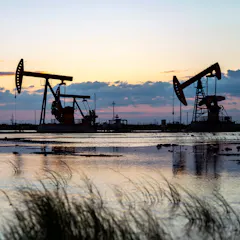
The seismic changes to energy supply and demand during the pandemic could be just the beginning.
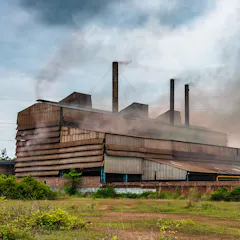
Countries cannot be expected to all tread the same path to net zero emissions.
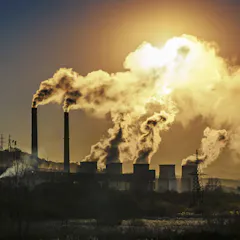
Humanity can still limit global warming to 1.5°C this century. But political action will determine whether it actually does. Conflating the two questions amounts to dangerous, misplaced punditry.
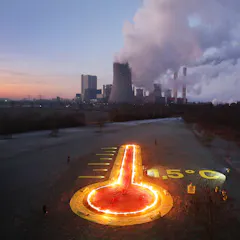
Discord and doubt are the last things the world needs at this critical moment.
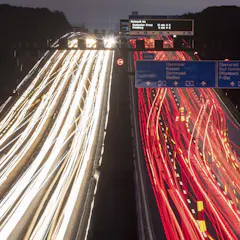
Several countries have made pledges to reduce their greenhouse gas emissions to zero by mid-century. But new research finds the remaining carbon budget will be depleted before we get there.
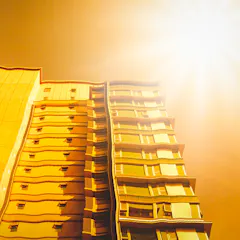
Climate models are likely underestimating the true severity of future warming in urban areas.

Our new study shows that cutting emissions now will bring benefits sooner than expected.
Top contributors
-

Professor of Physical Climate Change; Director of the Priestley Centre for Climate Futures, University of Leeds
-
Adjunct Professor of Energy, Murdoch University
-
Chief Research Scientist, CSIRO Environment; Executive Director, Global Carbon Project, CSIRO
-
ARC Future Fellow and Associate Professor in Climate Science, ARC Centre of Excellence for 21st Century Weather, The University of Melbourne
-
Professor of Energy Systems, UCL
-
Professor and Climate Scientist, Department of Geography, Planning and Environment, Concordia University
-
Senior Researcher, Center for International Climate and Environment Research - Oslo
-
Professor of Earth System Science, UCL
-
Research Group Leader, International Institute for Applied Systems Analysis (IIASA)
-
Professor of Infrastructure Engineering and International Development, UCL
-
climate campaigner
-
Researcher in Earth System Resilience, University of Sussex
-
Associate Professor of Law, University of Waikato
-
Director of Research and Lecturer - Grantham Institute Climate Change & the Environment, Imperial College London
-
Lecturer in International Development, UCL