

Cyber abuse between intimate partners is common and devastating – there needs to be a greater focus on holding perpetrators to account.
Western Sydney University

Western Sydney University prides itself on challenging the traditional notion of what a university should be. We are deeply embedded in the community and the region we serve – Australia’s fastest growing economy.
Ranked in all major global rankings systems, we are delighted to be ranked the world’s best in the 2022 Times Higher Education (THE) University Impact Rankings.
Assessing universities on their commitment to the UN’s Sustainable Development Goals, Western Sydney University topped the list out of more than 1,400 universities for our work tackling issues like sustainability, climate action, equality, inclusivity and social justice.
Western Sydney University is also a research leader – the result of focused investment in its research strengths and facilities. We see learning and research as connected aspects of the student experience. We work with regional, national and international partners to deliver research that has a positive impact on the economic, social and environmental well-being of our communities.
With a modern outlook, the University has an agile and contemporary take on traditional higher education offerings, affording students, both international and Australian-based, significant advantages and unique opportunities.
Links
Articles

We now value the house as a wealth builder, not just a place to live in and raise a family. The result is a distorted investment market that makes home ownership and rental unaffordable.

Our need for unbiased, well-researched information has never been greater.

How do we know what we think we know? Accuracy, care and rigorous method gets us somewhere there, especially on issues like racism.

Young women are are confident in implementing budgeting and savings strategies, but lack the knowledge and confidence required to implement long-term financial strategies, a new pilot study finds.

Strategies that exploit what our online data trails reveal about us can be used to fool us into thinking our desires will be met. Brexit and Trump show us how politics at the margins can be played.

Pour les enfants bilingues, le fait de passer d’une langue à l’autre est un formidable exercice pour le cerveau et les oreilles.

Foxtel’s high-priced oligopolistic control over Australian pay TV has again clashed with the demands of sport fans and the increasingly sophisticated capture and relay technologies available to them.

Examining our sporting heroes reveals much about ideas of national identity and who is accepted.

Politics is a world for which show business celebrities are perfectly adapted and their predominance in the Philippines offers a glimpse of what televisual populism could look like in other countries.

Dallas Rogers speaks with Nicole Cook about how union 'green bans' in the 1970s stopped the redevelopment of working-class suburbs in Sydney.

From photoshopped images, to fake eye-witness accounts, to a real-life attempted murder, the Slenderman is the internet’s urban myth.

There is much work to do if Australia is to eradicate various barriers to participation in sport.

VR cinema explodes the frame, placing the spectator inside the space of the film. Audiences effectively edit it themselves, by choosing what to look at and when.

Many parents love sharing photos of their children on social media. But they should stop and think about how it might affect their children, now and in the future.

The latest survey of residents in coal seam gas regions reveals continuing lukewarm attitudes towards the industry.

Diabetes is on the rise and one of its most common complications is Diabetes-Related Foot Disease (DFRD). DFRD is difficult to treat but simple preventive strategies do exist.
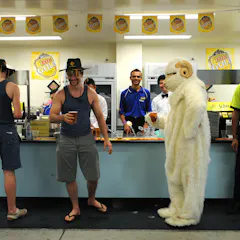
Overpriced and low-quality beer at sports stadiums leaves fans feeling exploited. Here’s how that can change.

It’s almost impossible for any human to spot something unknown or unusual in the massive amount of data collected by our telescopes. So we’re teaching an intelligent machine to search the data for us.

Employees who ‘cut corners’ at work tend to be morally compromised, low in conscientiousness, self-focused and impulsive.
Authors
-

Associate Professor in Public Health, School of Medicine, Western Sydney University
-
PhD Candidate, School of Medicine, Western Sydney University
-
Senior Lecturer in Law and Emerging Technologies, Western Sydney University
-
Associate professor accounting, Western Sydney University
-
Emeritus Professor of Cultural Research, Institute for Culture and Society, Western Sydney University
-
Researcher, Digital Wellbeing, Western Sydney University
-
Senior Lecturer in Physics, Western Sydney University
-
Senior Lecturer, School of Business, Western Sydney University
-
Professor, Western Sydney University
-
Professor of Planning and Director of Urban Transformations Research Centre, Western Sydney University
-
Associate Professor in Nursing and Midwifery, Western Sydney University
-
Adjunct Fellow, Humanitarian and Development Research Initiative, Western Sydney University
-
Senior Lecturer in Microbiology, Western Sydney University
-
Emeritus Professor, Institute for Culture and Society, Western Sydney University
-
Senior Research Fellow, Urban Transformations Research Centre, Western Sydney University