

The independent review of the Reserve Bank should be headed by someone from outside the country say 12 leading economists in an open letter to the treasurer.
The University of Melbourne

The University of Melbourne is a global leader in higher education. Across our campuses we convene brilliant minds from different disciplines and sectors to come together to address important questions and tackle grand challenges. In a disrupted world, that capacity has never been more important.
Our vision is to equip our students with a distinctive, future-facing education personalised around their ambitions and needs, enriched by global perspectives and embedded in a richly collaborative research culture. As active citizens and future leaders, our students represent our greatest contribution to the world, and are at the heart of everything we do.
We serve society by engaging with our communities and ensuring education and research are inspired from the outset by need and for the benefit of society, while remaining committed to allowing academic freedom to flourish. In this, we remain true to our purpose and fulfil our mission as a public-spirited organisation, dedicated to the principles of fairness, equality and excellence in everything we do.
We strive for an environment that is inclusive and celebrates diversity.
Beyond our campuses we imagine an Australia that is ambitious, forward thinking and increasing its reputation and influence globally. We are committed to playing a part in achieving this – building on our advantageous location in one of the world’s most exciting cities and across the state of Victoria, in a region rapidly becoming a hub for innovative education, research and collaboration.
Links
Articles

We can use AI to protect nature and human health. But first, we have to expand AI beyond being entirely human-centred.
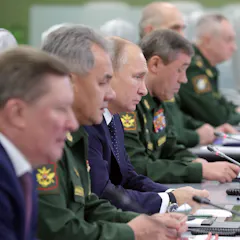
Russia’s botched invasion of Ukraine vividly demonstrates the real-world impacts of corruption, with Russian soldiers forced to eat rations years out of date while their leaders bought mega-yachts.
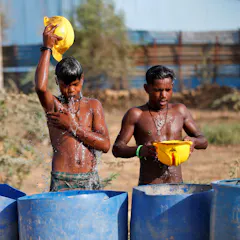
And after India banned wheat exports in May due to the high temperatures, we find out how vulnerable crops are to extreme heat. Listen to The Conversation Weekly podcast.

As cases continue to skyrocket in Australia, parents are understandably worried about what would happen if their baby got COVID.
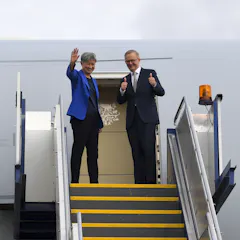
In the final episode of our election podcast, our regular panellists are joined by two expert guests to discuss what the election outcome could mean for domestic and foreign policy.
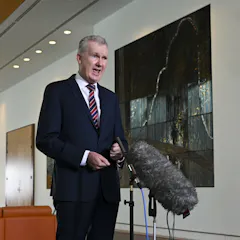
After holding the shadow portfolios, it is expected Tony Burke will be sworn in as minister for the arts and minister for industrial relations.
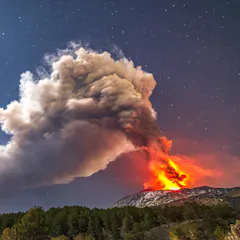
New modelling shows how tectonic plate movements, carbon-rich deep-sea sediment, and mountain weathering have regulated Earth’s climate.

Do we read crime novels because we know what is right and wrong, or for guidance through a world that appears ‘all grey’? The books of lawyer-turned-writer Dervla McTiernan prompt such questions.

In many countries, helpful background information and context is offered to audiences in the accompanying program – why are Australians missing out?

Our research shows the co-contribution scheme does little to help low and middle-income earners. The new Albanese government should consider discontinuing it – saving hundreds of millions of dollars.
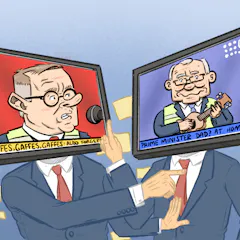
The major parties have come to control the way the media can cover election campaigns – leading to dress-up stunts and gotcha questions instead of meaningful journalism.

Technology businesses are already making computers with human matter.
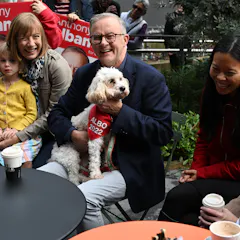
Below the Line Episode 12
The Conversation75.2 MB (download)
In this episode of Below the Line, we dissect the election result and how the media's "presidential–ised" coverage looks in light of it.

A patchwork of Roman laws (including Rome’s complex murder laws) sought to address coercive and violent behaviour

While Labor winning with a small primary vote might seem confusing, the answer is in the flow of preferences in the Australian electoral system.

Despite rising cases and deaths, governments are have not even raised the prospect of imposing some public health restrictions.
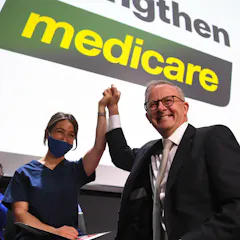
Primary care and COVID will be the top two challenges for new government. But the likely ministers have strong credentials.
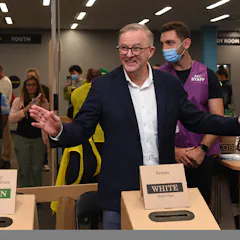
If Labor wins majority government, it can thank Western Australia, which turned away from the Coalition savagely.
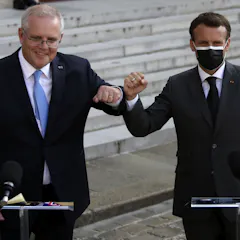
It all started to unravel for the prime minister when the French president accused him of lying to him.
Authors
-

Election Analyst (Psephologist) at The Conversation; and Honorary Associate, School of Mathematics and Statistics, The University of Melbourne
-
Guest Research Fellow, School of Computing and Information Systems, The University of Melbourne
-
Professor of Sociology of Law and Deviance, Università di Bologna; University of Essex; The University of Melbourne
-
McKenzie Research Fellow, The University of Melbourne
-
Research assistant, Movember Institute of Men's Health, The University of Melbourne
-
Senior Research Associate, School of Agriculture, Food and Ecosystem Sciences, The University of Melbourne
-
Paleontologist, The University of Melbourne
-
Senior Lecturer, Centre for Advancing Journalism, The University of Melbourne
-
Research Fellow, Centre for Youth Mental Health, The University of Melbourne
-
Deputy Vice-Chancellor (Global, Culture and Engagement), The University of Melbourne
-
Emeritus professor, History, The University of Melbourne
-
Professor of Health Economics, The University of Melbourne
-
Associate Professor and Head, Behavioural Neuropharmacology Laboratory, The University of Melbourne
-
Lecturer in History, The University of Melbourne
-
Associate Professor, Centre for Youth Mental Health, The University of Melbourne