
Plastic waste is everywhere in Southeast Asia. It flows through rivers, piles up along coastlines and gradually breaks down into microplastics that enter the ocean, ecosystems and even the food chain. According to a publication by the Economic Research Institute for ASEAN and East Asia (ERIA), 353 million tonnes of plastic waste are generated each year globally, and nearly one-third of it is mismanaged. In the ASEAN Plus Three region alone, plastic waste is projected to more than double, from 113 million tonnes in 2022 to 242 million tonnes by 2050. Without coordinated action across the entire plastic lifecycle, this growth will likely increase the amount of plastic spilling into our lands and oceans.
The scale of the problem is enormous. Scientists estimate that around 170 trillion microplastic particles are already floating in the world’s oceans. Studies also show that microplastics have entered human bodies and wildlife primarily through food, drinking water and the air we breathe. Southeast Asia contributes a significant share of global marine plastic pollution, driven by rapid urbanisation, rising consumption and uneven waste management systems. Addressing this crisis, therefore, requires fundamental changes, rather than just single policies. It demands coordinated action across the entire plastic lifecycle, from production to disposal, alongside strong partnerships among governments, regional institutions, the private sector, civil society and communities.
At the same time, the region holds an important opportunity. Young people across Southeast Asia are increasingly documenting environmental issues through writing, videos and social media. Research shows that Generation Z tends to respond more strongly to visible actions and peer influence than to lectures or instructions, while social media platforms such as Instagram significantly shape pro-environmental behaviour. With their high awareness of climate and environmental issues, and with the right skills and networks, young communicators have the potential to translate complex environmental challenges into stories that resonate with wider audiences.
What is the ASEAN Young Green Communicators programme?
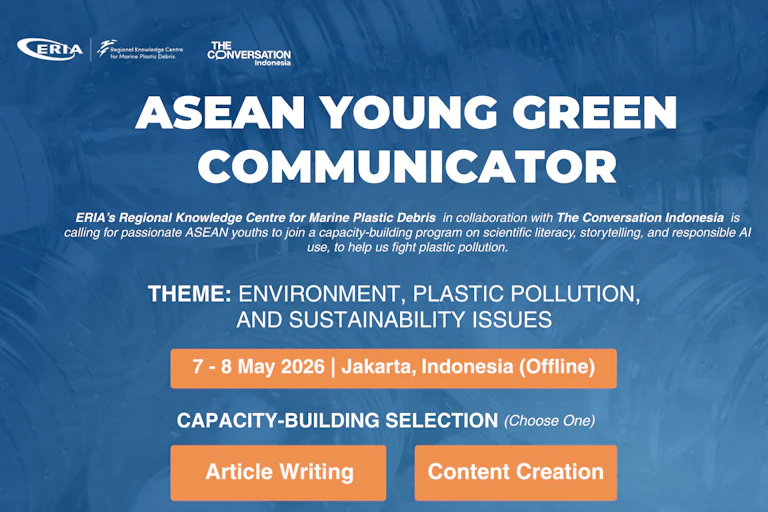
The ASEAN Young Green Communicators (AYGC) programme is a training initiative by ERIA in collaboration with The Conversation Indonesia. The programme will take place 7–8 May 2026 in Jakarta, bringing together young people from across Southeast Asia to learn science communication, storytelling and the responsible use of AI in environmental communication.
Over two days, participants will take part in in-depth learning sessions, article writing and content creation training, interactive discussions and hands-on practice. Around 12 to 18 participants will be selected. After the workshop, they will also collaborate on a communication project to amplify environmental stories across the region.
Turning knowledge into stories
The programme offers two learning pathways:
1. Article writing
Participants will learn how to develop evidence-based environmental stories with strong angles and clear narratives. To apply, submit a recent article or a draft article you would like to develop during the training.
2. Content creation
Participants will explore visual storytelling through formats such as short videos, digital storytelling or social media content. To apply, create new content, upload it to your social media, and submit it as part of the selection.
Applicants should choose one pathway when applying.
Who can join the programme?
The programme is open to young people across Southeast Asia who are interested in environmental storytelling. You are eligible if you:
- are 20–25 years old
- are a citizen of an ASEAN country
- have working proficiency in English
- are available to attend the full offline workshop in Jakarta
Writers, content creators, students, young researchers and storytellers are all encouraged to apply. For full details, please refer to the ToR and FAQ here .
What will you gain?
Selected participants will receive:
- Transport and accommodation during the workshop in Jakarta
- Two full days of hands-on science communication training
- A participant allowance during the programme
- Opportunities to connect with young changemakers across Southeast Asia
- Experience working on a collaborative communication project
- Merchandise and an e-certificate upon completion
Participants will also work closely with mentors and peers to develop communication outputs that can reach regional audiences.
Why young communicators matter?
Solving plastic pollution is not only about technology or policy. It also depends on how people understand the issue and how communities respond. Clear and compelling communication helps translate science into everyday conversations.
Across Southeast Asia, young people are increasingly leading these conversations through digital platforms and creative storytelling. If you care about the environment and believe stories can create change, this is a good place to start.
Apply here:
http://bit.ly/AYGC-2026 before April 5, 2026.
Join the next generation of ASEAN Young Green Communicators and help shape how Southeast Asia talks about the future of its environment.
*
For more information, contact us at id-stakeholder@theconversation.com (Lia) or marineplastic@eria.org (Annisa)