

Boards of directors bear direct oversight responsibility for a single employee: the chief executive officer (CEO). Selecting, evaluating and, if necessary, replacing that executive are among a board’s most important governance functions.
Conventional wisdom holds that boards must engage in ongoing succession planning to ensure a replacement is always within reach. However, when a CEO becomes too big to fire, that wisdom no longer holds.
The recent events surrounding Nvidia CEO Jensen Huang illustrate the problem. On Nov. 12, Huang resigned following reports of multiple extra-marital relationships, including one suspected of having links to Chinese intelligence and another a senior employee of the company.
On Nov. 23, the board reinstated Huang under mounting pressure from employees, investors and, reportedly, even United States President Donald Trump. The board said it had received input from senior U.S. government officials and was satisfied Huang’s return posed “no national security risk.”
Despite the controversy surrounding Huang, the board in effect decided he was too big to fire.
Read more: Trump had 4 reasons to ‘convince’ Nvidia to rehire Jensen Huang. Here’s why it matters globally
Celebrity CEOs
CEOs don’t become too big to fire overnight. They often begin as compelling but unproven leaders, articulating propositions that challenge established business models and promising to create entirely new markets or industries. Over time, they can grow beyond their companies and become celebrities in their own right.
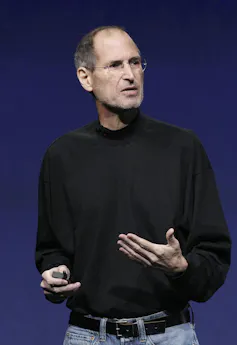
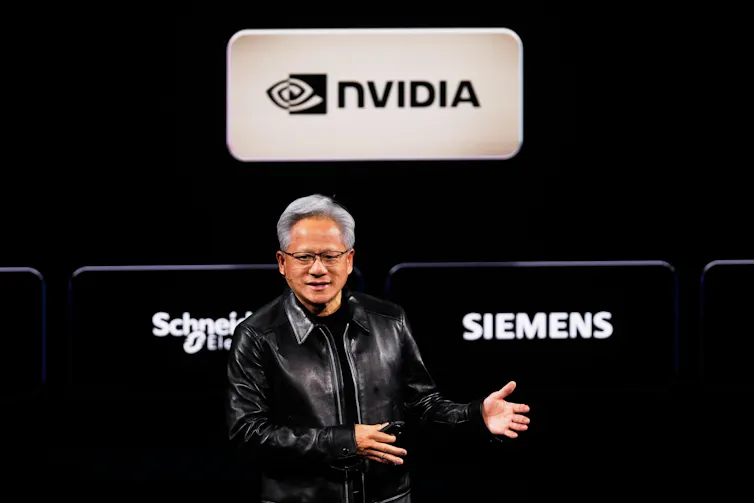
They build strong personal brands, often reflected in their distinctive personal styles: think of Huang’s leather jackets or Steve Jobs’ black mock turtlenecks.
They engage in ongoing, unapologetic self-promotion, appearing at keynote presentations and speaking for their entire sectors. As they accumulate successes and followers, these leaders become known for their genius — a perception they work hard to cultivate.
Over time, as the value-creation propositions articulated by these CEOs are realized, the distinction between the person and the proposition vanishes. The board — and other stakeholders — come to view the CEO as the embodiment of the significant, scalable value being created.
People may have come to believe that AI could not exist without Nvidia’s chips and Huang, that user-friendly personal computing and tablets would not exist without Apple and Jobs and that inexpensive, accessible and comprehensive blood testing would not be possible without Elizabeth Holmes and Theranos.
As this final case illustrates, the legend surrounding these CEOs can be based more in fiction than in fact. But even when evidence challenges the legend, it can remain more influential than reality.
Becoming too invested in a CEO
Why would boards buy into these legends? One reason is that some directors are present for the full arc of the CEO’s story. At the company’s nascent stage, they may be early investors who buy into the person as much as the value proposition.
Over time, they remain in place as the company grows and eventually goes public. As the CEO leads the company through the trials of growth, board members grow increasingly committed to the legend, benefiting from the company’s successes and becoming increasingly invested in it.
But perhaps most importantly, they become supporting characters in the legend’s story. They have been at the CEO’s side, recognizing and enabling their genius and vision.
Research suggests this can make independent oversight more difficult. Directors may become less inclined to challenge the CEO or turn a blind eye to negative aspects of their conduct, viewing them as inconsequential when weighed against the realization of a world-altering vision.
When CEOs become untouchable
When a CEO becomes indispensable in the minds of the board and other stakeholders, succession planning can become pointless and even destructive.
CEOs can influence succession planning, including which potential successors are considered and how the process unfolds. A CEO’s interests can sometimes conflict with the board’s responsibilities.
Raising the need to discuss successors may be seen as heresy. Superstar CEOs may actively resist these discussions and characterize directors who raise them as wasting time, or worse, as disloyal unbelievers.
In extreme cases, directors may even be in jeopardy of being summarily replaced if a CEO also holds majority voting control. The 2021 dispute at Rogers Communications illustrates how concentrated voting power can be used to reconstitute a board, as Edward Rogers did through his control of the Rogers Control Trust.
Instead of relying solely on a succession plan, boards might develop a robust incident-response plan for circumstances that incapacitate the CEO. This could also provide a basis to act when a CEO’s behaviour becomes so excessive the board can no longer turn a blind eye.
Read more: From Vincent Massey to Ed Rogers: Canada’s history of family firm feuds rivals Succession
Keeping the CEO accountable
Boards can, and should, act to ensure their CEO does not become too big to fire. As the company grows, they should add experienced independent directors whom the founder-CEO will respect, helping to balance the CEO’s power and authority.
They should conduct in-depth annual reviews that consider both quantitative and qualitative dimensions of the CEO’s performance and make succession planning a matter of course. Most importantly, they should demonstrate the courage to ask tough questions and continuously challenge the CEO constructively.
Huang had become irreplaceable in the eyes of many stakeholders. The Nvidia board ultimately reinstated him. Although its decision has been widely criticized, one could argue the board believed retaining him was in the best interests of the company and its shareholders.
The governance failure this case illustrates is the risk that a board allows its one employee to dominate it — to become too big to fire. All boards should be alert to this possibility. If boards give legendary leaders a pass for bad behaviour, corporate governance becomes a punchline.