

It was a day-and-a-half past the official deadline when the UN climate summit COP31 began to unravel in earnest.
On Sunday morning, the corridors inside the huge expo-style venue in the Turkish city of Antalya were almost empty. Tired groups of delegates and media sat propped against the walls waiting for updates, charging their phones and drinking coffee. Many had barely slept. Australian Energy Minister Chris Bowen – who headed up the COP31 negotiations – reportedly slept for only a few minutes on the final night, as delegates kept waking him.
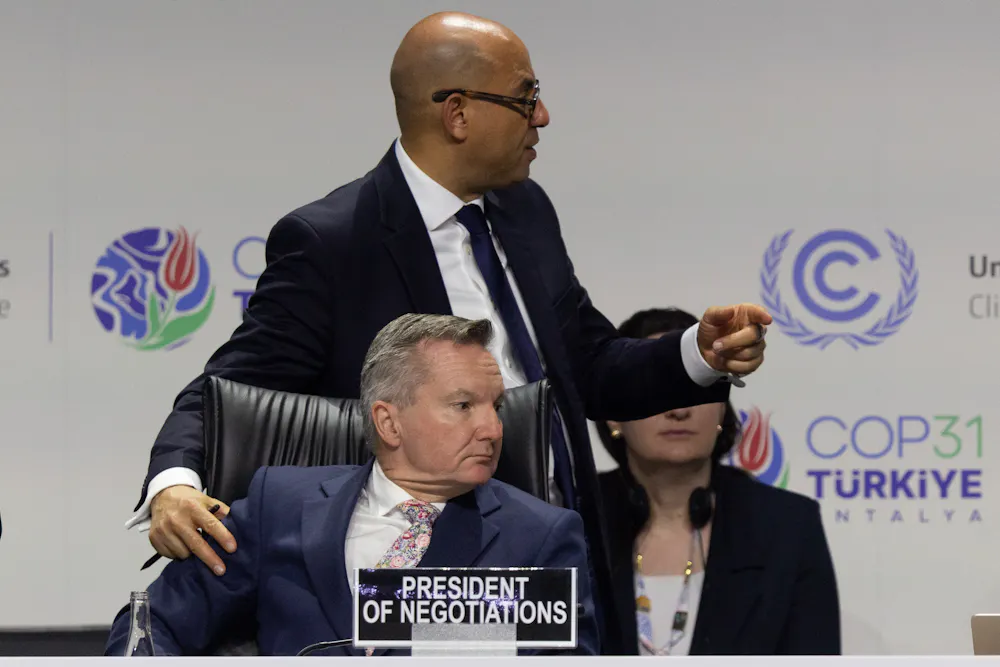
The talks dragged well into overtime to become the longest summit on record. But it would not finish the way co-presidents Bowen and Turkish Environment Minister Murat Kurum had hoped.

A third draft of the proposed agreement had been released overnight. But it still made no mention of the crucial words “fossil fuels”, “oil,” “coal,” or “phase out.”
Suddenly, a media huddle formed and German Climate Minister Carsten Schneider appeared, looking grim. Before the final plenary had even begun, he confirmed Germany would reject the agreement, telling reporters it was a “step backward”.
Shortly afterwards, the European Union followed suit, in a dramatic intervention during the plenary from Ireland’s Climate Minister Darragh O'Brien. The text had failed to meet the moment, he told the assembled countries: “We will not endorse a decision […] that does not even mention fossil fuels.”
Journalists were shuttling between the meeting and talking to delegates in the halls, trying to establish the extent of the dissent. A BBC reporter somehow continued a live cross as he ran down the hallway after delegates from the EU and Iceland.
Inside the meeting, Panama announced it was out. This was not surprising – the country’s environment minister had said the world was “held hostage by fossil fuels”, ruefully declaring “we are in love with our kidnappers.” The Marshall Islands soon followed, and the United Kingdom too. The number of countries grew.
By now, it was clear: the COP31 negotiations to reach an agreement had collapsed.

What now?
This year’s conference was my first in person, though I’d covered a number from Australia. For two weeks, I’d listened to discussions and press conferences, interviewed Bowen and commissioned academic experts to explain the labyrinthine world of these UN summits.
In an interview with Bowen, he sang the praises of Australia and Turkey’s signature “35 by 35” electrification pledge. Electric vehicles, heat pumps and batteries are more efficient than fossil fuel precursors, and cut emissions. But the pace of change is too slow, he said. Bowen was less keen to talk fossil fuels, after Prime Minister Anthony Albanese failed to mention the words in his opening remarks.
While Bowen and his Turkish counterparts could not get the electrification goal embedded in the agreement, more than than 75 countries and 180 businesses signed on outside the official process, including the EU and China.
In the last three days, the COP process became a rollercoaster. Nobody knew when the next agreement draft might drop. Minister and negotiators delayed their flights once, then twice. Bowen’s office went quiet as he holed up in negotiations. The clearest sign talks would stretch over another night was the daily email from organisers about late-night catering options. I joined other media at the site all weekend, waiting for news.
The UN climate talks are no stranger to division. There are longstanding arguments between developed and developing countries, petrostates and those pushing for rapid action away from fossil fuels.
Agreements have to be made by consensus, meaning a tiny minority of opposing states can stop progress. But consensus has been reached before, most notably producing the 2015 Paris Agreement to hold climate change well below 2°C. In 2023, the world’s governments even managed to mention the “F” word – fossil fuels – in the final text for the first time in decades of trying to stop climate change.
Even as climate change accelerates and a giant El Niño threatens crops around the world, the divisions were too great. And the fallout has begun. Civil society leaders are describing it as one of the most dismal COP failures yet. The Coalition in Australia is calling on Bowen to resign.
As recriminations begin, more and more people will ask whether these talks are worth it. What’s the point of flying thousands of people around the world to meet when consensus on something as fundamental as fossil fuels cannot be reached?
I’ve covered environment and climate for years. It’s not a round known for uplifting news, but every day I’m immensely grateful to work on such urgent stories. And surprisingly, today I’m not feeling too glum.
Globally, change is underway. China’s emissions are now falling due to intense domestic effort to boost solar, wind, electric vehicles and batteries. Pakistan is installing solar as fast as possible to bypass its expensive, failing grid, while Ethiopia and Nepal are pushing hard on EVs to avoid paying for oil. The Iran war cut supply of petrol, diesel and other fossil fuel products, driving up prices.
The failed COP31 draft agreement had some good points, such as recognising climate science and underlining the importance of oceans. But if we’d witnessed the world sign up to a cowardly cover text in Antalya that didn’t even mention fossil fuels it would have felt like real failure. This COP’s inability to land a cover decision has laid bare the consequences of failing to hold the fossil fuel industry accountable. And that feels like a breath of fresh air.
Multilateralism was still on show in the final days as over 130 countries – from the EU to Pacific Island nations to the least developed countries – pushed back against an unsatisfactory draft.
During the summit, I witnessed passionate people from all over the world come together with hope and ingenuity in a truly global meeting, and that was humbling. These meetings are the only forum where developing countries, those bearing the full brunt of the climate crisis, can look rich countries in the eye and demand change.
These UN summits are not the only forum for climate action. Dozens of nations focused on phasing out fossil fuels met for the first time this year. Next year, Tuvalu and Ireland will host the second conference with a growing coalition of countries, a complement to UN climate negotiations.
Let’s end on the words of Tuvalu’s climate minister, Maina Talia: “We will not allow inaction and obstruction to dampen our resolve. We will advance where we can with those willing to show up.”