
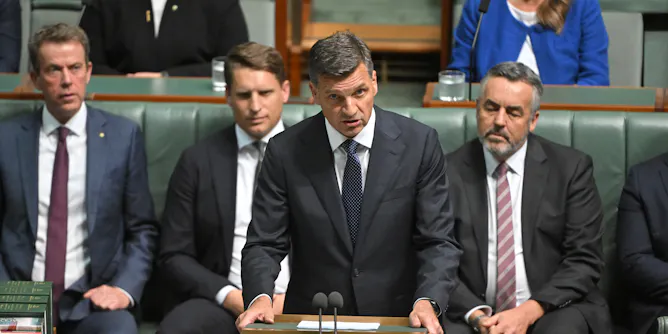
The opposition leader has described the plan as ‘generational tax reform’.
Articles on Tax reform
Displaying 21 - 40 of 210 articles

After decades of wealthy investors getting a better deal, this budget finally tilts the scales for younger people trying to buy their first home.

Budget 2026 contains important changes to capital gains tax, negative gearing and trusts. While the reforms are significant, the timing is cautious.
The Albanese government has used the first budget of its second term to do what you’d expect a Labor government that had won a massive majority would do.

More than 1.8 million Australians earn money from trusts, which can be legally used to reduce people’s tax bills. There may be changes coming in Tuesday’s budget.

And what might it mean for renters – especially rental housing supply and prices – if the government does tackle negative gearing?

We don’t inflation-proof any other parts of the tax system, so why should we give special treatment to capital gains?

If we want to avoid becoming a nation where the great divide is between those who own property and those who never will, we should jump at the chance for reform.

Australia’s inflation rate could peak in “the high 4s or even higher” this year, according to Treasurer Jim Chalmers.

Would the policy be family-friendly, or discourage women from the paid workforce?

Is the government prepared to reduce speculation in housing in favour of returning to its social purpose?

As Australia reforms laws that can inadvertently trap financial abuse victims, New Zealand must ask what protections – and risks – exist here.

The government moved quickly after its election victory to seek ideas for economic reform. As it prepares the next federal budget, we cannot let that momentum lapse.

The revised plan still leaves gaps – especially for people earning $45,000 or less a year – that will quietly chip away at its fairness over time.

While simply scrapping the 2018 deal might not be feasible, moving to an altogether new system could be a way forward.

Many Australians support the government’s plans to change the way large super balances are taxed. Yet key aspects of the policy still face vocal opposition.

The summit brought agreement on broad principles for tax reform. The objections will come when it gets down to details.

Jim Chalmers ends his roundtable more optimistic then he started, leaving in its wake broad support to work on three major areas of tax reform.

When it comes to improving the fairness of the tax system, this is no time to be squeamish.

A new road charge mooted for electric vehicle drivers is based on a fundamental misconception.
Top contributors
-

Professorial Fellow, University of Canberra
-
Lecturer, School of Taxation & Business Law, UNSW
-
Professor, Department of Economics, The University of Melbourne
-
Professor Emerita, Curtin Law School and Curtin Business School, Curtin University
-
Associate Professor of Taxation Law, UNSW
-
Chief Executive, Grattan Institute
-
Senior Industry Fellow - Taxation and Director of the UTAS Tax Clinic, University of Tasmania
-
Visiting Professor of Tax Law, New York University, and Professor of Law, The University of Melbourne
-
Professor of Taxation, QUT Business School, and ARC Future Fellow, Queensland University of Technology
-
Professor of Urban Policy and Director, Urban Futures Enabling Impact Platform, RMIT University
-
Deputy Director and Associate Professor, Centre of Policy Studies, Victoria University
-
Lecturer in Accounting, The University of Queensland
-
Visiting Fellow, Crawford School of Public Policy, Australian National University
-
Professor of Economics, University of Canberra
-
Senior Associate, Housing and Infrastructure, Grattan Institute