
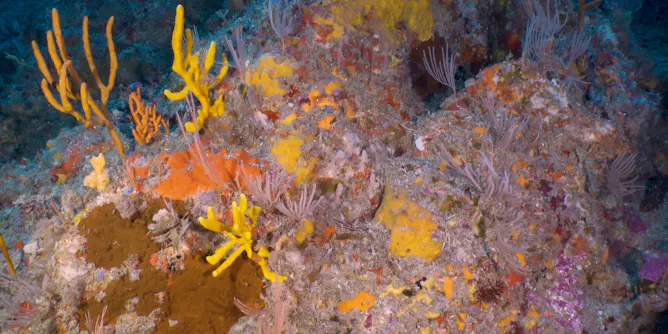
A new study challenges a common assumption that deeper marine ecosystems act as refuges which could reseed damaged shallower reef systems.
Articles on Marine sponges
Displaying all articles
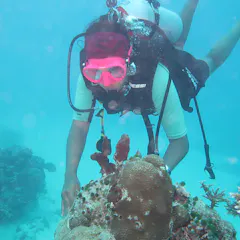
A marine sponge from Mauritius has shown potential as the source of compounds that kill liver cancer cells.
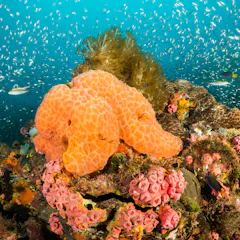
New research has unravelled the mystery of why sea sponges die when the water gets too warm. The cause of death appears to be the sudden loss of microbes that usually act to detoxify sponge tissue.
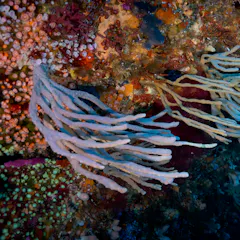
Sponges are ancient marine animals and have already shown robustness against stresses from climate change. New research now shows they can also tolerate low-oxygen conditions.

In Lough Hyne’s shallows, animals and plants thrive that would otherwise be found in the ocean’s depths.
Ancient fatty molecules, once believed to be traces of some of the first animals to live on Earth, may have been produced by algae instead.
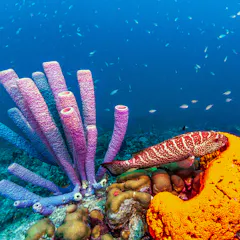
Marine sponges are ancient organisms that have survived mass extinctions. Many are more tolerant of climate change and may dominate over corals in future reef systems.
Top contributors
-

Professor of Marine Biology, Te Herenga Waka — Victoria University of Wellington
-
Professor of Marine Conservation, University College Cork
-
Postdoctoral Researcher, Te Herenga Waka — Victoria University of Wellington
-
Research Group Leader, Max Planck Institute for Biogeochemistry
-
Principal Research Scientist, Australian Institute of Marine Science
-
Postdoctoral Fellow, Research School of Earth Sciences, Australian National University
-
Postdoctoral Research Fellow, Leibniz Centre for Tropical Marine Research (ZMT)
-
Research Scientist, Australian Institute of Marine Science
-
Postdoctoral Researcher, Max Planck Institute for Biogeochemistry
-
Postdoctoral Researcher in Marine Science, Te Herenga Waka — Victoria University of Wellington
-
Research Officer, UNSW
-
Postdoctoral Fellow, California Institute of Technology
-
Professor, Australian National University