
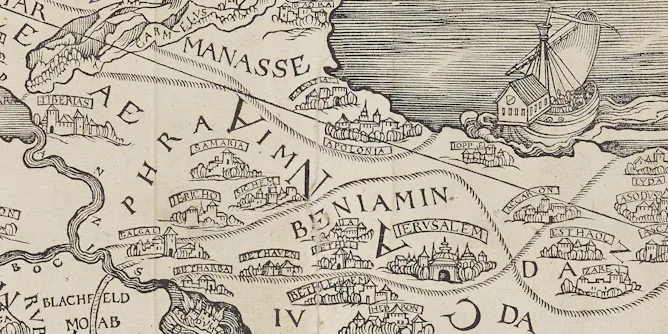
The map of the Holy Land in Christopher Froschauer’s 1525 Old Testament has the Mediterranean to the east of Palestine instead of to the west.
Articles on Maps
Displaying 21 - 40 of 102 articles

Maps have always both granted power and threatened it, depending on who controls the data, the scale and the narrative.

We’ve got this week’s cultural fix all lined up for you.

This fascinating show offers visitors a deeper sense of Le Guin’s maps as world-making and storytelling devices.
Combining psychology and geography has huge potential for improving mental health services.
Maps help shape how we make sense of the world.

As many as 10% of enslaved people on St. Croix escaped. Where they went has remained a mystery, but scientists are using new mapping technology to find answers.
AI models are not politically neutral nor free from bias. In fact, it may not even be possible for them to be unbiased.
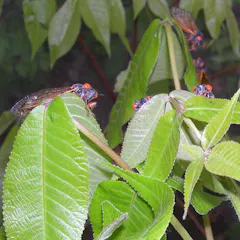
Two ecologists explain why a misleading map is worse than no map at all, and how they have worked for years to track the emergences of 13-year and 17-year cicadas.
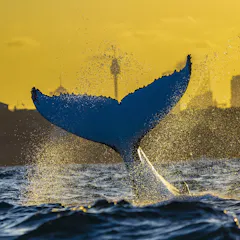
The map combines findings from more than 1,300 studies and is an important tool for conservation.

Rewriting the map can influence the public psyche in ways subtle and not so subtle.
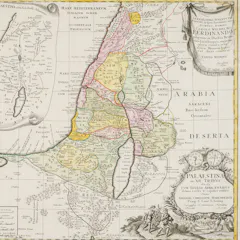
How maps’ names and border territories − and what they omit - can project different political objectives.
How do place names get made and then changed? There’s a process. But it involves people as well as bureaucracy, so it’s not simple or quick, as President Trump is about to find out.
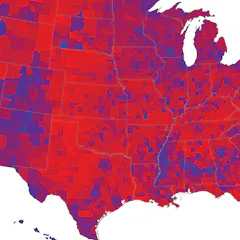
Showing just red and blue states doesn’t paint an accurate picture of national politics.
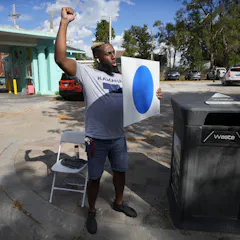
Blue dot signs are going up across Omaha to show support for Kamala Harris. Heavily Republican Nebraska splits its electoral votes, and Omaha cast its single vote for Dems in 2008 and 2020.
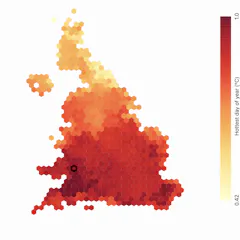
You can look up past and future climate changes in your own area.
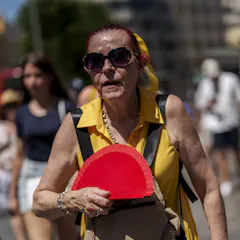
Older adults face greater health risks from extreme heat for several reasons, including their medications..
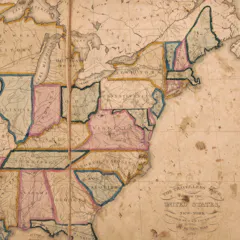
Few copies remain of the earliest known board game produced in the US.
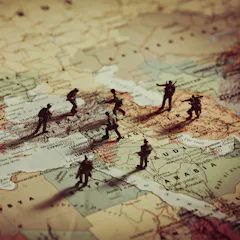
Maps can shape how we see conflict.
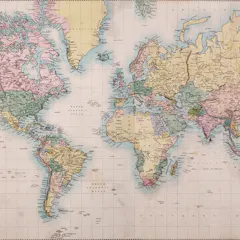
Cartography has become one of the most successful technologies for understanding the world around us. But like the world itself, maps and map-making are constantly evolving.
Top contributors
-

Professor of Geographic Information and Cartography, Department of Geography, UCL
-
Derek H. Alderman is a Friend of The Conversation.
Chancellor's Professor of Geography, University of Tennessee
-
Lecturer in Humanities, University of Tasmania
-
Lecturer in Digital Culture and Technology, King's College London
-
Assistant Professor Department of Geography & Sustainability, University of Tennessee
-
Reader in Cultural Geography and Communication, University of Westminster
-
Associate Professor at the ARUA Water Centre of Excellence Academic Manager, Institute for Water Research, Rhodes University
-
Professor in Urban Studies and Planning, University of Sheffield
-
Professor Emeritus of Ecosystem Science and Sustainability, Colorado State University
-
Associate Professor of Geography, University of Wisconsin-Stout Polytechnic
-
Lecturer in GIS, University of Southampton
-
Ecologist, Charles Darwin University
-
Co-founder, Wonder Labs, University of Wollongong
-
Professor of Conservation and Sustainable Livelihoods, Charles Darwin University
-
Scientific Advisor, Hungarian Academy of Sciences, Budapest