
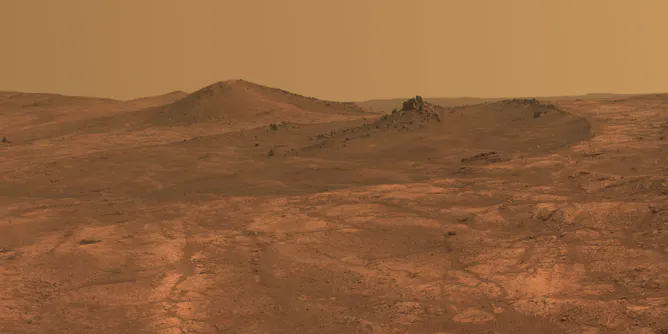
Before sending humans to Mars, NASA will first return humans to the Moon’s surface to test its technology and train astronauts.
Articles on Lunar water
Displaying all articles
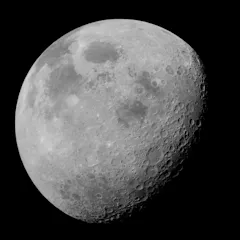
Some dark craters on the Moon are never exposed to light − ice could be hiding in these permanently shadowed regions, and India’s Chandrayaan-3 mission marked a big step toward finding it.

A 10kg rover, due to land on the Moon by 2024, will be fitted with an advanced robotic arm design and manufactured in Australia.
CC BY-ND49.4 MB (download)
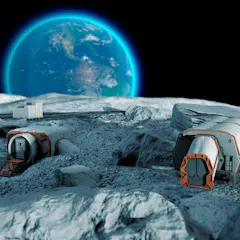
In the fourth episode of our podcast series, we look at the practical, legal and ethical questions about going to set up base on the moon – and mining its resources.
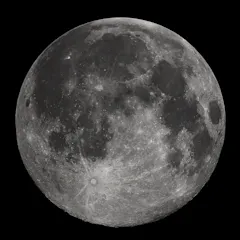
The story of how water got inside the moon could also help us understand the origin of water on Earth.
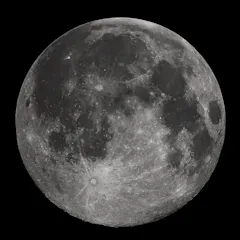
A six degree change in the moon’s tilt could help us understand the origin of water in the inner solar system, and help us mine our staellite for it, too.
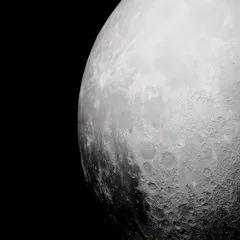
One of the main aims of the Apollo missions of the 1960s was to determine whether the moon had any water on it. If man were to build a colony on the moon, having water present would make living there easier…
Top contributors
-

Postdoctoral research associate, The Open University
-
Professor of Planetary Science and Exploration, The Open University
-
Postdoctoral researcher in Planetary Science and Exploration, The Open University
-
Chargé de recherche (CNRS) à l'Observatoire Astronomique de Strasbourg, Université de Strasbourg
-
Assistant Professor and Deputy Director of the International Institute of Air and Space Law, Leiden University
-
Royal Society University Research Fellow / Reader, School of Earth and Environmental Sciences, University of Manchester
-
Lecturer and Topic Coordinator, The University of Melbourne
-
Senior Research Fellow, Department of Earth and Environmental Sciences, University of Manchester
-
Professor of Space Law, University of Nebraska-Lincoln
-
Space Plasma Physicist, Imperial College London
-
Podcast host, The Conversation
-
Senior lecturer, University of Technology Sydney
-
Research Professor of Applied Science, William & Mary
-
Assistant Professor of Astrophysical and Planetary Sciences, University of Colorado Boulder
