

The recent conflict between Israel and Hamas has exacerbated hate crimes in Canada and put Canadian multiculturalism to the test.
Articles on Israeli-Palestinian conflict
Displaying 261 - 280 of 388 articles
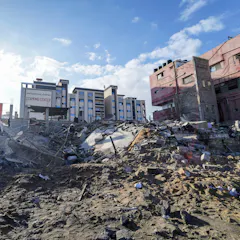
A selection of analysis from our coverage of the war in Gaza over the past fortnight.
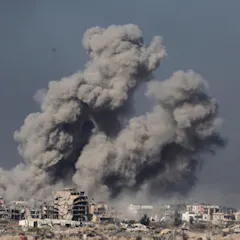
Geopolitical concerns have once again brought the UN security council to a standstill.
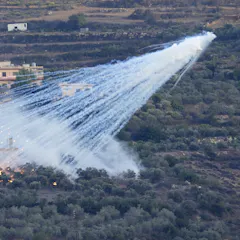
The use of such incendiary devices is only legal under very specific circumstances. A careful examination of the evidence is now required.
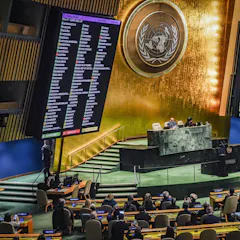
In war time, the type of conflict determines what formal rules of war apply. But how to determine the nature of the conflict?
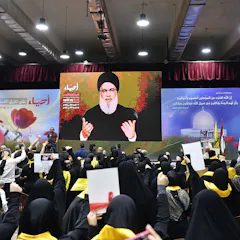
Israel is effectively fighting a war on two fronts.
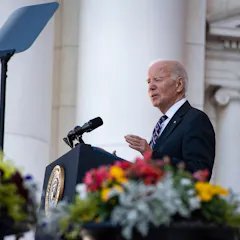
Around 50% of those under 30 supported Biden’s policy on Israel, a higher number than other age groups.

The leaders called on Israel to ‘respect international humanitarian law’, and said Hamas has no place in the future governance of Gaza.
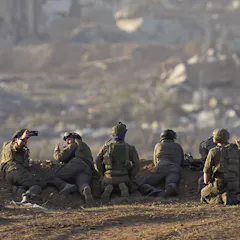
The best — or least bad — solution to resolving the Israeli-Palestinian conflict involves setting up a transitional administration in Gaza. Here’s how it could work.
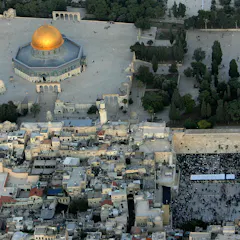
Conflicts over the Alsace-Lorraine region and Northern Ireland offer examples of how territory is often at the center of a conflict − and what is necessary to pave the path to peace.
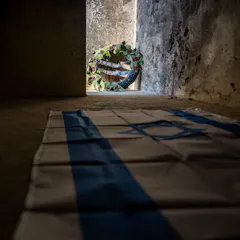
Sexual violence can be used as a weapon of war. Hamas’ use of sexual violence was likely meant to show its power over Israeli women and girls and to humiliate Israeli men and Israel’s military.

Mass forced movement of people has been used in conflicts to serve three goals: population control, territorial expansion and as a sorting mechanism. All three could be in play in Gaza.
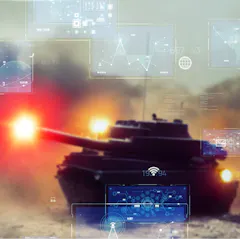
Advances in technology are deployed in war, changing the ways that wars are both fought and communicated.
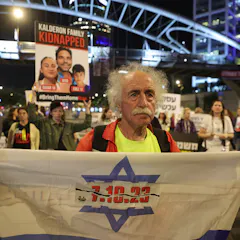
Israelis are still reeling after October 7 and many feel that the international community has turned against them.
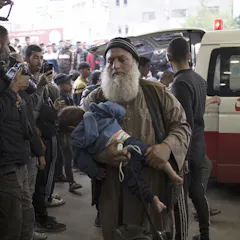
Gaza is being systematically razed to the ground as the IDF continues its assault.
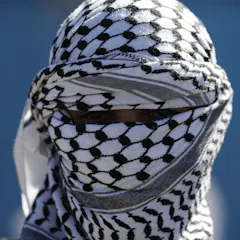
The Houthis are not mere Iranian proxies in the war. Their support for the Palestinians is also aimed at garnering domestic and international support for the group’s position in Yemen.

Censure might occasionally be necessary to preserve the integrity of a parliament, but using it to punish members for their personal views threatens the foundations of democracy.
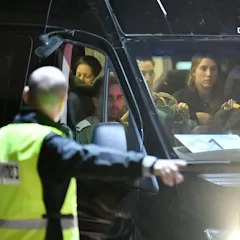
Most of the hostages and prisoners being exchanged have been women or children.
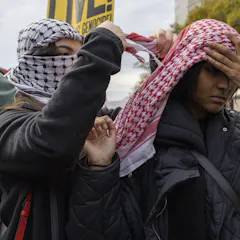
The keffiyeh’s prominence soared in the 1970s when Yasser Arafat, leader of the Palestinian Liberation Organization, adopted and popularized the garment.

Proportionality requires that lives of civilians on both sides of a conflict must be treated with the same degree of respect.
Top contributors
-

Professor of International Politics, Clinton Institute, University College Dublin
-
Senior Lecturer in International Politics, City St George's, University of London
-
Emeritus Professor of Law, University of East London
-
Associate Professor in Interdisciplinary Race, Gender and Postcolonial Studies, UCL
-
Professor of International Relations, Lancaster University
-
Deputy Director of the HUMLOG (Humanitarian Logistics and Supply Chain Management Research) Institute, Hanken School of Economics
-
Professor of International Relations at UCL | Associate Fellow on the Middle East at Chatham House, UCL
-
Research Scholar, Middle East Studies, Australian National University
-
Professor of History and Peace Studies, University of Notre Dame
-
Professor of Peace Studies, University of Bradford
-
Senior Lecturer
-
Associate Professor in the School of Middle Eastern and North African Studies, University of Arizona
-
Senior Lecturer in Peace and Conflict Studies, University of Sydney
-
Professor of International Relations and Political Science, St. Thomas University (Canada)
-
Senior Lecturer, Politics & International Relations, Monash University