
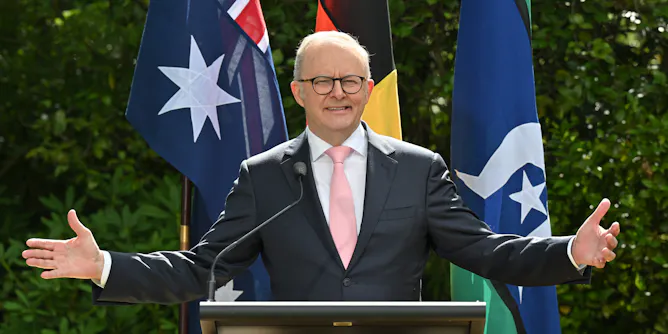
The deal struck between states and territories and the federal government follows a long-running standoff. Here’s what’s been agreed, and what’s still missing.
Articles on commonwealth budget
Displaying all articles

The thing to look for is the “fiscal strategy”. For the past quarter-century, it’s provided a surprisingly accurate insight into what each budget is doing.
Former treasury boss Ken Henry has fessed up to helping dumb down debates about tax and budgets to lists of winners and losers. He says what matters is what wins rather than who.

Australia’s past reports have been largely ignored big issues like housing and climate change. Ahead of the latest report’s release, here’s what we’re still missing – including giving you a say.
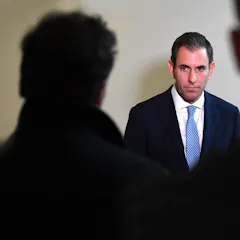
From October, Australia will start routinely quantifying the benefits as well as costs of federal spending. It’s already shaping up as the new treasurer’s most important legacy.

Unemployment is far lower than predicted and isn’t setting off the kind of inflation seen in the United States. There’s no telling how much lower it can go.

The US debt ceiling is a form of self-delusion: a limit imposed on a borrower by the borrower itself. Australia had one until the Coalition and the Green us, abolished it.
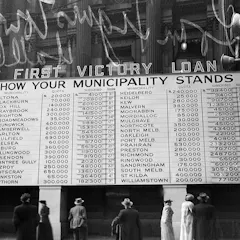
We’ll need to spend at least an extra 15-20% of GDP per year. It’ll be more palatable if it is funded by COVID bonds.
The attempts at product differentiation that preceded the $18 billion program are all but exhausted.
MYEFO contains a long-overdue admission: that low wage growth is the new normal. It’ll take extraordinary spending restraint to make the surplus forecasts stick.
The treasurer has pulled out all stops to continue to forecast budget surpluses, but they are low, and don’t take account of several likely costs.

From wage growth to renewable energy to religion, projections are being treated as predictions. We’d be better off insisting on genuine forecasts.
A big surplus will come. It should be saved for something important, not simply spent.

There are limits on how much governments can spend without earning, although increasingly politicians are behaving as if there are not.
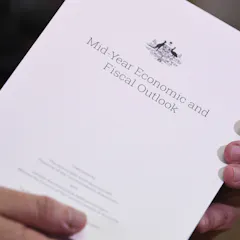
History suggests the government will spend most of the extra $10 billion per year that the MYEFO will reveal on Monday. The only problem is, those riches won’t last.
Top contributors
-

Visiting Fellow, Crawford School of Public Policy, Australian National University
-
Scientia Professor of Economics, UNSW
-
Professor, School of Economics, The University of Queensland
-
Industry Professor, University of Technology Sydney
-
Professor of Macroeconomics, University of Sydney
-
Democracy Deputy Program Director, Grattan Institute
-
Program Director, Health and Aged Care, Grattan Institute
-
Professor of Health Economics, University of Technology Sydney
-
Chief executive officer, Grattan Institute
-
Professor of Economics, University of Canberra