
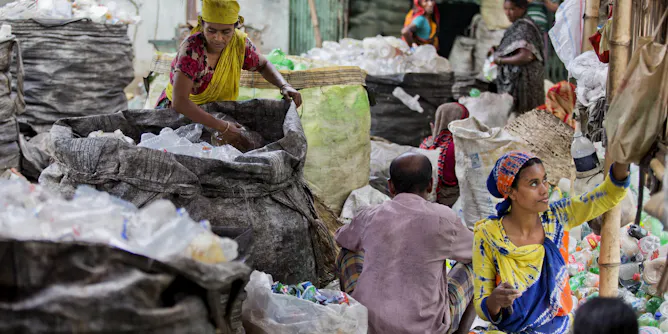
Millions of informal waste-pickers are the forgotten heroes of the the circular economy, without receiving the recognition their work deserves.
Articles on Circular economy
Displaying 1 - 20 of 160 articles
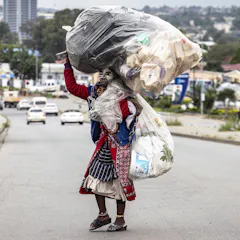
South Africa has laws and policies to reduce plastic waste. But they need enforcement, local recycling centres and to involve waste reclaimers in planning.
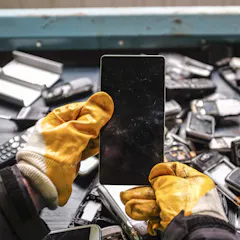
Broken devices are contributing to a growing mountain of e-waste.
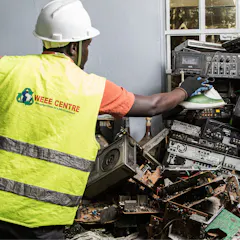
Africa’s circular economy is already at work in repair shops and scrap yards. Backing the people who keep goods in use could cut waste and create better jobs.

Canada’s new Responsible Data Centre Development Principles fail to address computer hardware alongside water and electricity usage.

Quality, rather than discounts or environmental benefits, is what’s needed to encourage shoppers to consider odd-shaped produce.
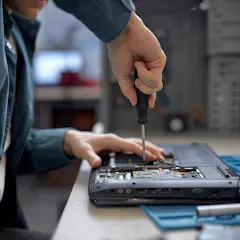
From phones and laptops to coffee machines and earbuds, new legislation is making it easier to fix tech products.
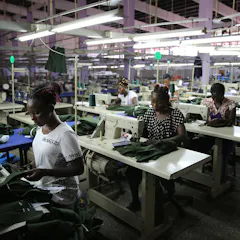
Going circular doesn’t have to mean buying expensive technology. African manufacturers can innovate by learning from what already exists.
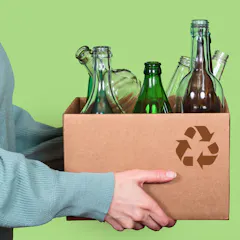
Learning communities are supporting circularity across Europe by rethinking processes for recycling waste or reconditioning clothing and vehicles, and navigating policy U-turns.

Many sustainability programs may be aiming at the wrong target because most entrepreneurs won’t become environmental activists.

An estimated 8 million handheld fans will be purchased in the UK in 2026. Many will end up as discarded electrical waste.

Although recovering and reusing house materials takes more time, there can be big social and environmental benefits.
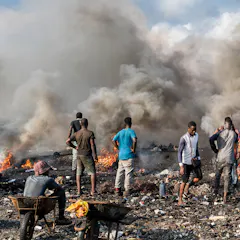
In Agbogbloshie, Ghana, thousands of young women and men burn electronic waste to extract minerals at a cost to their health. They need more protection.
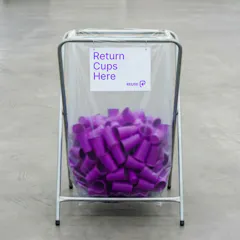
As part of a more effective network of reuse infrastructure, this new symbol could be a catalyst for more effective waste reduction.
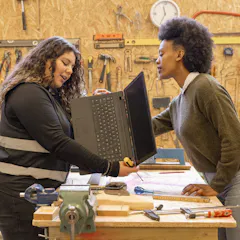
Circular economies don’t follow the ‘take, make and dispose’ model but try to keep products in use for as long as possible by reusing and recycling them.

Black soldier fly larvae can convert Canada goose feces into protein and fertilizer, transforming an urban nuisance into an agricultural resource.

Fashion made out of recycled polyester mostly uses plastic bottles. That’s not a good thing.

Under the right conditions, 1g of oyster shells can capture and lock away up to around 1.5g of the rare earth elements present dissolved in the surrounding water.
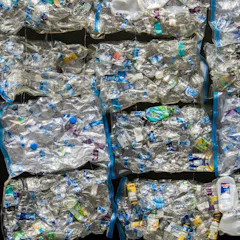
Instead of treating plastic purely as waste, new research shows that it can be transformed into something useful — acetic acid, a key component of vinegar and an important industrial chemical.

Burnout isn’t a personal failure. It’s a design flaw. But there is another way.
Top contributors
-

Associate Professor and Research Director, Institute for Sustainable Futures, University of Technology Sydney
-
Associate Professor, Global Management Studies, Toronto Metropolitan University
-
Professor of Technology Management and Circular Economy, Kingston University
-
Senior Lecturer in Urban Planning, School of Architecture and Cities, University of Westminster
-
Senior Lecturer, Auckland University of Technology
-
Lecturer in Circular Economy and Sustainable Transformations, University of Edinburgh
-
Professor, ESCP Business School
-
Reader in Fashion, Marketing and Sustainability, Glasgow Caledonian University
-
Professor, Harvard University
-
Associate Professor at School of Property, Construction and Project Management, RMIT University
-
Chair professor - Circular Economy, The University of Melbourne
-
Professor of Applied Environmental Science, University of Southampton
-
Professor of Management, Rochester Institute of Technology
-
Professor, Keevil Institute of Mining Engineering, University of British Columbia
-
Associate Dean and Head of Project Management, RMIT University