
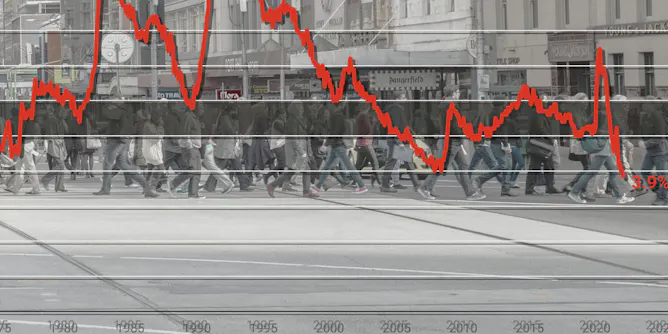
The share of the population in work has hit an all-time high as the share of the workforce underemployed has hit a 14-year low. The fresh low in unemployment will bring higher interest rates, and perhaps higher wages.
Articles on Australian Bureau of Statistics
Displaying 41 - 60 of 103 articles
Why raise rates now, for the first time in more than a decade? If the Reserve Bank isn’t careful, too many more rate hikes like this might help bring on a recession.
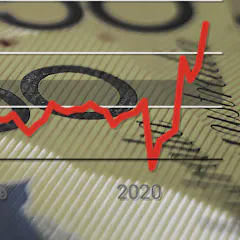
Inflation is well outside the Reserve Bank’s target band and higher than it has been for two decades.

Of the news on prices, wages, interest rates and unemployment, only the unemployment update looks set to be positive for the Coalition.
You might be surprised to know that many unemployed Australians are not on unemployment benefits. And then came COVID – which saw a big shift in how many people were able and willing to claim.
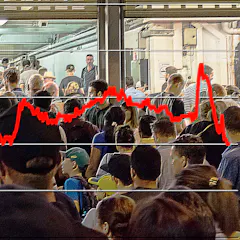
Even the government’s pledge of 1.3 million extra jobs might not be enough to keep unemployment below 4%. The pledge ought to be the unemployment rate itself.

While everyone’s talking about Anthony Albanese’s campaign stumble, the more extraordinary thing is that unemployment is actually set to fall below 4%. A 60-year low of 3% is now within sight.

Away from the states bouncing out of lockdown, spending growth was weak. The next figures, to be released after the election, might show the economy turning down.

The case for the RBA increasing interest rates certainly exists. But it’s far less pressing than in the United States.

Australia’s Consumer Price Index rose 1.3% in the three months to December, bringing inflation for the 2021 year to 3.5%.

Looking beyond the latest quarterly GDP figures, the truth is we’re getting better off more slowly than before.

Even now much of the recovery in employment seems to be happening without big wage increases.

The drop in Australia’s unemployment rate in August is not a sign of improving labour market conditions. Instead it shows many gave up on looking for a job.

When low-wage workers lose jobs the average wage goes up. There’s a better measure, but we’re not using it.

Australia’s first ‘land account’ is a great example of the nation’s environmental policy culture: we develop or adopt good ideas, but then tinker with, or even discard them.

The Australian Bureau of Statistics is doing what it can to push back against lobby groups’ over-inflated claims of job creation — but it can’t stop people misusing its figures.

Businesses won’t employ more people unless they are prepared to invest. Figures out on Thursday suggest they are.

Australia’s official unemployment rate falling to 5.5% is enough to make a treasurer dance. But we shouldn’t get too carried away.
This government has known more about the granular detail of the crisis than any government in any crisis before it.
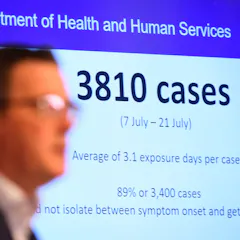
The COVID-19 pandemic has highlighted how much modern societies are governed by statistics. Despite their objective appearance, these numbers gain their strength from very human relationships.
Top contributors
-

Senior lecturer, Canberra School of Government, University of Canberra
-
Visiting Fellow, Crawford School of Public Policy, Australian National University
-
Professor of Economics, The University of Melbourne
-
Professor of Economics and Public Policy, ANU College of Arts and Social Sciences, Australian National University
-
Scientia Professor of Economics, UNSW
-
Associate Professor, POLIS@ANU Centre for Social Policy Research, Australian National University
-
Professor of Economics, University of Canberra
-
Professor, Crawford School of Public Policy, Australian National University
-
Director, Centre of Policy Studies, Victoria University
-
Professor of Economics, University of Canberra
-
Lecturer in Economics, Monash University
-
Professorial Fellow and Co-Director, HILDA Survey, Melbourne Institute of Applied Economic and Social Research, The University of Melbourne
-
Lecturer in Ageing and End of Life, La Trobe University
-
Professorial Fellow, University of Canberra
-
Associate Professor, Bankwest Curtin Economics Centre, Curtin University