

President Samia Hassan has set Tanzania on a change of course – time will tell if the pattern holds and addresses the country’s challenges.
Articles on African Continental Free Trade Area (AfCFTA)
Displaying 21 - 31 of 31 articles

Leaders in Africa need to develop practical ways to achieve their aspirations.

Relying on donor funding means that the funder ultimately determines the health priorities. This is one reason why many programmes in Africa focus on a single disease such as HIV.
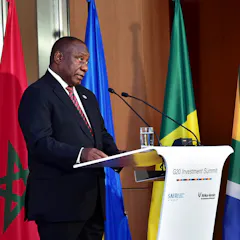
While South Africa should pay careful attention to all its existing trade and economic relations, particular attention should go to its intra-African economic relations.

African policymakers should strenuously safeguard their right to choose from the widest possible range of technology options that suit their countries’ development needs.

Border closure is an implicit admission of the ineptitude and incompetence of Nigeria’s customs and immigration officers

South Africa and Nigeria need to lead policy debates on long term measures to address migration in Africa.

Now that African countries have signed up for the continental free trade agreement, they must complete the institutional loop by jumpstarting the creation of the African Monetary Fund.

The free movement of people between African countries could facilitate economic development.

The African Continental Free Trade Agreement promises to redefine relations among African states and beyond.

Continental free trade area’s potential impact includes boosting intra-Africa trade, manufacturing exports, job creation and poverty alleviation.
Top contributors
-

Senior Research Fellow New South Institute, Emeritus Professor at The Nelson Mandela School of Public Governance, University of Cape Town
-
Professor of Economics, University of Minnesota Duluth
-
Associate Professor & Purdy Crawford Chair in Business Law, Dalhousie University
-
Professor/Senior Research Fellow, Centre for Advancement of Scholarship, University of Pretoria
-
Professor of Economics, Salisbury University
-
Associate Professor, School of Law, University of the Witwatersrand
-
Professor in Global Health Infection and Immunity. and co-Director of the Global Health Academy, University of Edinburgh
-
Assistant Director, Global Development Policy Center, Boston University
-
Assistant Professor, Political Science, Carleton University
-
Professor of law, Loyola University Chicago
-
Professor of Economics & Business, Allegheny College
-
Professor of Development Economics, University of Oxford
-
Jan Smuts Professor of International Relations and Director of the African Centre for the Study of the United States (ACSUS), University of the Witwatersrand
-
Research associate at African Centre for Cities, University of Cape Town
-
Research Fellow at Institute for Global African Affairs, University of Johannesburg