

The tropi mite spreads faster, kills colonies more quickly, and is harder to control with existing methods.
The University of Melbourne

The University of Melbourne is a global leader in higher education. Across our campuses we convene brilliant minds from different disciplines and sectors to come together to address important questions and tackle grand challenges. In a disrupted world, that capacity has never been more important.
Our vision is to equip our students with a distinctive, future-facing education personalised around their ambitions and needs, enriched by global perspectives and embedded in a richly collaborative research culture. As active citizens and future leaders, our students represent our greatest contribution to the world, and are at the heart of everything we do.
We serve society by engaging with our communities and ensuring education and research are inspired from the outset by need and for the benefit of society, while remaining committed to allowing academic freedom to flourish. In this, we remain true to our purpose and fulfil our mission as a public-spirited organisation, dedicated to the principles of fairness, equality and excellence in everything we do.
We strive for an environment that is inclusive and celebrates diversity.
Beyond our campuses we imagine an Australia that is ambitious, forward thinking and increasing its reputation and influence globally. We are committed to playing a part in achieving this – building on our advantageous location in one of the world’s most exciting cities and across the state of Victoria, in a region rapidly becoming a hub for innovative education, research and collaboration.
Links
Articles

After a lengthy and bitter dispute, the future of the media empire after Rupert Murdoch’s death has been resolved – and son Lachlan is to take the reins.

It makes great sense many plants flower when the insects and birds so vital to their reproductive success are also getting busier (and getting busy).

September has seen the passing of two of Australia’s ballet legends and foundation members of the Australian Ballet, Colin Peasley and Garth Welch.

Nanoplastics can cross the blood-brain barrier – and being able to better detect them is the first step in addressing their potential impact.

‘Set-off’ arrangements are an agreement to bundle certain entitlements owed under awards into higher base rates of pay.

Many Australian birds and animals rely on hollows in grand old trees. As these trees dwindle, researchers are experimenting with giving younger trees old features.

March For Australia did not occur in a vacuum. There’s a long history of racism and nationalism we’re at risk of obscuring.
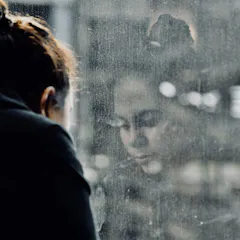
Some estimates say up to one in seven people are living in poverty, but Australia doesn’t properly measure it. Here’s how we could.

During the recent mass protests and political unrest in Indonesia, the looted homes of politicians in Jakarta revealed unexpected victims: the MPs pet cats.
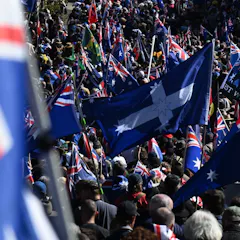
The Eureka flag originated on the gold fields, became a union symbol, and is now being waved at anti-immigration protests.

New research uncovers stories of resilience, entrepreneurship and thriving cultural creativity across seven decades of Australian TV history.
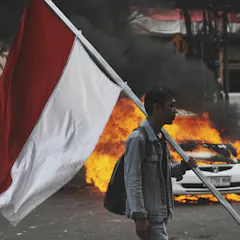
The president has made some concessions to protesters, but this may not be enough to quell public anger with politicians seen as lazy, corrupt and out of touch.

Some athletes are labeled ‘clutch’ for their match-winning feats. Research suggests this may be more fiction than fact.

When reporting on racist rallies, it’s important the media don’t fall for the shadowy language used by organisers.

Only about a third of infant foods in NZ, and a quarter in Australia, meet WHO nutritional recommendations. But many are packaged to create a ‘halo’ of health.

Without rebates, surgeries for trans people can cost between $20,000 and $100,000.
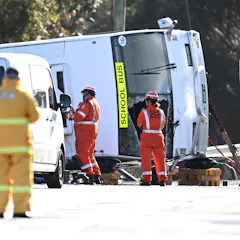
The Stonehaven school bus rollover, which killed a young girl, is a tragic reminder of how devastating such crashes can be. But there are ways to make buses safer.

Features like lane-keeping assistance and emergency braking stop crashes – but drivers often find them annoying or confusing.

New research points to ways systems could be improved so we have a better idea of how domestic violence is affecting suicides. It may help prevent women’s deaths.
Authors
-

Election Analyst (Psephologist) at The Conversation; and Honorary Associate, School of Mathematics and Statistics, The University of Melbourne
-
Professor of Sociology of Law and Deviance, Università di Bologna; University of Essex; The University of Melbourne
-
McKenzie Research Fellow, The University of Melbourne
-
PhD Candidate, Creative Writing, The University of Melbourne
-
Senior Research Associate, School of Agriculture, Food and Ecosystem Sciences, The University of Melbourne
-
Paleontologist, The University of Melbourne
-
Professor of Law (consumer protections and credit law), The University of Melbourne
-
Joanna Mendelssohn is a Friend of The Conversation.
Honorary Senior Fellow, School of Culture and Communication, The University of Melbourne
-
Emeritus Professor of Creative Writing, The University of Melbourne
-
Lecturer in World Literature (including Australian literature), The University of Melbourne
-
Deputy Vice-Chancellor (Global, Culture and Engagement), The University of Melbourne
-
Professor of Psychology, The University of Melbourne
-
Emeritus professor, History, The University of Melbourne
-
Professor of Health Economics, The University of Melbourne
-
Associate Professor and Head, Behavioural Neuropharmacology Laboratory, The University of Melbourne