
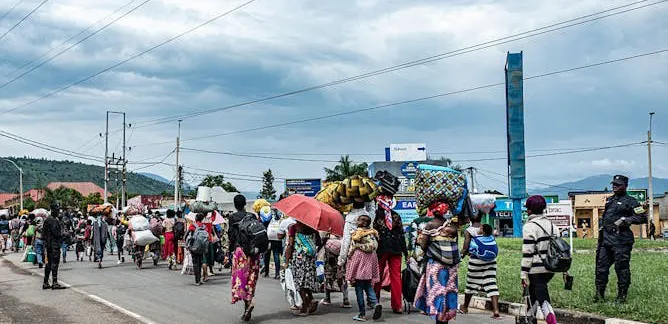
Une analyse des données montre que les craintes d'une migration à grande échelle de l'Afrique vers l'Europe sont exagérées.
German Institute for International and Security Affairs

Stiftung Wissenschaft und Politik (German Institute for International and Security Affairs, SWP) advises political decision-makers on international politics and foreign and security policy. Our services are orientated primarily towards the German government and Bundestag, as well as relevant international organisations such as the European Union, NATO and the United Nations.
SWP stands out in comparison to other policy advisers for its ability to draw on solid academic research conducted by our own staff. So as well as offering up-to-date information and demand-driven consulting, SWP also carries out rigorous academic work. We place a premium on independence. SWP is tied to no political party or other institution, nor to any programme or interest group. We set our own priorities and conduct our research freely, without preconceived outcomes. With roughly 50 researchers, SWP covers a broad spectrum of regional and thematic expertise, enabling us to bring together diverse perspectives. Great importance is also placed on academic exchange with colleagues at other research institutes. SWP researchers take the time they need to grasp a topic in depth, and consciously ignore crisis-driven demands for undigested responses.
If good ideas are to become better, they need to be questioned and challenged. SWP is therefore also a forum for exchange and communication, a place of (outward) calm where decision-makers can meet with SWP staff in a confidential setting to air questions and run through ideas without heed to political and party-political considerations.
As well as the German capital, Berlin, this exchange of ideas also takes place in Brussels. As Europe’s largest think-tank in the field of international politics, SWP opened a Brussels office in 2009. There, we maintain a lively exchange with the EU institutions and NATO, as well as with European research institutes and think-tanks.
SWP currently employs about 140 staff of its own. In the course of a year, another 70 or so join us, for example as visiting researchers, scholarship-holders, project staff and interns.
Links
Articles
An analysis of the data shows fears of large-scale migration from Africa to Europe are exaggerated.

A new approach to mediation is needed in Sudan, not simply a new mediator.

Pourquoi Khalifa Haftar et les gouvernements occidentaux se sont trompés sur la réaction que la tentative de prise de Tripoli allait susciter dans l’ouest du pays.

L’UE serait bien avisée d’abandonner les propositions actuelles de coopération avec la Libye visant à enrayer les flux migratoires. Le renvoi des migrants dans un pays en guerre serait inadmissible.
Authors
-

Research Assistant, German Institute for International and Security Affairs
-
Peace and Conflict Researcher, German Institute for International and Security Affairs
-
Associate, German Institute for International and Security Affairs
-
Researcher, German Institute for International and Security Affairs
-
Information and Data Manager, German Institute for International and Security Affairs
-
Politologue, chercheur à l’Institut allemand des Affaires internationales et de Sécurité, German Institute for International and Security Affairs