

Pope Leo is following in his predecessor’s footsteps by placing migrants in the focus of his pontificate.
City St George's, University of London

City St George’s, University of London is the University of business, practice and the professions. City St George’s attracts around 27,000 students from more than 150 countries. Our academic range is broadly-based with world-leading strengths in business; law; health and medical sciences; mathematics; computer science; engineering; social sciences; and the arts including journalism, dance and music.
In August 2024, City, University of London merged with St George’s, University of London creating a powerful multi-faculty institution. The combined university is now one of the largest suppliers of the health workforce in the capital, as well as one of the largest higher education destinations for London students. City St George’s campuses are spread across London in Clerkenwell, Moorgate and Tooting, where we share a clinical environment with a major London teaching hospital. Our students are at the heart of everything that we do, and we are committed to supporting them to go out and get good jobs.
Our research is impactful, engaged and at the frontier of practice. In the last REF (2021) 86 per cent of City research was rated as ‘world-leading’ 4* (40%) and ‘internationally excellent’ 3* (46%). St George’s was ranked joint 8th in the country for research impact with 100% of impact cases judged as ‘world-leading’ or ‘internationally excellent’. As City St George’s we will seize the opportunity to carry out interdisciplinary research which will have positive impact on the world around us.
Links
Articles

A study tracking nearly 4,000 NZ children finds that, by eroding self-belief, adversity can leave them feeling less connected to school.

The next UK prime minister will enter a tough economic environment.
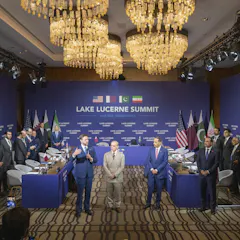
There may be a pause in hostilities, but a long-term settlement is still a long way off.

This agreement simply restores the pre-war status quo without resolving any of the underlying issues.

The Middle East risks state of permanent confrontation where violence periodically erupts, diplomacy intervenes and neither changes the underlying reality.

Ordinary Lebanese and Israeli people are caught in the middle of a longstanding conflict between the Israeli government and Hezbollah.

Could psychopathy be something we’ve just imagined because it’s convenient? Some experts believe so.

Rapid changes at the top don’t always lead to better results in the long run.

Economist Can Cinar talks to The Conversation Weekly podcast about how Javier Milei’s policies to cut inflation are making Argentinians feel poorer.

Streeting accused Starmer of creating a ‘vacuum’ in the Labour party where vision is needed.

The US and Israel believed that military superiority would be enough to humble Iran. It looks as if they were wrong.

The probiotic industry is worth US$112 billion. But if you knew what was actually inside that capsule, would you still buy it?

Starmer has outsourced political judgment and party management to others.

Is it right for a potential employer to assess you without your knowledge?

But the longer it continues the more damage it does to the whole world.

For decades, the US has been unequivocal in its support for Israel.

Both sides are claiming success, but it may be Tehran that benefits more from the deal.

Le dessalement a permis aux villes du Golfe de prospérer malgré la pénurie d’eau. Mais la concentration de ces installations essentielles pourrait devenir l’un des points faibles majeurs de la région.

The Israeli prime minister’s chances of re-election are likely to hang on the outcomes of the war against Iran.
Authors
-

Professor of Management, City St George's, University of London
-
Lecturer in English Literature and Publishing, City St George's, University of London
-
Honorary Research Fellow, Department of International Politics, City St George's, University of London
-
Executive Dean, City St George's, University of London
-
Professor of Sociology, City St George's, University of London
-
Reader in English, City St George's, University of London
-
Professor in International Politics, City St George's, University of London
-
Research Fellow at the Centre for Food Policy, City St George's, University of London
-
Senior Lecturer in International Politics, City St George's, University of London
-
Lecturer in Psychology, City St George's, University of London
-
Senior Lecturer in Mathematics, Department of Mathematical Sciences, City St George's, University of London
-
Director, European Social Survey, City St George's, University of London
-
Research Fellow, Centre for Food Policy, City St George's, University of London
-
Honorary Research Fellow, City Political Economy Research Centre, City St George's, University of London
-
Lecturer in Digital Media Sociology., City St George's, University of London