

Domestic violence is a significant personal, community and social issue attracting much attention.
After several recent horrific cases, media discussion, calls for a royal commission to end the violence and public rallies, Australia is saying “enough is enough”.
Domestic violence can be fatal and repercussions can last for years. Yet domestic violence is one of the most under-reported crimes locally and internationally, and the least likely to end in conviction.
Violence against women takes a profound and long-term toll on women’s health, wellbeing and their economic security, and negatively impacts families, communities and society at large.
Using marketing campaigns to tackle the issue
Over the past 40 years, government bodies and community organisations have attempted to tackle this problem through social marketing campaigns worldwide.
These campaigns aim to raise awareness of the issue and ultimately prevent domestic violence.
Some have received coveted awards, such as the Salvation Army South Africa campaign “Why is it so hard to see black and blue”. But others have been criticised and even banned for their violent images, like the UK Women’s Aid campaign “The Cut” featuring actress Keira Knightley, which showed violent physical abuse.
‘Stop it at the Start’ – a campaign for respect
In April 2016, the Australian government launched a national campaign “Stop it at the Start”.
This prevention campaign was jointly funded by all state and territory governments to reduce violence against women and children.
It aimed to help break the cycle of violence by encouraging adults to reflect on their attitudes and have conversations about respect with young people, addressing how violence against women starts with disrespect.
One part of the campaign encouraged community members to “unmute yourself” – to stand up to disrespectful behaviours and support those who are experiencing abuse.
The campaign’s latest phase centres on the notion of “bring up respect”, which encourages parents and other influencers of young people to positively role model and create education around respectful behaviour.
How effective are these campaigns for preventing violence?
“Stop it at the Start” was a campaign aimed at preventing domestic violence. The PSS survey data reports indicate a reduction in cohabiting violence, intimate partner violence, physical violence, sexual harassment and stalking from 2012 to 2021-2022 but a minor increase in sexual violence during the same period.
However, Bocsar data indicates reported domestic violence related assault offences in New South Wales have risen from 31,349 in the 12-month period of January 2019 to December 2019, to 36,072 in the 12-month period of January 2023 to December 2023.
This represents a 15% increase in a five-year period with an average annual percentage change of 3.6%.
We also examined the average word search of “domestic violence” using data obtained from Google Trends, which showed an overall increase in average search interest by 29.1% from 2012 to 2022.
This may indicate an increased awareness of domestic violence in the broader population. However, the increasing number of reported cases in NSW alone during the same time period suggests reevaluating the effectiveness of domestic violence campaigns in reducing or preventing violence against women.
How effective are past campaigns?
This raises an important question of how campaigns send a message to prevent gendered violence.
To assess this, we searched various platforms such as YouTube and AdsoftheWorld and industry media, including 120 print and 25 video advertisements on YouTube. We were interested in understanding who the perceived target audience of the advertising was and its messaging.
In reviewing the advertisements, we found older examples showed a higher degree of violence by perpetrators, sometimes extremely graphic.
This type of “shock advertising” aims to get the viewer’s attention.
Shock advertising has been used in public health and safety campaigns for many years to scare people about HIV/AIDS prevention, for example.
However, research has found the use of violence in shock advertising overpowers key messages and audiences can become desensitised.
More recent campaigns appear to have moved away from shock messages to try to send the message to the broader community.
Our research team reviewed the advertising messages and created a perceptual mind map based on the (1) target of the message (perpetrator or community) and (2) the degree of violence (non-violent or graphic).
Positioning of domestic violence advertising images
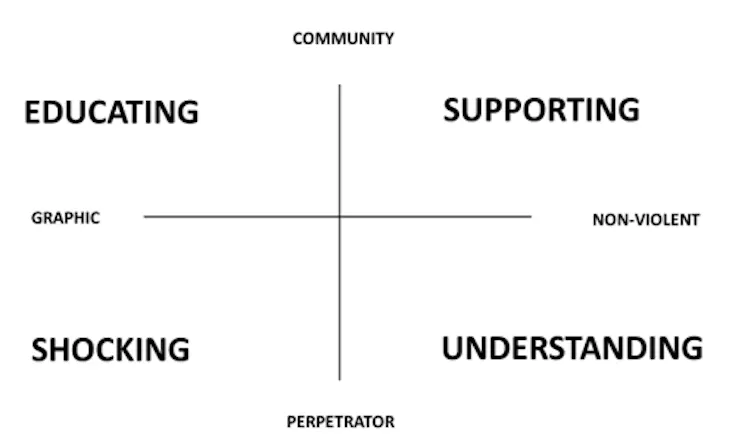
We observed messaging change depending on the target audience – shocking for awareness/understanding of the issue to the perpetrator, and educating the issue/supporting the survivor to the community.
However, we identified a major gap in the messaging – the survivor.
Targeting victims and survivors
There appears to be movement from violent, shock advertisements to campaigns aimed at the community to support victim-survivors.
But few campaigns have identified the strength and empowerment needed for survivors to take action, although the NSW government’s recent campaign “it’s not love, it’s coercive control” is a start.
Domestic violence is a complex problem and more work is needed to prevent violence. In doing the same thing over and over in campaigns, there is a risk of “outsourcing” this important preventative work to future generations, as others have recently argued.
We need to also focus on more immediate actions to prevent violence in the short-term.
If this article has raised issues for you, or if you’re concerned about someone you know, call 1800RESPECT on 1800 737 732. In immediate danger, call 000.
Correction: this article has been amended to correct a misinterpretation of the Stop it at the Start data.